Trans Atlantis is undergoing some reconstruction. The site is fully functional, but the design is being updated, so it looks suboptimal for now. Additionally, some older posts (10 yrs or older) lost image links during the site migration. Things should return to normal within the next month or so. Thank you for your patience.
Blog
-
Planeta Philosophorum—Silver Surfer 4-5 (1987)
This post is part of an ongoing series looking at the Silver Surfer series (1987) written by Steve Englehart and drawn by Marshall Rogers. Previous installments: Part one. Part two. It’s also part of a larger project, Event Horizon, about comics from 1985 to 1987.
Mantis (issue 4)
The Surfer, damaged and dying on a lifeless world (see previous issue), is saved by Mantis. Most of the fourth issue is dedicated to Mantis, the Celestial Madonna. Mantis is one of Steve Englehart’s favorite Marvel characters. He’s been writing her for over a decade (her first appearance was in Avengers #112 in 1973), and she’s consequently amassed quite a long history.
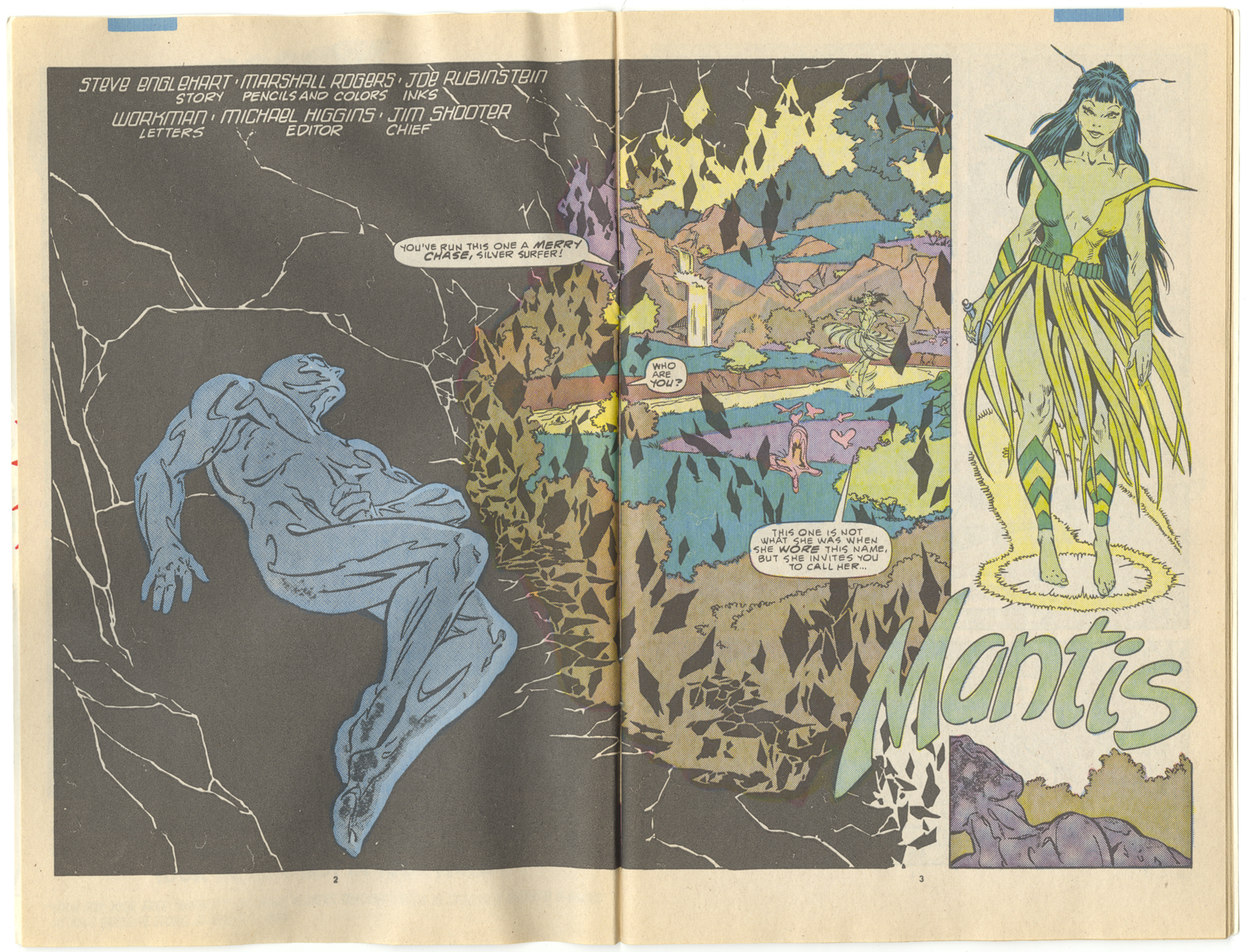
Celestial Madonna
Mantis heals the Surfer’s skin and leads the Surfer to the hidden enclave of the Elders. On the way to the Elders, she recounts her story. Where the info dumps in previous issues were somewhat perfunctory, here, Mantis’ story is lovingly retold over several pages. A full quarter of the issue recounts Mantis’s back story! It’s too long to get into, so I advise the reader to either seek out the comics or check out her Wikipedia entry.
The most important part of her story is her cosmic wedding to the Cotati, a race of sentient plant life. Through this marriage, she entered symbiosis with plants, forming a union of flora and fauna. It’s another nod to the alchemical themes that begin to permeate the series. She became the Celestial Madonna, and a celestial child was born from this union. As we encounter her, Mantis travels the universe using her cosmic powers to transfer her consciousness from planet to planet.
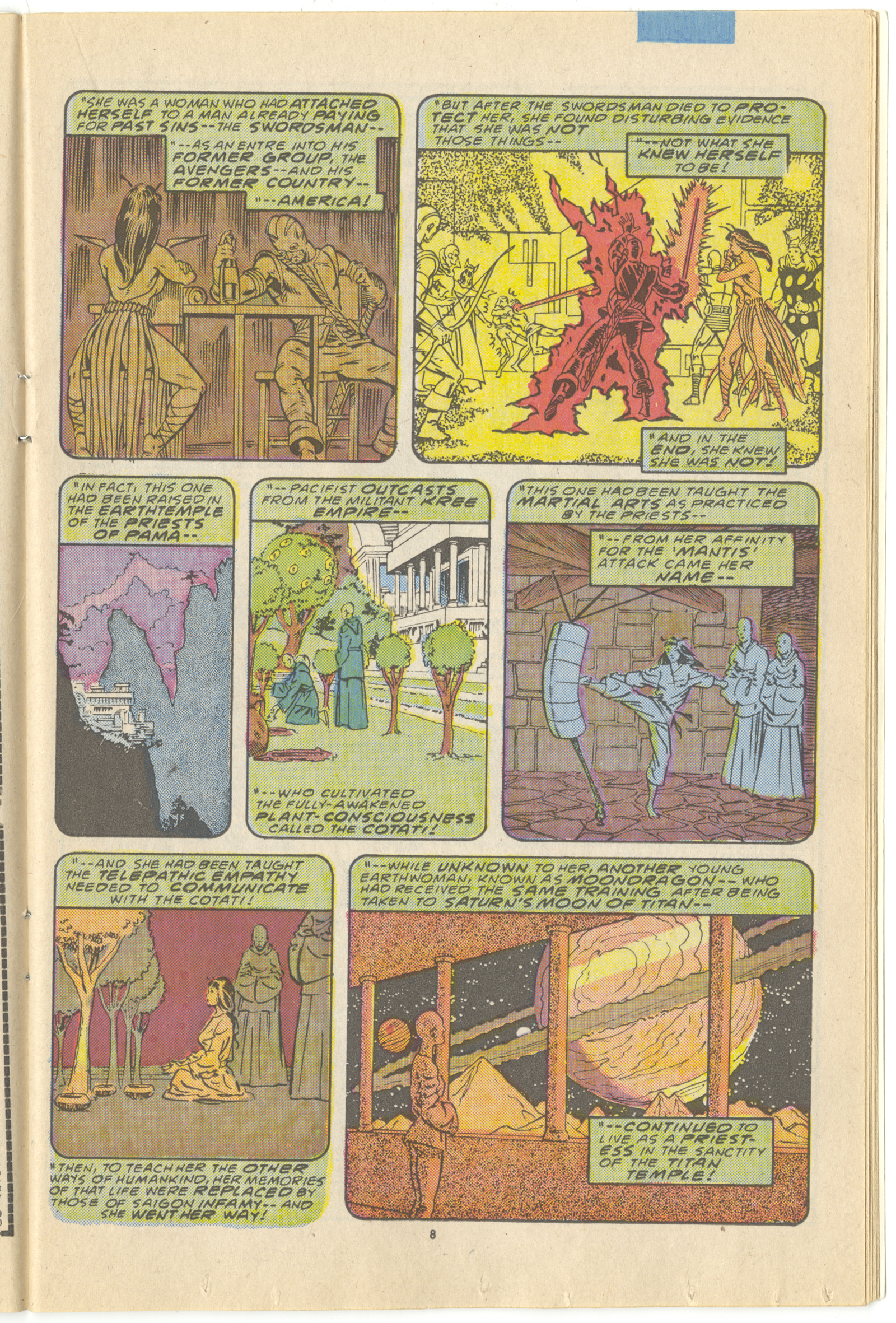
The Info Dump
The info dump has a vital function in the Marvel Universe. As the various Marvel titles became more and more intertwined in the 80s, the “info dump” became a more frequent feature. As a young reader, I used to love them. They showed me the vast history that remained out of reach. They also function as an essential storytelling device that smooths over gaps, lacunae, and inconsistencies.
Mantis’ story is elegantly retold, edited, smoothed over, and historicized. A telos of Mantis’ story emerges: to get her here, into this moment is Surfer’s life. It’s a mild retcon: this was always her purpose and calling. It’s as if this was always supposed to happen. All stories lead to Silver Surfer #4. It’s an effective technique when used well.
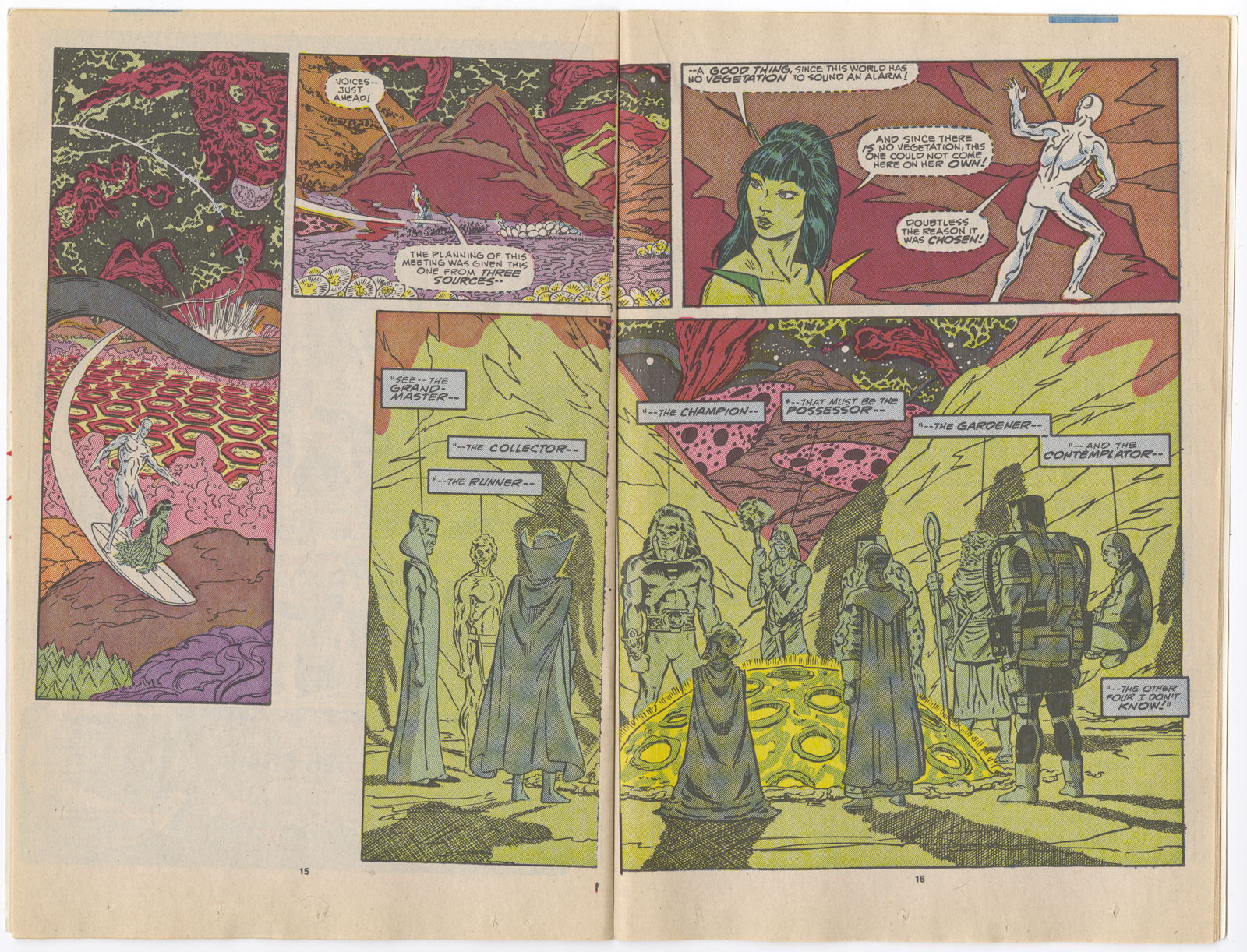
Elder Planet
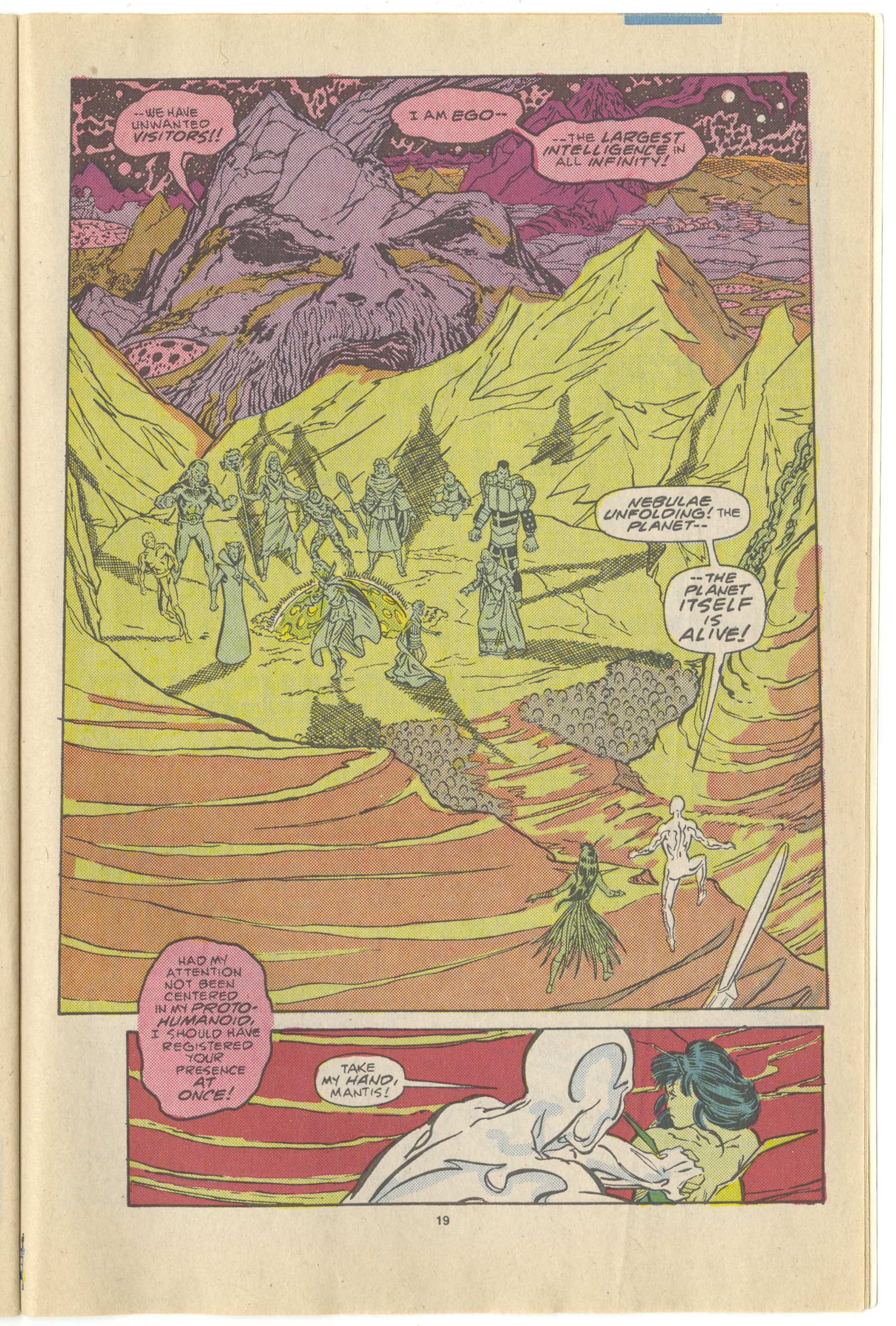
Surfer and Mantis arrive at the Elders’ hideout. Here we finally meet the full roster: Grandmaster, Collector, Runner, Champion, Possessor, Gardener, Contemplator, Obliterator, Trader, Astronomer, and… Ego, the Living Planet… the very ground upon which the meeting is taking place!
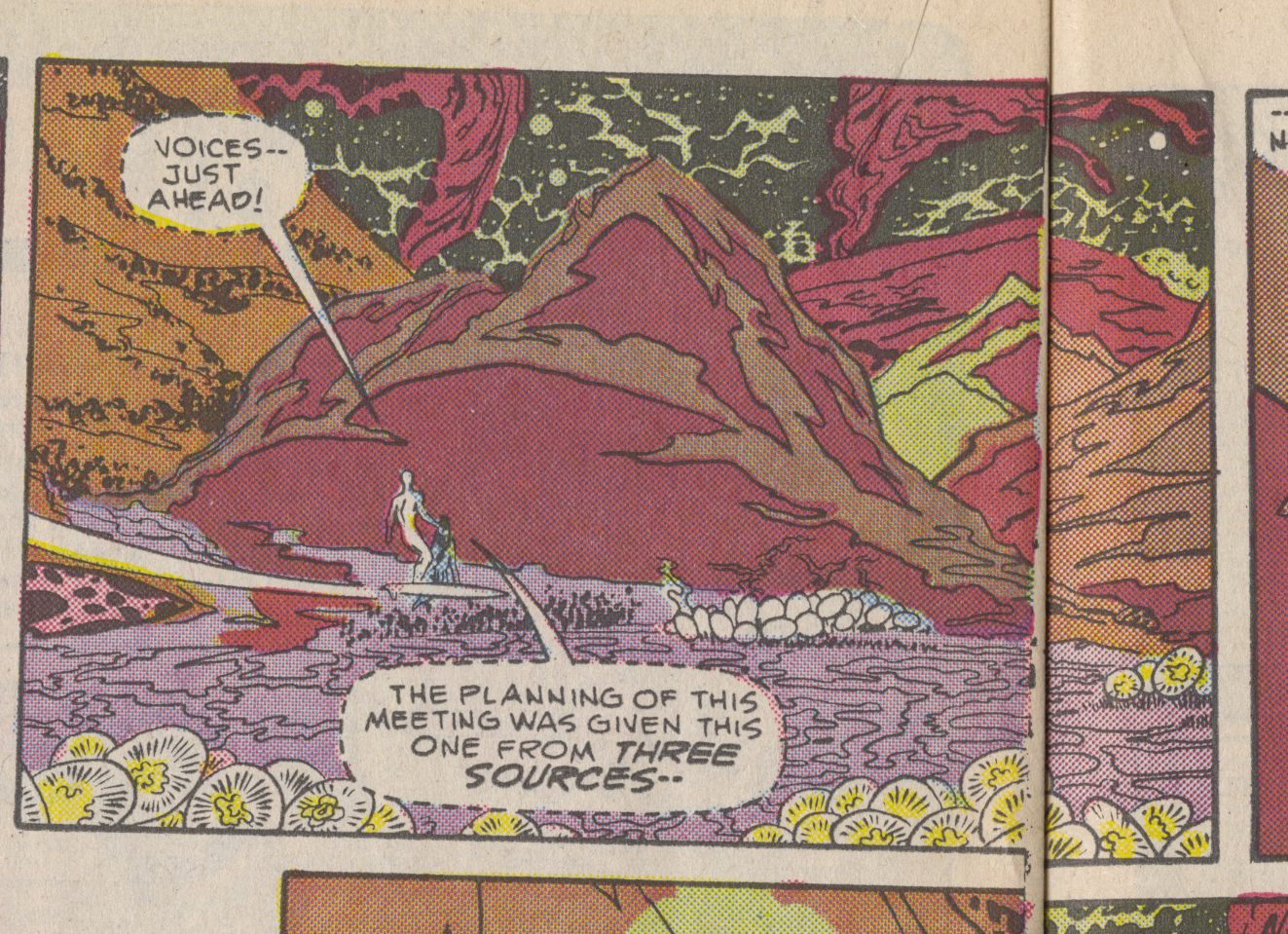
The face of the planet. Can you see it? Incidentally, as the Silver Surfer and Mantis arrive at the planet, there’s a nice visual hint of Ego’s (as yet unknown) presence. The background landscape is arranged like a gigantic face. It’s a nice touch I never noticed before.
Lapis Philosophorum
The Elders are self-proclaimed “oldest beings in the universe.” Their immortality is another alchemical element often associated with the Philosopher’s Stone. Each one has a unique obsession that has fueled their near-eternal lives. The obsessions are pretty obvious based on the names of the characters. These obsessions are the key to their immortality. Each obsession is a unique Philosopher’s Stone, which drives them forward. They are a living will-to-power, or will-to-life, the conatus that drives them forward. Through it, they achieve literal immortality—eternal life.
Planeta Philosophorum
Ego, the living planet, is another alchemical character. Typically, we think of “Earth” as “Mother Earth.” We perceive our planet as a nurturing feminine entity. Ego is the opposite. He’s a stern father commanding all his constituent elements with his iron will. A planet-sized philosopher’s stone—he can transmute his constituent elements into others. He’s immortal and has achieved the unity of opposites, a melding of base matter and life.
Eternal Envy
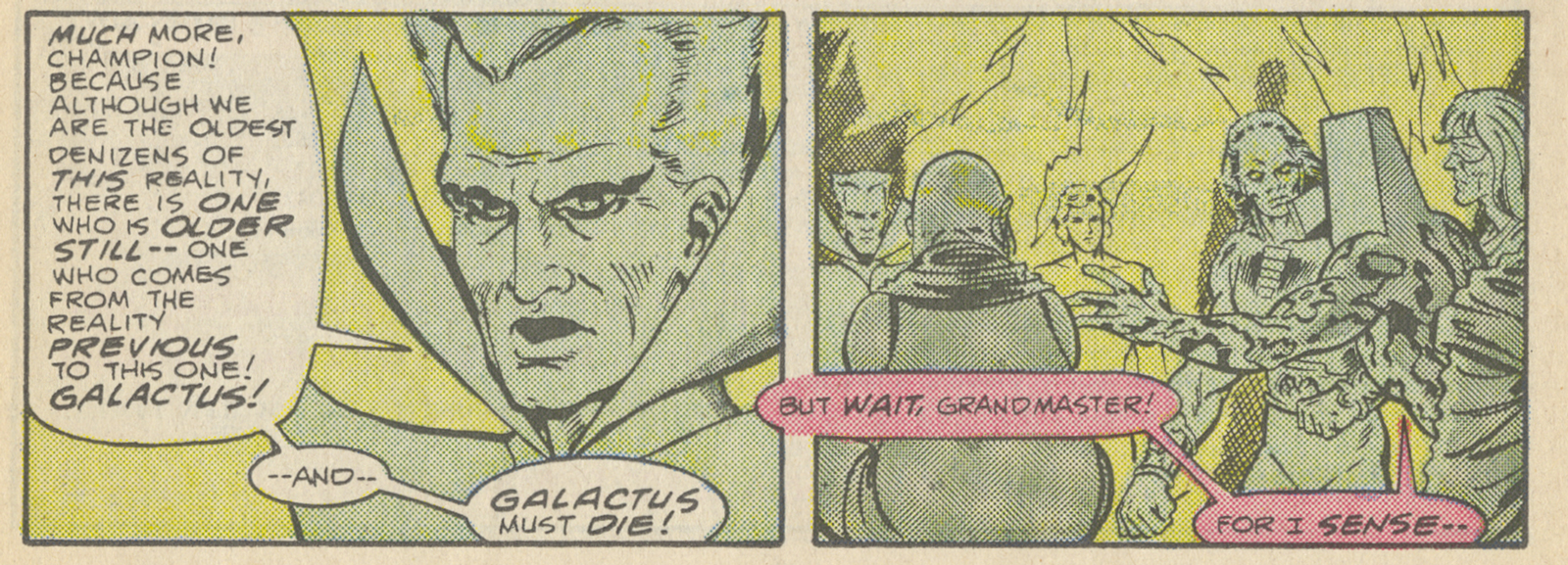
The Elders mostly recount recent backstory, but the Grandmaster drops a tantalizing hint of what’s to come. The Elders are the oldest beings in the universe, but there’s one older than all of them: Galactus! Therefore, “Galactus must die!”
Escape
Before any more could be heard, Ego detects the presence of Mantis and the Surfer. A quick fight breaks out as the two escape off Ego into space… and share a brief kiss. “We two work so well together!” says Mantis.
Meanwhile, we also get a quick update on the Kree-Skrull conflict in this issue. The Supreme Intelligence deduces that the Skrulls have lost their shape-shifting abilities! And a Celestial appears in the Skrull empire!
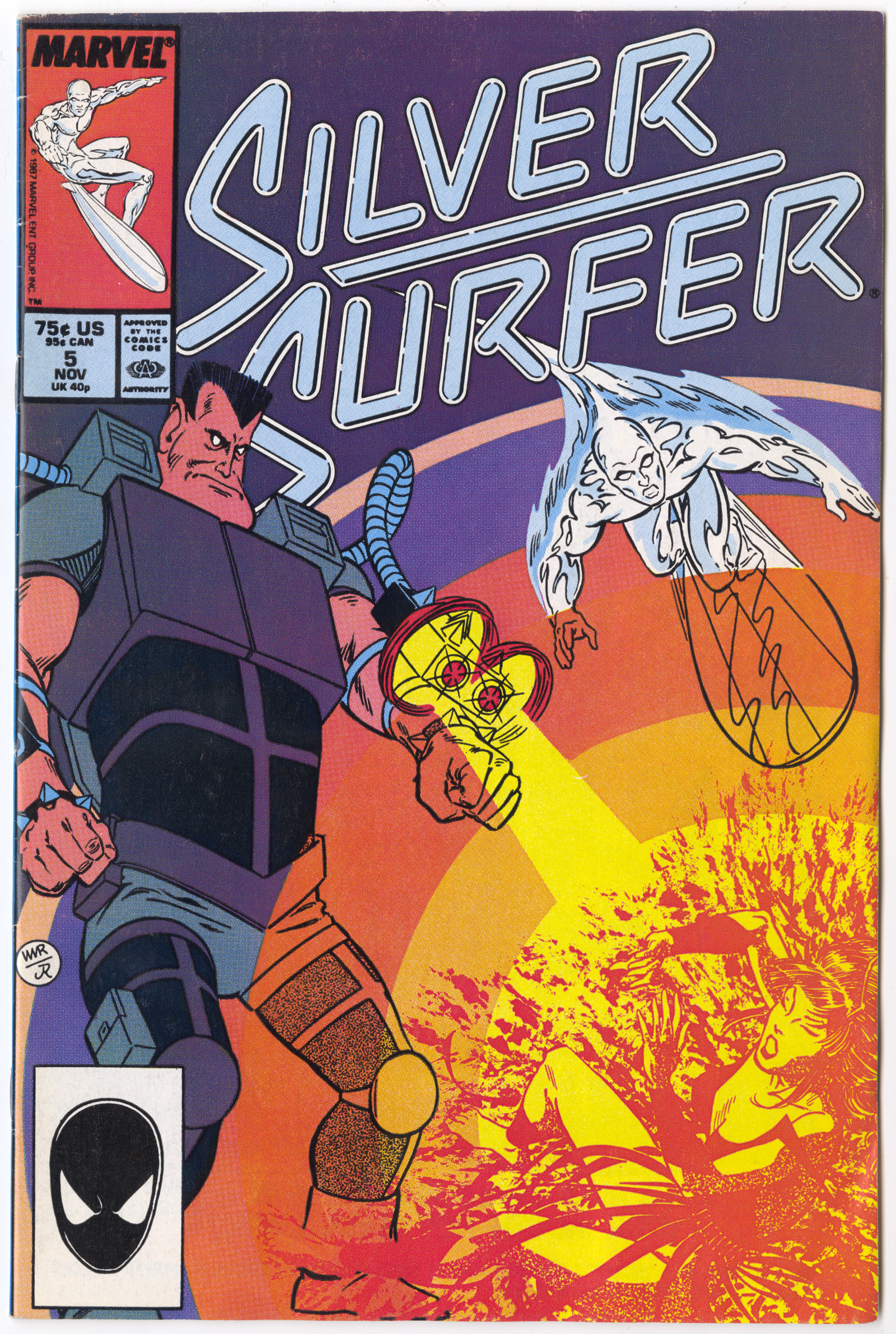
Obliteration! (Issue 5)
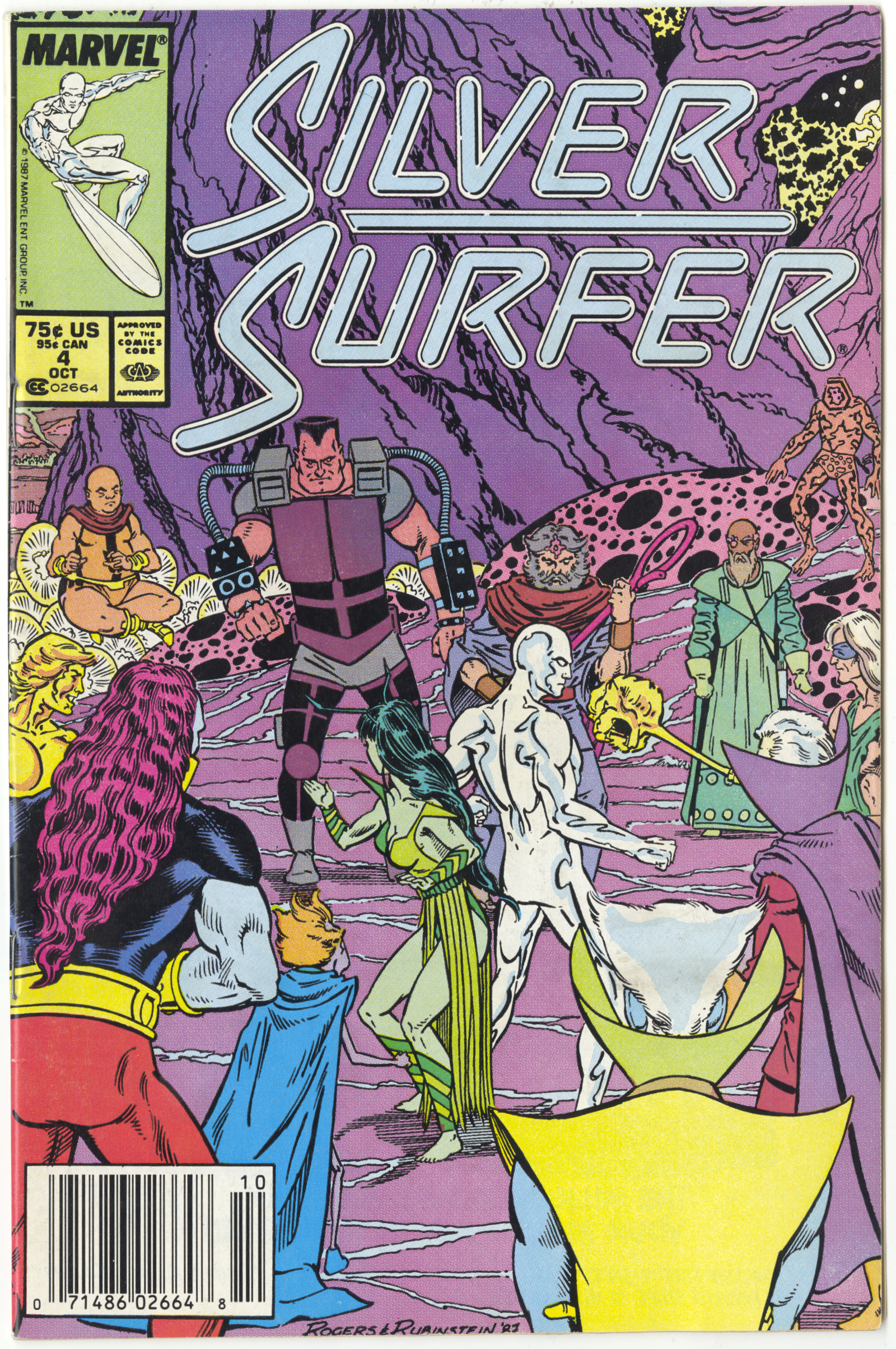
Look at that cover! Flat colors, color-hold, cartoon-eyed Obliterator… just great.
The Obliterator catches up with Surfer and Mantis, and their fight consumes most of the issue. The Obliterator is like the Terminator; he keeps coming back! The Surfer and Mantis manage to ditch him several times, but he finds a way out and catches up with them again and again. He’s relentless!
The Obliterator is an interesting character. Rogers draws him almost in a cartoony style that is more familiar to indie comics. He has simple features. A pointy jarhead haircut, overbuilt torso, short legs, and blank Little-Orphan-Annie eyes under a heavy brow. It’s a startling design that feels somewhat out of place in the Marvel Universe—more on him in the next issue.
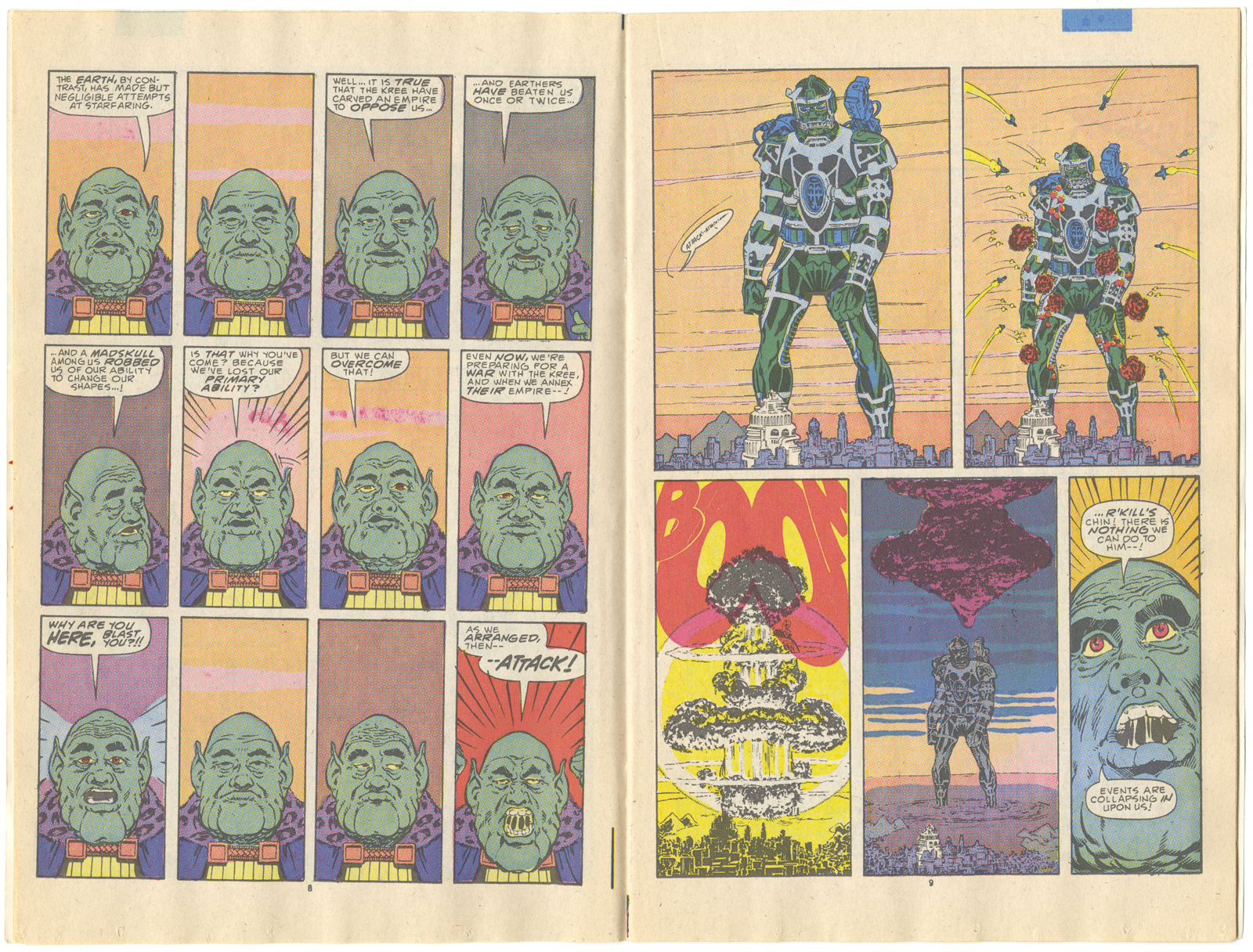
Celestials
In the meantime, the Skrulls face off against Jamiah, one of the mysterious Celestials. It was the Celestial genetic experiments that eons ago created the Skrull species. Now, one of them returns. For what purpose? Usually, they are seen to stand in judgment of their creations. Jemiah is no different. Like a god, he towers over a Skrull capital. Kylor, one of the pretenders to the throne of the decaying Skrull empire, approaches the giant. The conversation is one-sided. Like a god, Jemiah is silent and inscrutable. The Skrulls attempt to nuke the colossus, but to no avail. “Events are collapsing upon us!” Kylor laments.
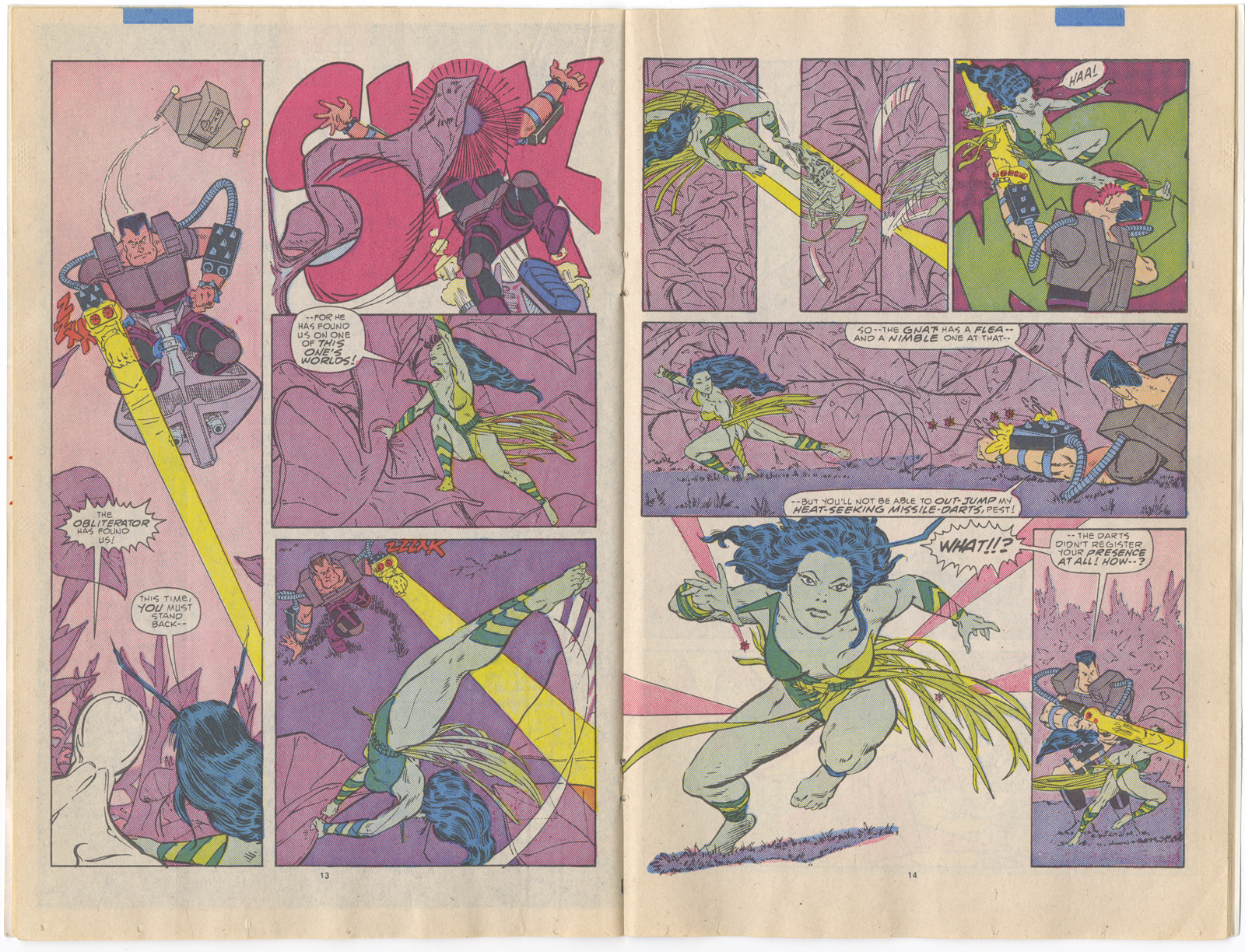
Preying Mantis
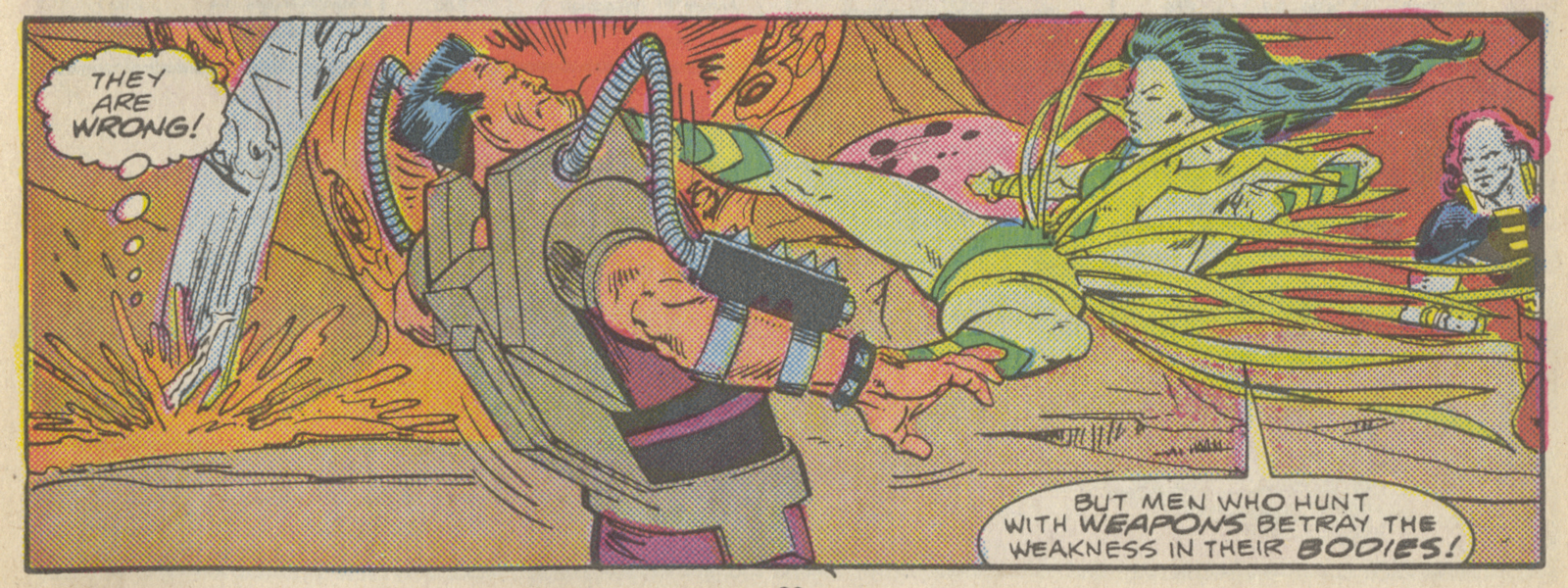
The Obliterator catches up with the Surfer and Mantis, and they have a final confrontation. Marshall Rogers’s art shines when he shows Mantis’ martial arts abilities. She goes one-on-one against the Obliterator and almost gets the best of him. Look at the fantastic spread above. Minimal dialogue, paired with an arrangement that shows off Mantis’ agility. She traverses up, over, down, and forward directly into the camera. She is in constant movement; all the while, she’s delivering deadly blows. But he obliterates her!
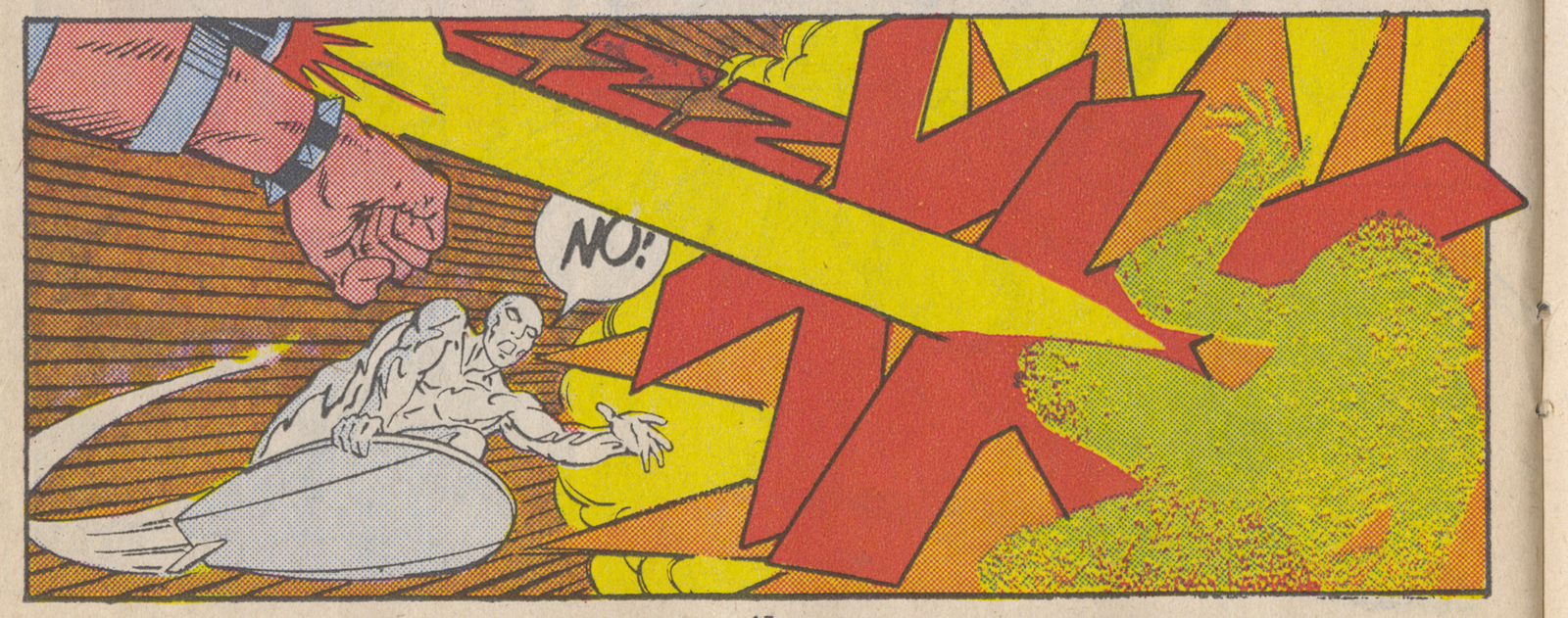
Transubstantiation
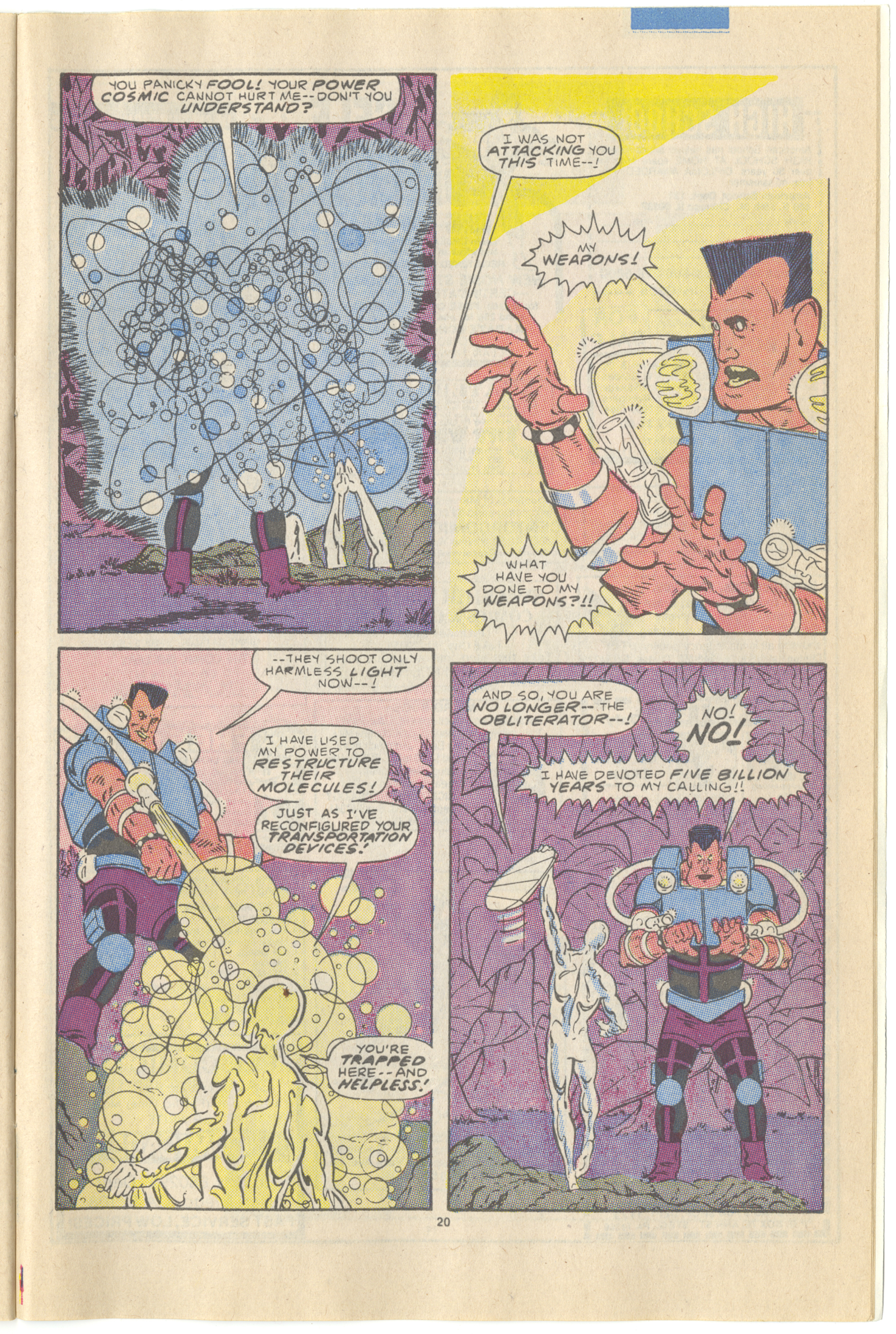
The Surfer, enraged, battles the hulking villain to a standstill and finally wins by disarming him through a power cosmic trick. He transubstantiates the Obliterator’s deadly weapons into harmless light emitters. The Surfer typically emits various rays of energy when engaged in combat. But Englehart likes to show an alchemical side of Surfer. He transmutes matter like a living Philosopher’s Stone. The Surfer is the perfect foil for the Elders—he’s just like them.
Resurrection
It turns out Mantis survived her obliteration. A split second before disintegration, she transferred consciousness to local plants and re-grow a new body—like a homunculus. The Surfer is overjoyed. The relationship between the two cosmic beings grows.
-
Love and Alchemy – Silver Surfer 2-3 (1987)
This post continues a look at the Silver Surfer series (1987) written by Steve Englehart and Marshall Rogers. For part one, look here. It’s also part of a larger project called Event Horizon, which is about comics from 1985 to 1987.
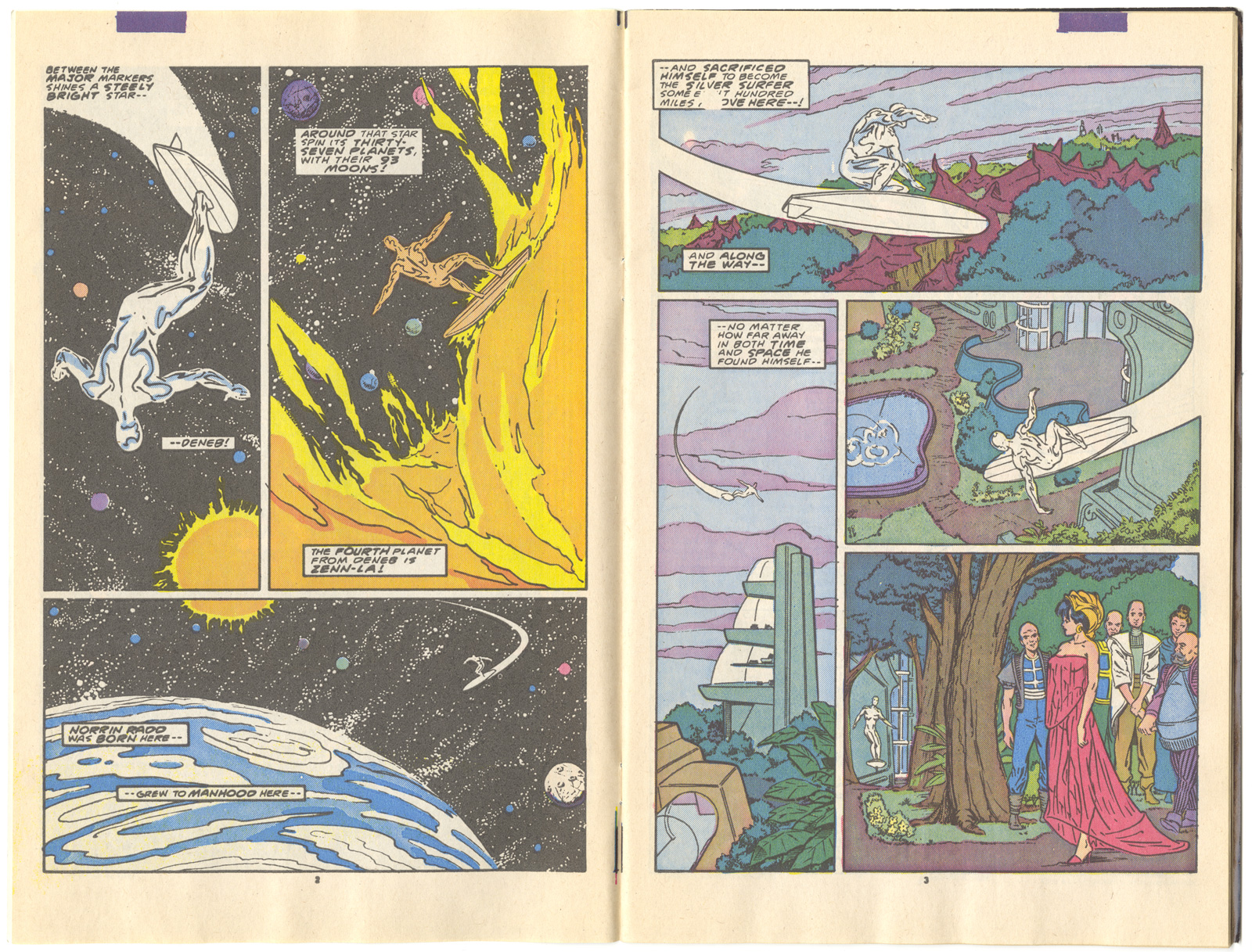
Silver Surfer #2. Surfer is returning home to Zenn-La. Lond Distance Relationship (Issue 2)
In the second issue, the now-free Silver Surfer visits Zenn La to return to his love, Shalla Bal. Previously, the relationship of the two was presented as eternal, trans-universal, etc. In other words, it was idealized. The Surfer, a literal prisoner of Earth, had no choice but to keep a very long-distance idealized memory of Shalla Bal.
While the Surfer was away, Shalla Bal created a new, independent life on Zenn La. Zenn La was devastated by Galactus (again, I’ll refrain from relating the Surfer’s long history; read it here). To help heal the planet, The Surfer gifted part of his “power cosmic” to Shalla Bal. With this power, she restored the planet’s biosphere and, as a result, became the “Empress” of Zenn La.


Fictional Politics
As an aside, it’s always interesting to see what political systems are deployed in fictional worlds. Why did Zenn La become a monarchy? Was it one before? Is it constitutional? Absolute? The Skrulls are also an empire. In this series, the Skrull empire breaks into competing kingdoms, each ruled by a pretender to the imperial throne. The Kree are governed by the Supreme Intelligence, an AI composed of the minds of millions of Kree warriors. It’s a weird amalgam. It’s easy to imagine it as a Sparta-like warrior democracy that “progressed” to a pseudo-democratic technocratic rule by democracy as AI. More on this later.
Love Will Tear Us Apart
Anyway, Shalla Bal and Surfer finally meet! But immediately, Surfer’s ideal love hits the unmoving force of reality. It becomes apparent that the two star-crossed lovers have different priorities. The love that bound them previously has ceased to exist. Shalla Bal becomes possessed by her duties as Empress.
The Empress has more important matters to attend to. The Skrulls sent an embassy to secure Zenn-La’s loyalty in the reigniting Kree-Skrull war. The Skrull designs must be checked, and the planet must be rebuilt. Romance is impossible under these circumstances. She rejects him romantically but insists that the Surfer remains a “protector” of Zenn La.
And the Surfer is… a bit lost. His freedom shatters all his illusions about love, duties, and his very nature. He’s also angry in a way we’ve never seen him before. This isn’t the anger of facing an enemy. This is the anger of a noble soul, rejected by his eternal romantic love, who remains honor-bound to protect the realm as its shining knight.
Knight-Errant
As he leaves Zenn La, he modifies a monument: “Here was born Norrin Radd, a son of Zenn-La,” to read “Here was born The Silver Surfer, a son of Zenn-La.”
He’s now a masterless knight in silver armor. His life as Herald over, he was ready to sacrifice for love. In the end, he realizes his love was “human.” It was Norrin Rad who loved Shalla Bal. The Surfer is now ready to discard his humanity and accept the Silver armor. The Silver Surfer flies alone. Or does he?
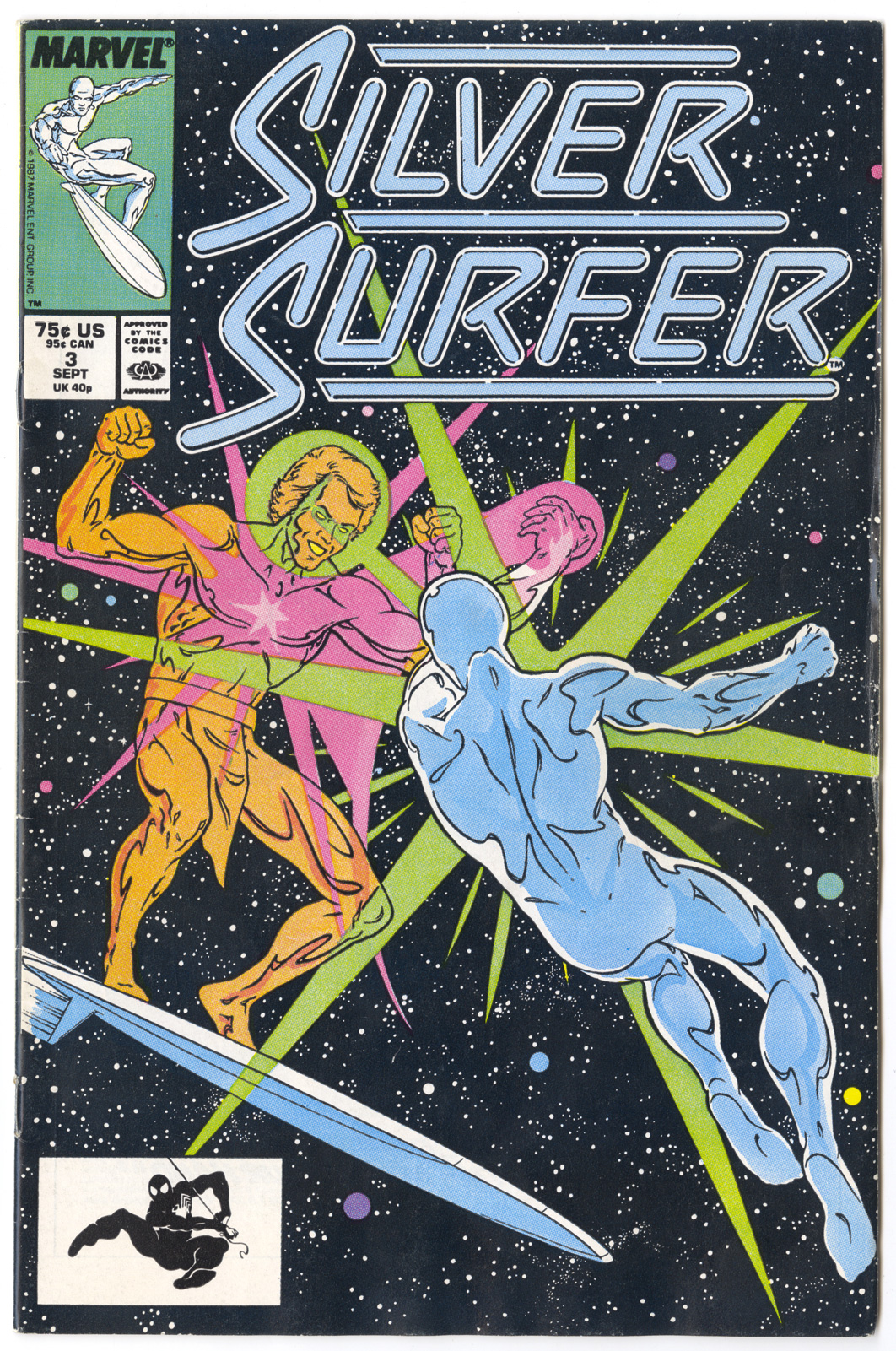
Silver Surfer #3. Cover. Gold vs. Silver. The Content of Freedom (Issue 3)
In the third issue, the continuity gets wonky. This is not uncommon in the vast labyrinthine Marvel Universe. By the late 1980s, crossovers, events (see my piece on Crisis on Infinite Earths), etc., created an increasingly tightly interwoven narrative tower of Babel. Englehart wants to tell a relatively clean Surfer arc, but much of the back story is vast and pulls in threads from other Marvel titles.
We already know the Elders of the universe are planning something. A big piece of this scheme is told elsewhere in two Avengers annuals. For the sake of brevity, I won’t get into it. Suffice it to say that the Surfer is now firmly set on a collision course with the Elders and intends to learn all he can about their nefarious plans.
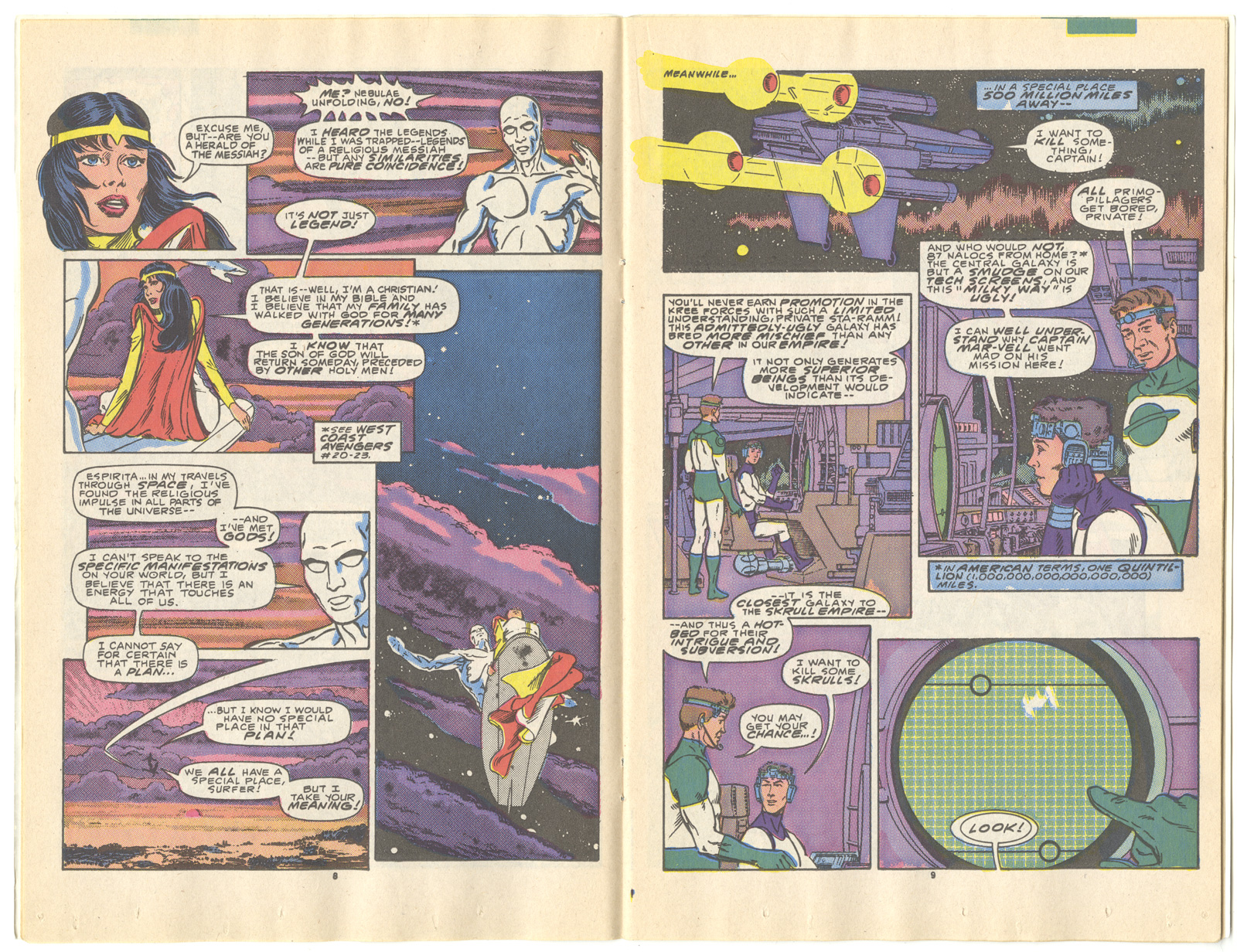
Silver Surfer #3. Dense layouts and information density. Holy Man
Two interesting moments occur in this issue. First, after a brief confrontation with the Collector, the Surfer escorts Espirita, a Christian superhero, back to Earth. The two have a short conversation. Espirita tells the Surfer that many people thought him to be a Herald of the Messiah during his imprisonment on Earth. The Surfer, startled, denies any religious affiliation. He believes the religious impulse is universal and that some energy touches us all… but there’s no plan. In any case, he wouldn’t have a special place in that plan. Espirita, a good Christian, retorts, “We all have a special place, Surfer!”
The moment nicely foreshadows the scale of the Elders’ plans, which will have cosmic repercussions. The Surfer here sees himself as insignificant in the universe, and his insignificance will haunt him for the rest of this arc.
Twins
The other moment is the Surfer’s confrontation with the Elder known as the Runner. The Runner confronts the Surfer out of nowhere in the vast depth of space. Instead of silver, he is clad in gold. His appearance is that of a Greek god-like statue that comes to life. The Runner is a kind of twin of the Surfer. He says, “many sentients have spied my golden skin and thought us related.” Even though it is a physical contest, Surfer’s encounter with the Runner is also fraught with symbolic meaning.
Symbolically and archetypically, twins are often cast as moral opposites: good/evil, white/black, or civilization/barbarism. [ 1 ] Twins are locked in an everlasting struggle, whether on the physical plane or mental one. In Jungian terms:
“From this conflict, an irrational third arises the transcendent function, often in the form of a symbol. Logically, the opposites are always split and in conflict, but illogically, they coalesce in the unconscious psyche. The duality of archetypal content can be said to be integrated only when the full range of the spectrum has been made conscious.”
Source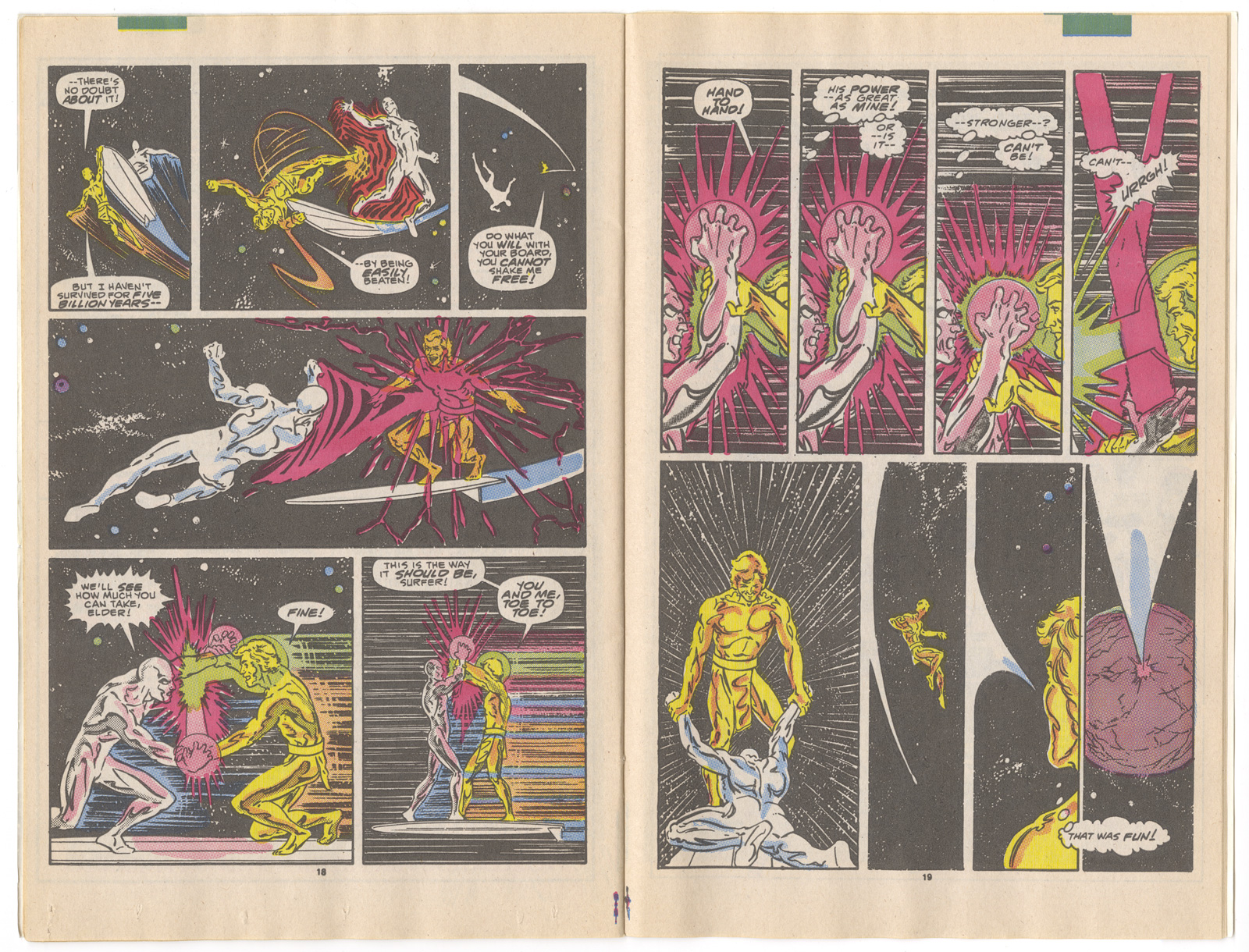
Silver Surfer #3. Runner vs. Surfer. Swept Away
There are interesting contrasts between the Surfer and the Runner. As the name suggests, the Surfer “surfs” on cosmic waves on his board. The symbolic implication is that he goes where the waves take him. Despite his vast power, he is swept up by events rather than affecting them directly.
The Runner, as the name suggests, “runs.” He is self-propelled and goes where he pleases. This goes well with his Elder-obsession. All Elders have an obsession (a Nietzschean will to power?) that has sustained and kept them alive for billions of years. We’ll get more in the weeds later, but the Runner’s obsession is to “see all there is to see, in all the universe!” Symbolically, he’s self-directed and possesses a goal and a destination (however vast it may be).
Alchemical Romance
The Surfer is silver, and the Runner is gold. Both are noble metals, but they have different symbolic meanings.
Silver Gold moon sun Artemis Apollo purity prestige strength luxury clarity wisdom silver age golden age feminine masculine youth decadence Slave, Meet The Master
The Surfer has always exhibited aspects of silver: purity, strength, clarity, and focus. Silver is associated with the moon and is also the color of Artemis. As such, it also contains feminine energy, which aligns well with his surfer nature and his general neurotic nature, full of self-doubt. He’s a human thrust onto a cosmic level; there’s a touch of impostor syndrome. He is the slave in Nietzsche’s master/slave dialectic.
The Runner exudes the ease and manner of an aristocrat, a golden child. He is confident and administers his brand of justice (kill the Surfer) without remorse. He also charismaticly affects the Surfer: “Something about him sweeps all caution from me!” The Runner has no qualms about his quest for more power. If he can take it, he will. He embodies Nitschean master morality.
The Runner says, “I would’ve swiftly reached the end of my five billion years if I’d had to endure what you did [imprisonment on Earth]!” At first glance, it sounds like a compliment, but it’s also an insult. The Runner values freedom over everything. To be trapped anywhere would mean the Runner cannot fulfill his obsession; it’s the same as death. By implication, the Surfer allowed himself to be trapped and endured a lengthy imprisonment. Only slaves do that.
Free
The Runner says a tantalizing phrase to the Surfer: “[you are] too new to this freedom to understand how utterly it dwarfs individual concerns.” The Runner spells out the Surfer’s current predicament. Since sacrificing himself for Zenn-La by becoming the Herald of Galactus, this is the first time he has truly been free.
The Runner proceeds to attack the Surfer. After brief combat, the Surfer is defeated and crashes into an uninhabited planet. In bad shape and dying… he is met with… Mantis!
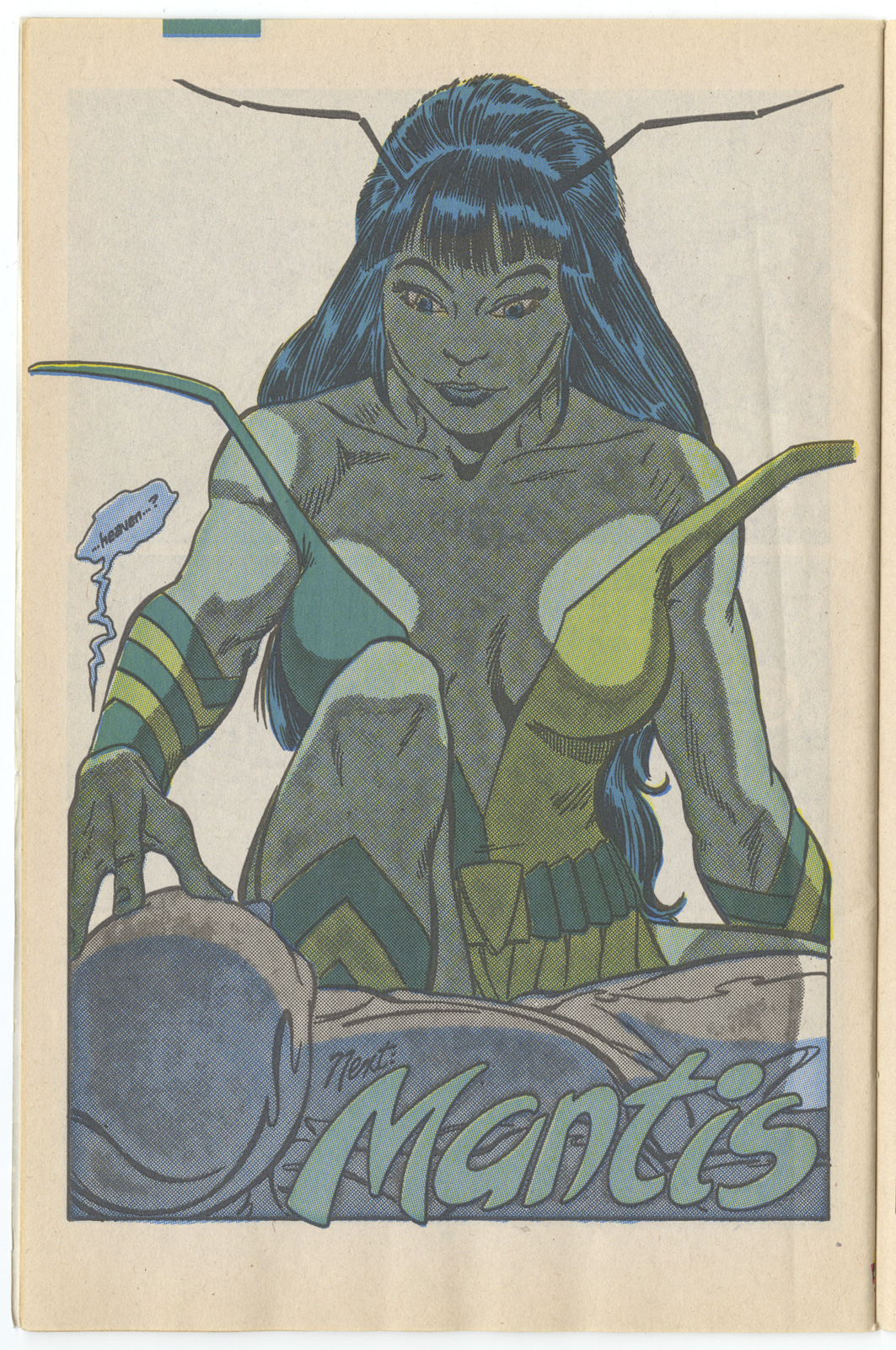
Silver Surfer #3. Mantis! Information, Art, Color, Letters
Both issues are still very informationally dense and heavy on backstory. One of the pleasures of reading stories set in the Marvel or DC universes is the back story, the obscure details, forgotten characters, missed connections, and esoteric lore. Steve Englehart is a master at this kind of pulp archaeology. He sifts through a mess of Marvel continuity and extracts a silver thread, which he uses to weave a complex narrative tapestry in The Silver Surfer.
While these two issues don’t have the visual impact of the first issue, they demonstrate Marshall Rogers’ mastery of the form. His art and layout continue to impress even when he must accommodate some information-heavy layouts.
The lettering is credited to John Workman, one of the great comic book letterers. Typically, letterers also create the sound effects (SFX). But in Silver Surfer, the SFX appear to have been drawn by Rogers. They are integrated into the art and don’t resemble Workman’s usual SFX. It seems Rogers is doing the SFX uncredited. If anyone knows otherwise, let me know. Anyway, look at that!
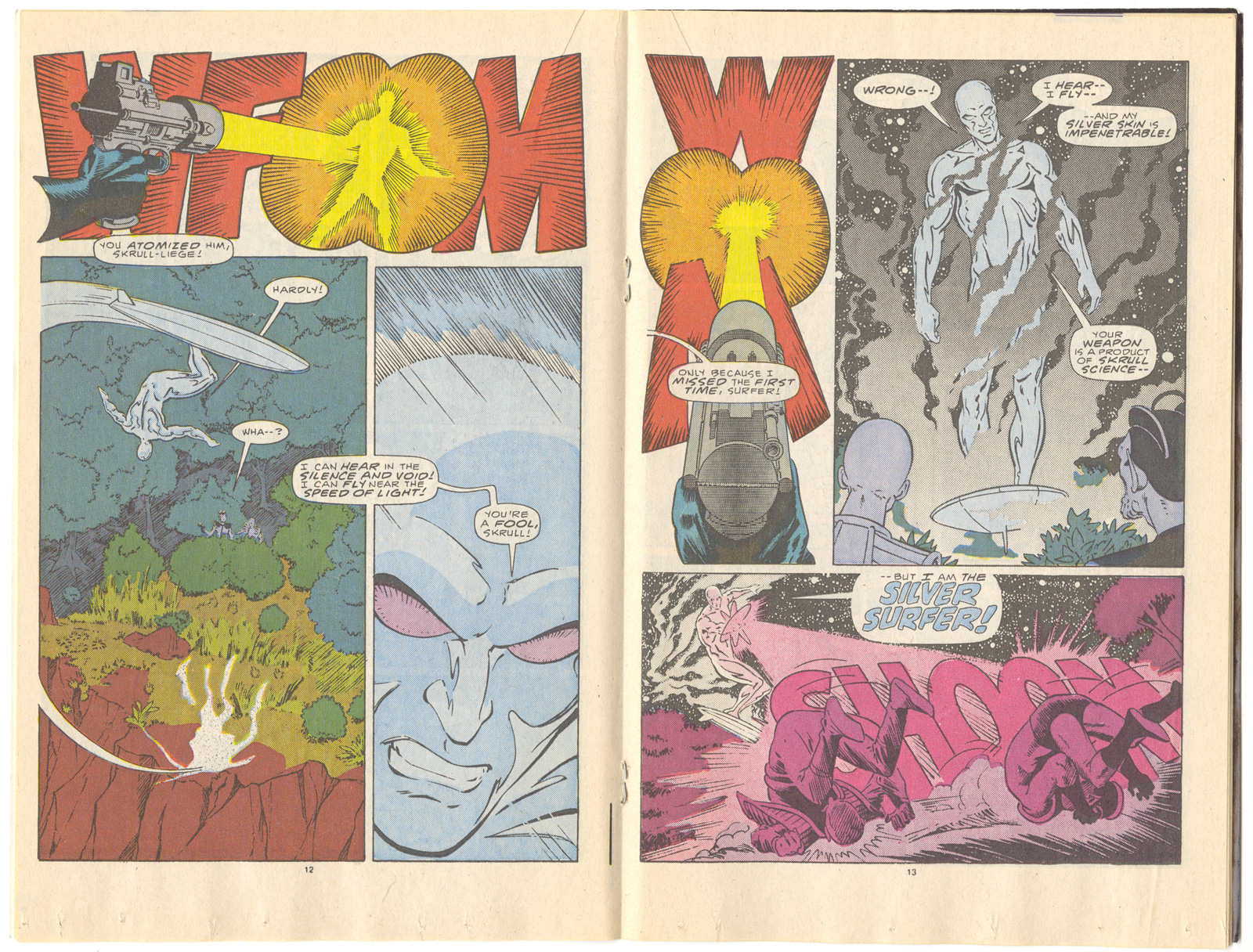
Silver Surfer #2. Sample SFX. NOTES:
[ 1 ] “Twins appear frequently in folk cosmologies – usually cast in morally opposing roles. Anthony Stevens in his Guide to the Symbols of Mankind, Ariadne’s Clue, suggests that this archetype reflects the evolutionary ascent and involuntary descent of the sun: the good twin is represented as white, the bad one as black; one creates civilization, the other destroys it; Thus twins are locked in everlasting struggle (see, for example, the myths of Romulus and Remus, Cain and Abel, Jacob and Esau, Osiris and Set).
Stevens suggests that the symbolism has grown out of humanity’s primordial awareness that day is paired with night, light with darkness, summer with winter, and so on.
The archetype of twins is therefore to do with opposites, that together represent a whole.” — source
-
Free – Silver Surfer #1 (1987)
Space Is The Place
The 1987 Silver Surfer series is an under-appreciated high point in Marvel’s stable of comics during the tail end of the Event Horizon.
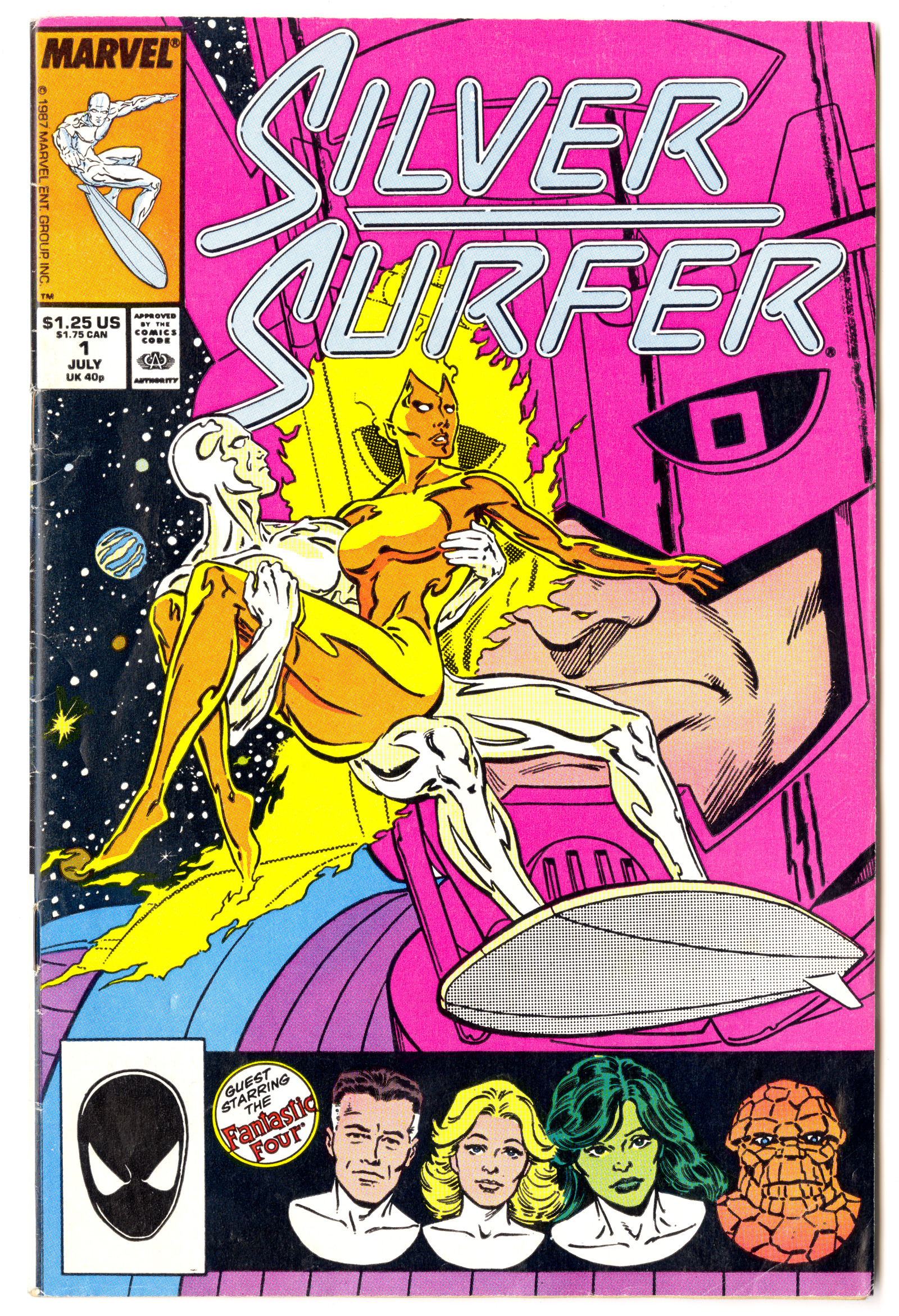
Fig. 1. Silver Surfer #1 (1987) Cover The Silver Surfer has had a fraught career in the Marvel Universe. It’s an iconic character from the early golden Kirby/Lee age of the Fantastic Four. He became a popular guest star and a one-time member of the Defenders, but he never really came into his own as a character. (check The Silver Surfer’s convoluted back story here) Instantly recognizable, the Surfer was a compelling cosmic character. His imprisonment on Earth (by his former master, Galactus) created the impression of being a failure due to the Surfer’s “constant whining” about his predicament.
The 1987 series writer Steve Englehart (drawn (and colored) by Marshall Rogers and inked by Josef Rubenstein) consciously addressed the character’s shortcomings. In the first issue, the Silver Surfer is finally set free!
One thing to note is the density of the narrative. The Surfer runs into the Fantastic Four as they investigate the hole in the ozone layer in Antarctica. The team quickly solves the mystery when the Surfer admits to depleting the ozone in another futile attempt to break Galactus’ barrier.
Out of the blue, Champion, one of the Elders of the Universe, attacks the Surfer. The Surfer wins and demands an explanation by right of victory. Champion launches into one of the several info dumps that convey massive amounts of information:
- A recap of the entirety of Silver Surfers’ Marvel history
- The Skrulls have lost their ability to shapeshift, and as a result, a new Kree-Skrull war is brewing
- The vague contours of the Elders’ scheme behind it all begin to take shape
All of the above ties into a decades-long Marvel history, much of it written by Englehart. That’s all on top of the main narrative!
Once the Surfer dispatches Champion, Ben Grimm stumbles into an ingenious solution to the Surfer’s imprisonment. And, after a few pages, the Surfer is free! Instantly, the Surfer’s true nature is on full display as he surfs the cosmic spaceways. For the Surfer, space is the place.
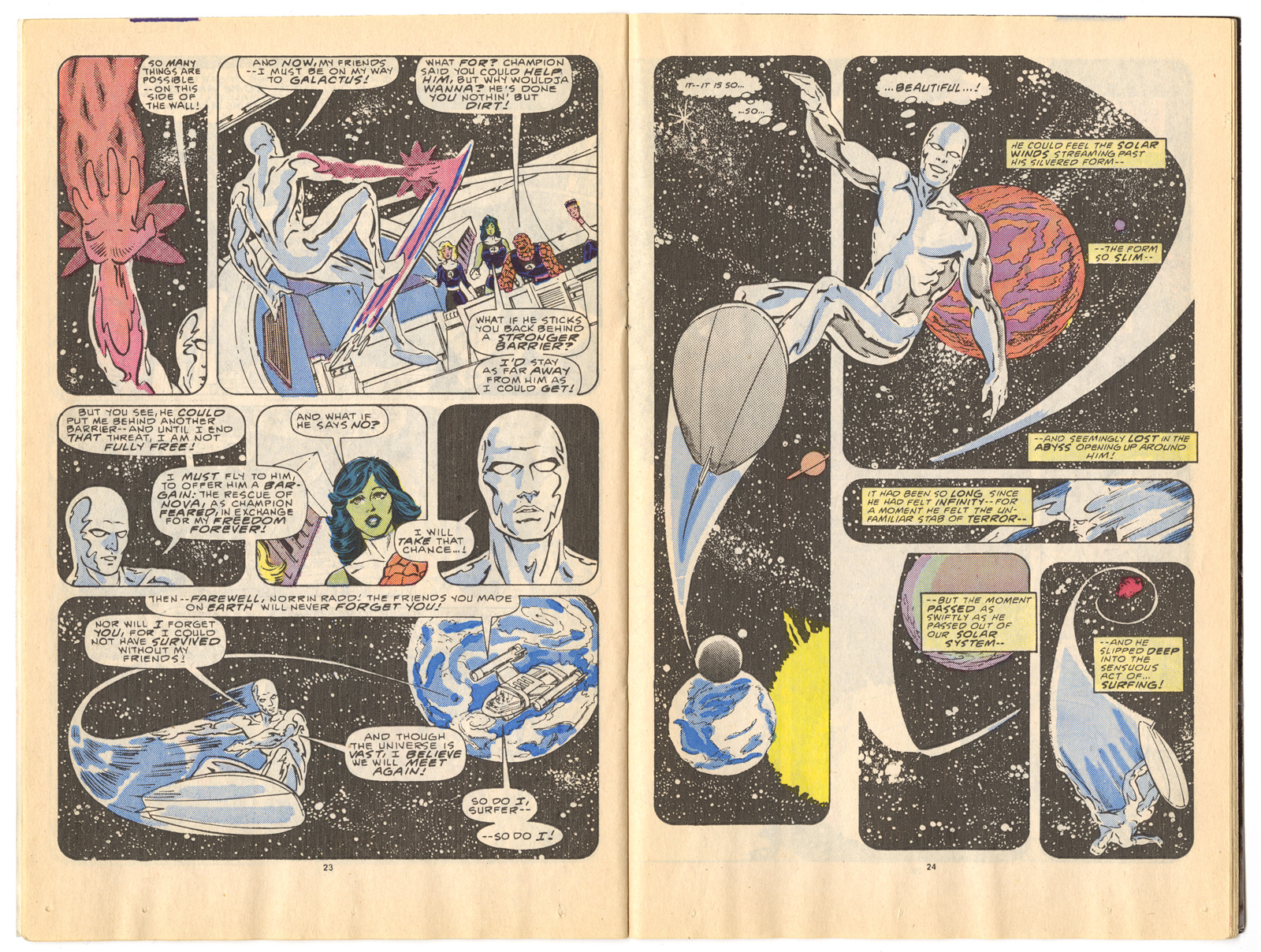
Fig.2. The Surfer is free! Master And Servant
But, before he can fully taste his new freedom, the Surfer must confront his jailer, his former master, Galactus. To remain free, Galactus must lift the punishment that bound the Surfer to Earth for so long. Silver Surfer proposes to free Nova (the current herald of Galactus) in exchange for a pardon. The two strike a bargain (Fig. 3).
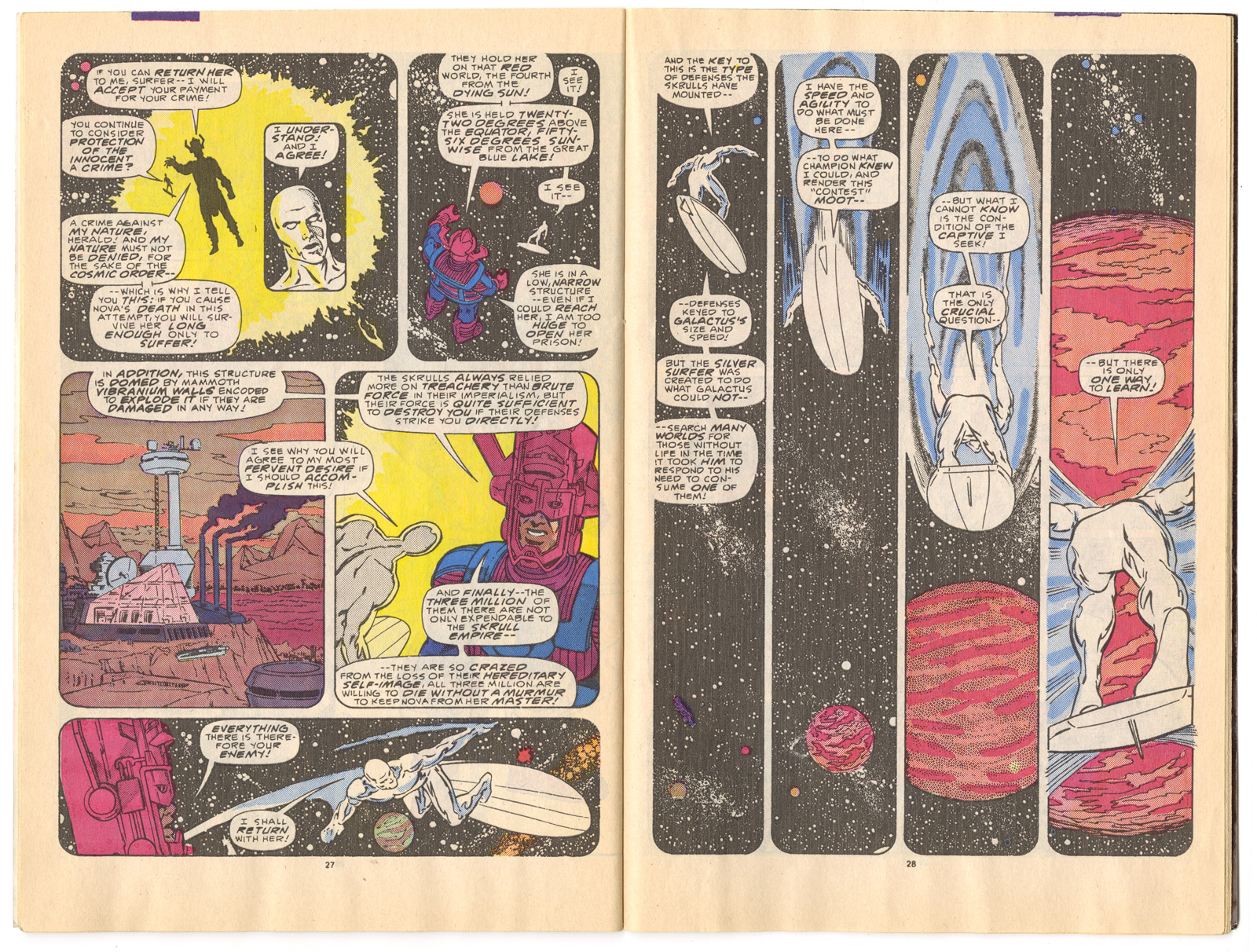
Fig. 3. Nova rescue sequence pt. 1 The Skrulls hold Nova hostage on an “expandable” planet guarded by three million “expandable” fanatical Skrulls. The Skrulls, desperate to keep their secret: the loss of their species’ shapeshifting ability. They fear their eternal rivals, the Kree, would take advantage of their moment of weakness and invade. The Skrulls want to trade Nova’s life to force Galactus to consume the thousands of Kree planets! They want to turn the very forces of the cosmos against their rivals! Nova’s trap is specially designed to confound any effort by Galactus. The Surfer can succeed where Galactus would fail.
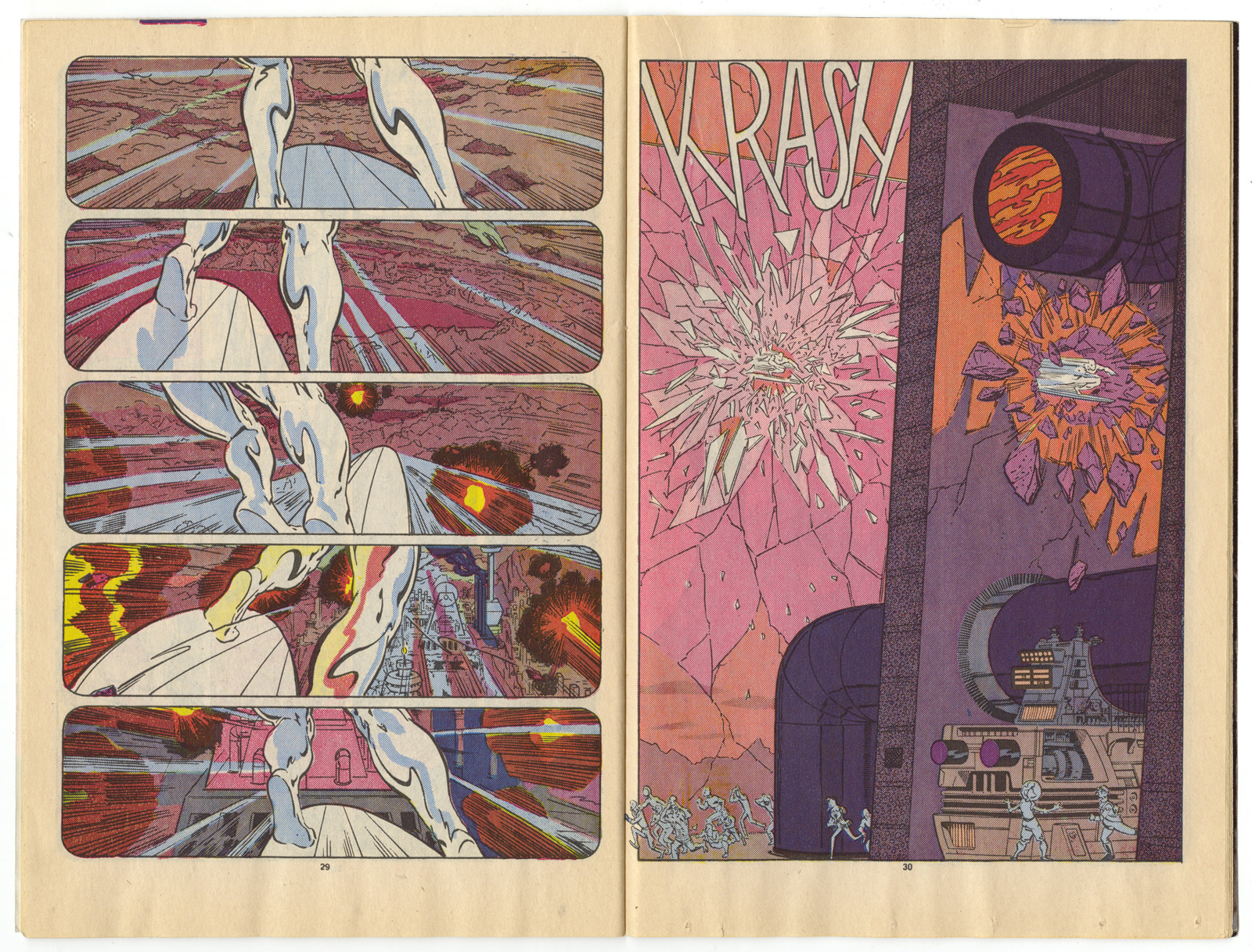
Fig. 4. Nova rescue sequence pt. 2 Marshall Rogers wonderfully visualizes the rescue sequence. First, the Surfer descends from space in a series of vertical panels emphasizing the distance traveled (Fig 2.). Then Rogers switches to horizontal panels as we see the changing ground below the Surfers board. The reader’s POV is like sitting on the board behind the Surfer. Then, two full-page splash pages of the Surfer penetrating massive barriers surrounding the central device that holds the captured Nova (Fig. 4).
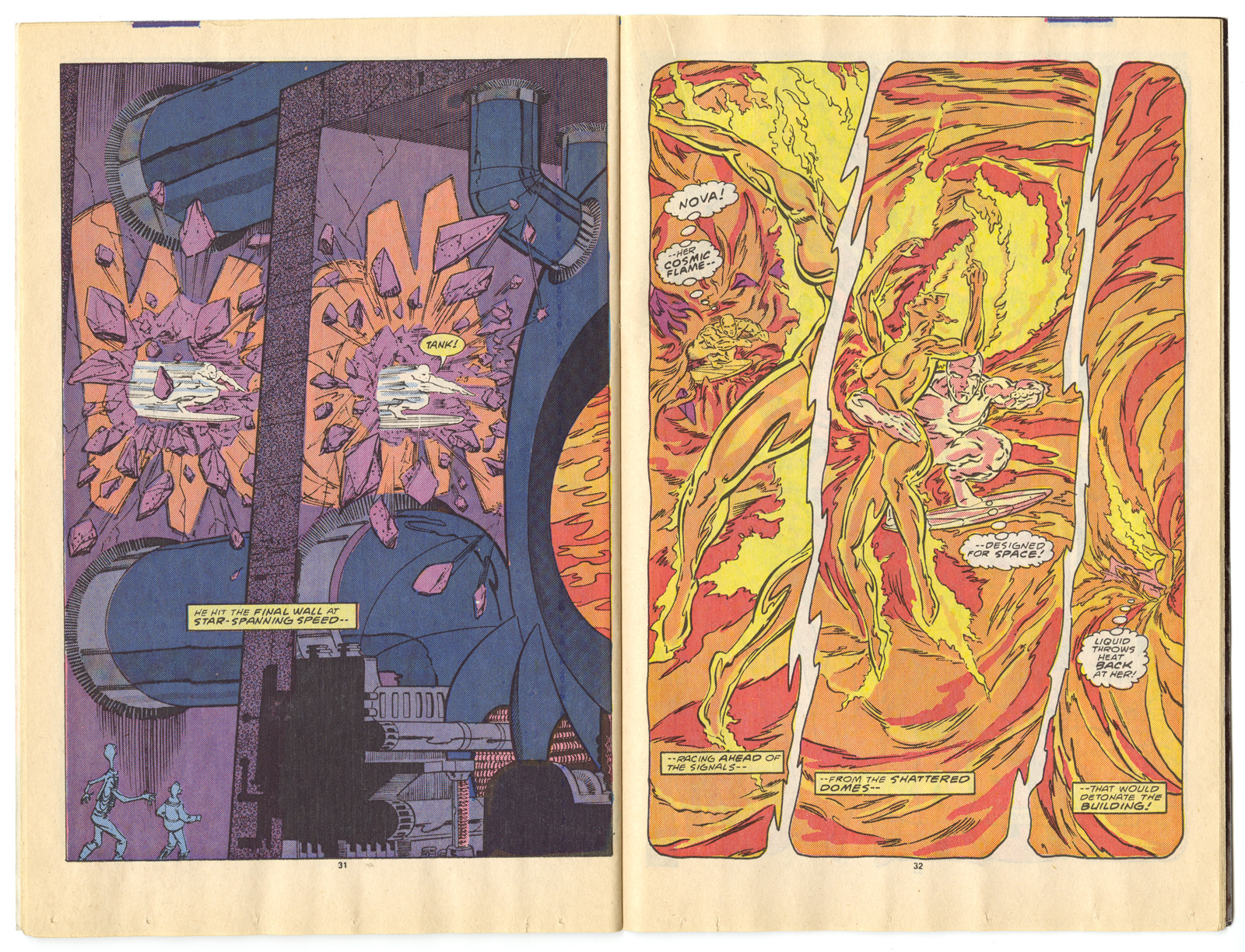
Fig. 5. Nova rescue sequence pt. 3 On the next page, the Surfer locates Nova in three vertical panels (Fig 5). On the subsequent page, three more vertical panels follow the Surfer, holding Nova, and escapes into space (Fig. 6). The denouement is another splash page of the Surfer holding the weakened Nova as they speed away from the Skrull planet (Fig. 7). It’s a masterful sequence that shows off the narrative and visual power of the medium.
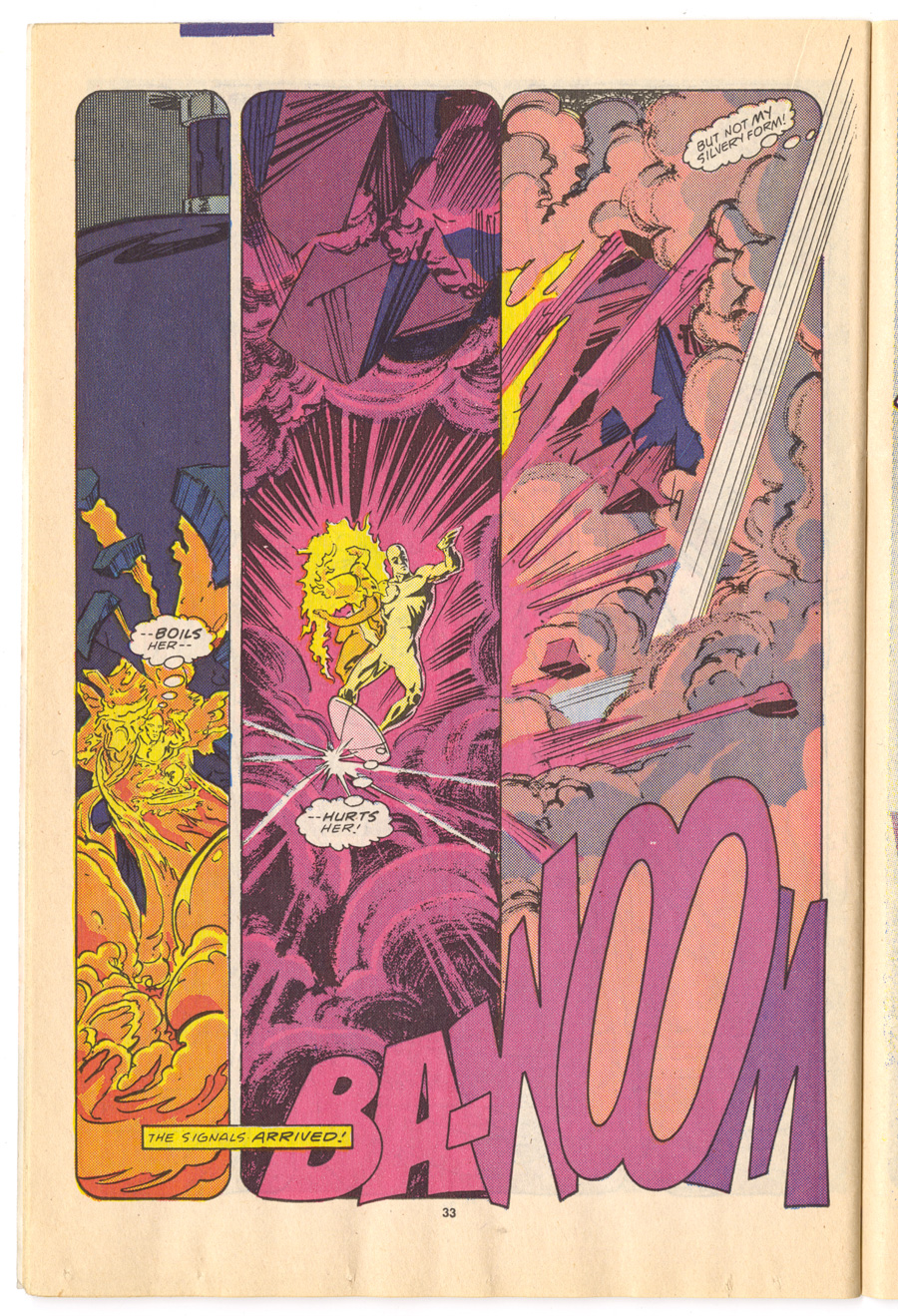
Fig. 6. Nova rescue sequence pt. 4 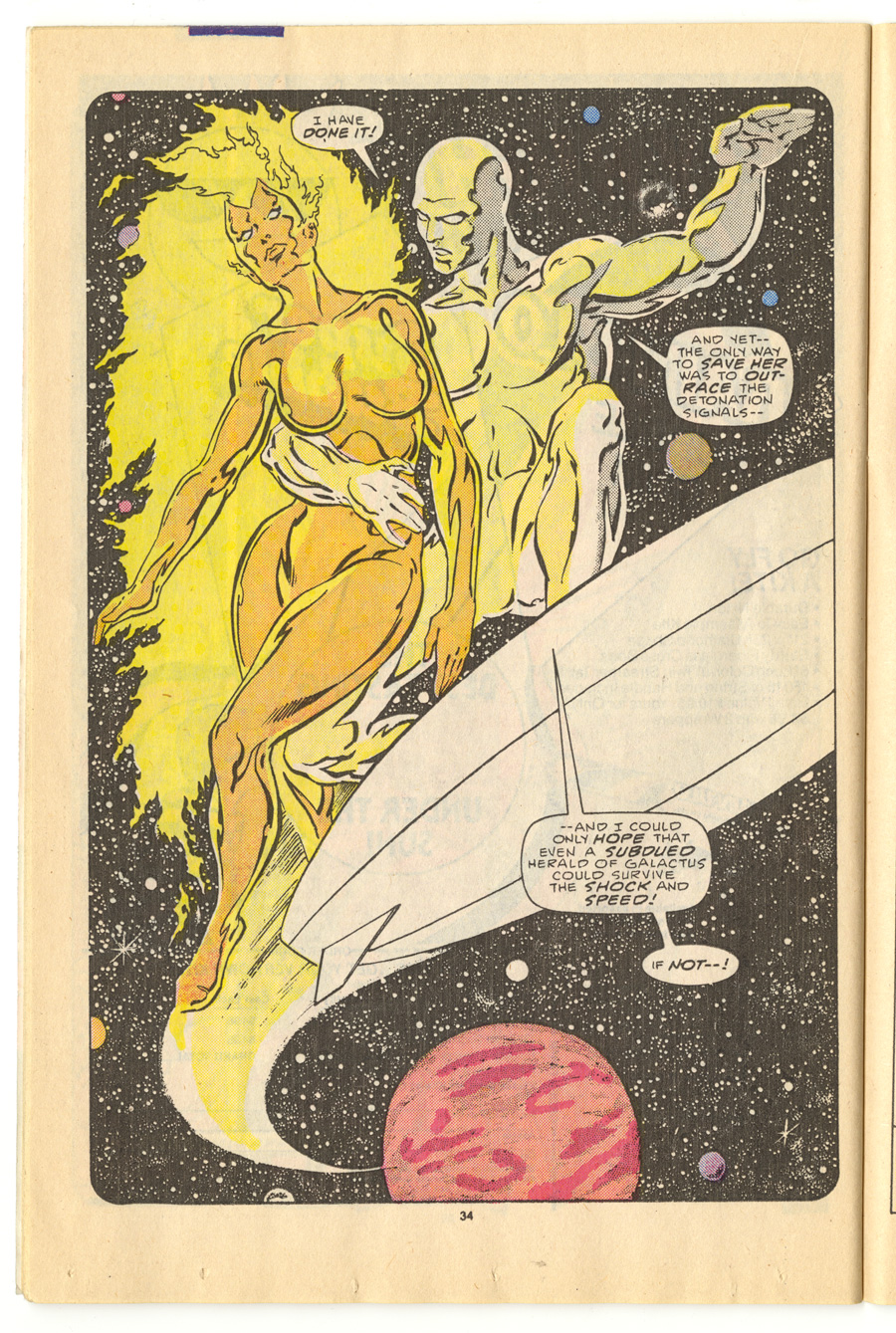
Fig. 7. Nova rescue sequence pt. 5 It’s a great example of the push-pull between comics-specific realism and abstraction. Rogers reserves realism for characters and environments, while abstract visuals depict speed, energy, and superpowers. The old cartoon jokes (Fig. 8) about abstract art found their full narrative use in American superhero comics. The artist/cartoonist Keith Tilford had a few salient observations on this subject:
[George Perez] understood abstraction via storytelling and had an incredibly strong design sense. I also thought immediately when Stephen Platt came onto the scene that there was a connection there. I still see it, and I am always interested in how these kinds of formal translations take place in comics.
Keith Tilford – TCJ Interview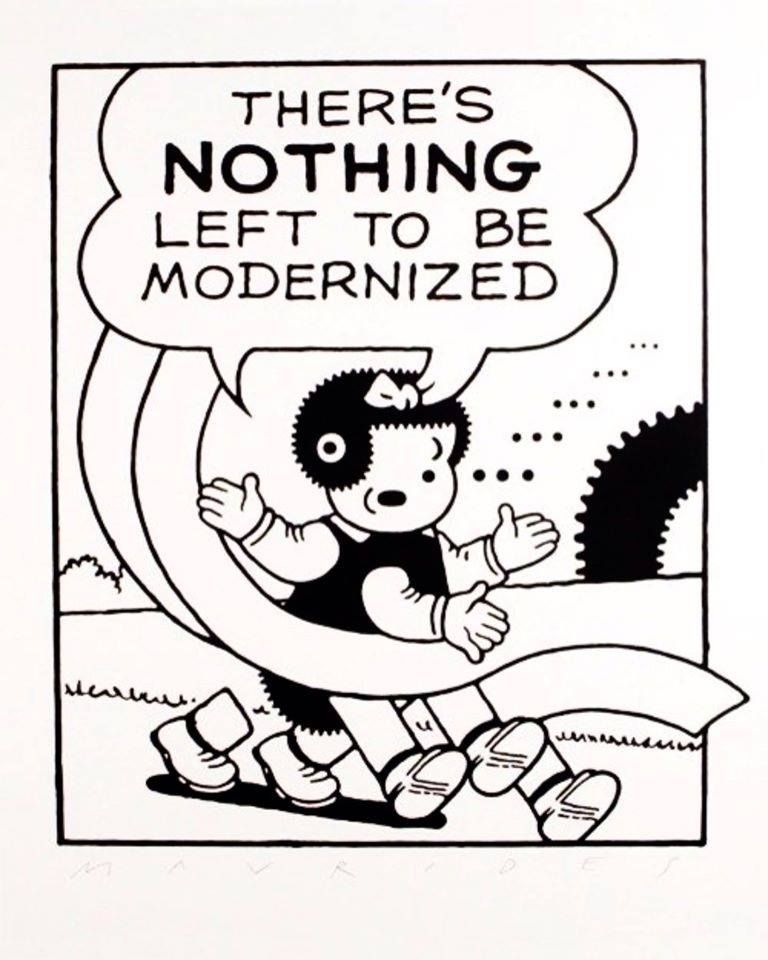
Fig 8. Nancy panel by Ernie Bushmiller. The art Avant-Garde “discovered” abstract visual expression. Still, comic books found the proper subject for the experiments: to visualize the intangible, unrealized, speculative, and hidden “cosmic” forces unleashed or uncovered by the technological revolution.
Moments like the above sequence and (elsewhere) show how integrated the Avant Garde experiments of the first half of the 20th century have become on the pages of American superhero comic books.
The Surfer returns Nova to Galactus and receives a pardon. The master/servant relationship no longer binds the two.
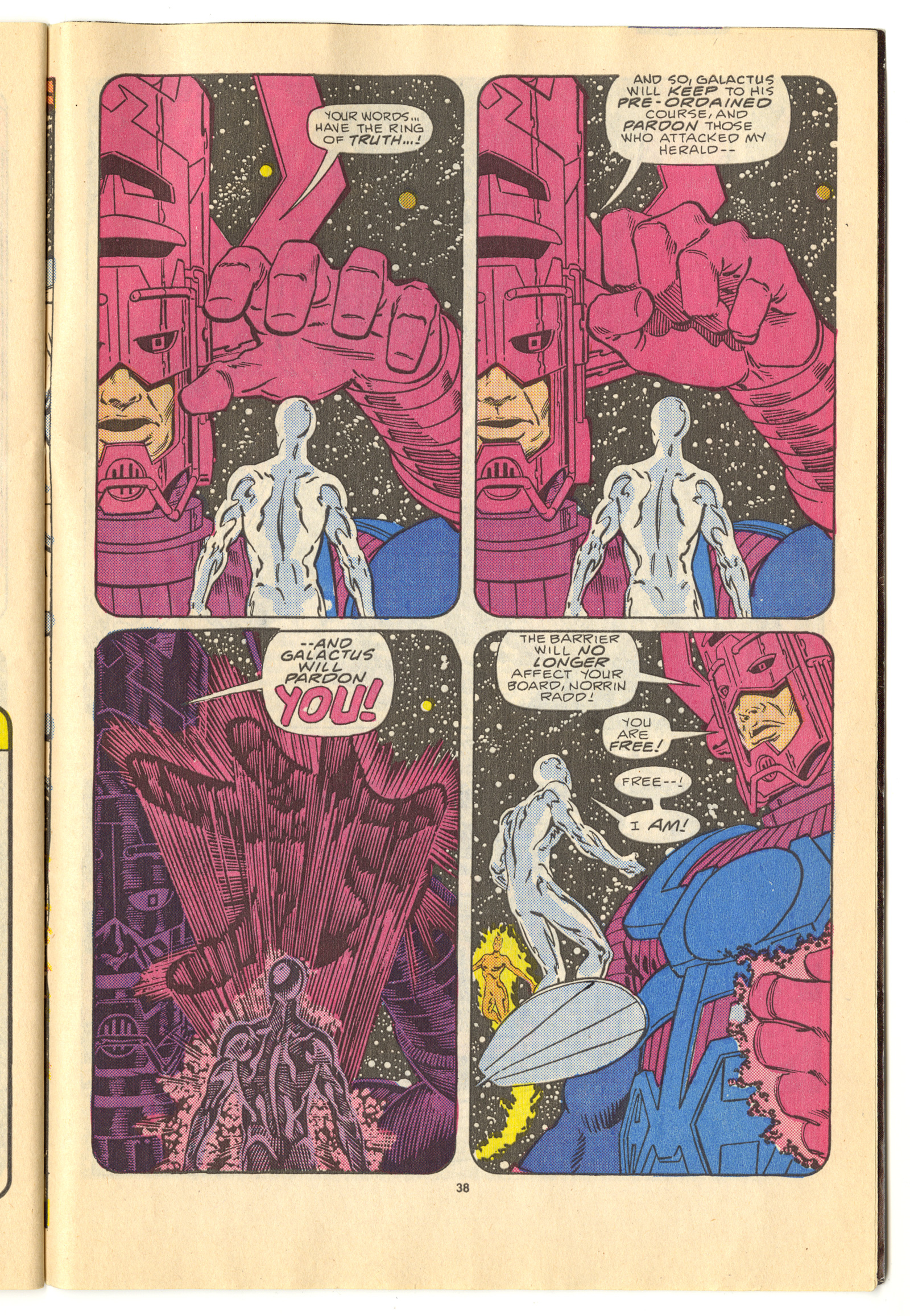
Fig. 9. Galactus pardons Silver Surfer. It’s another great moment for the character. No longer confined to Earth, his conscience clear, The Silver Surfer surfs the cosmic spaceways!
-
Million Year Boom | Notes to Beta Testing the Ongoing Apocalypse
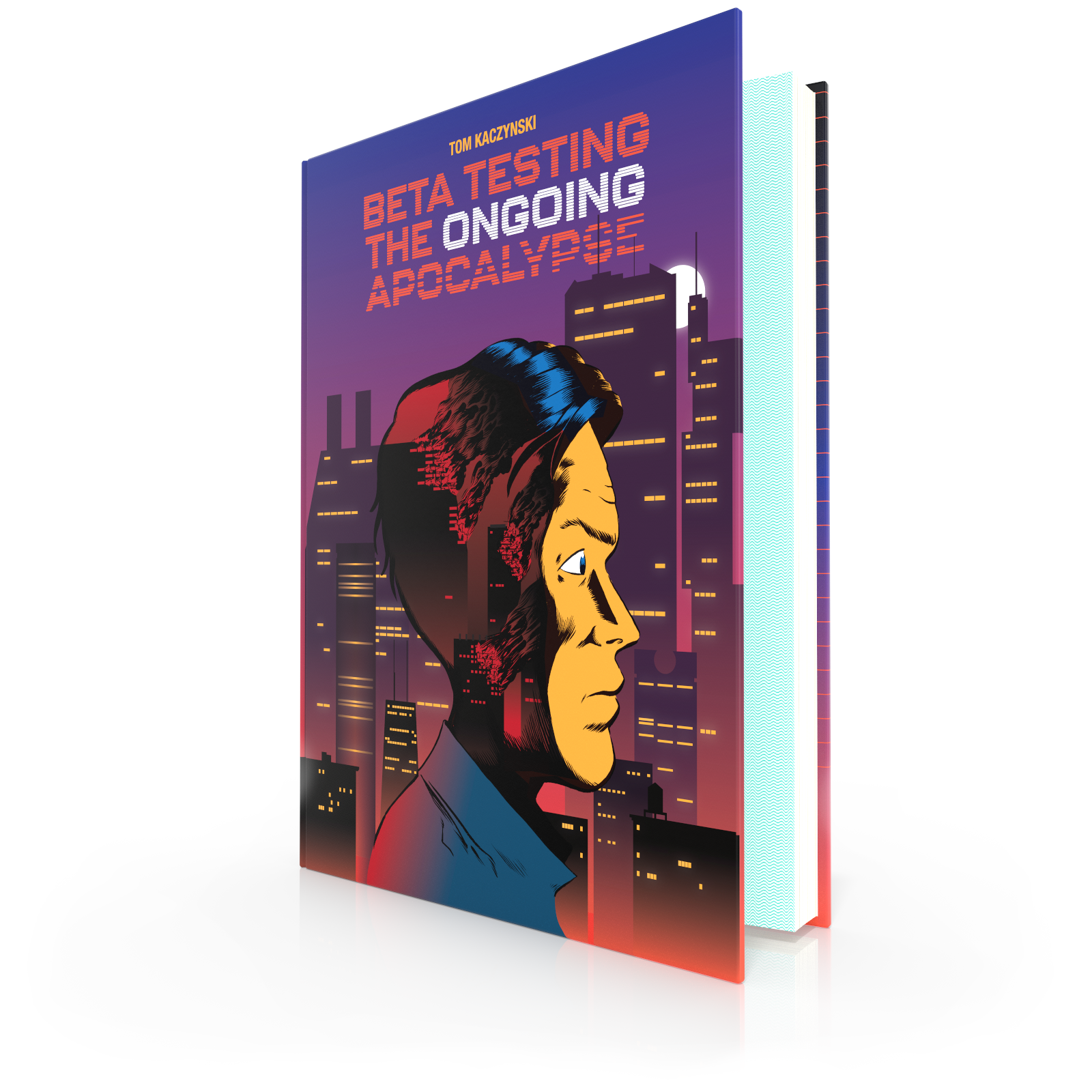
This post is part of a series: Adalbert Arcane’s expanded Notes & Theories to Beta Testing the Ongoing Apocalypse by Tom Kaczynski (Fantagraphics, 2022). This time we have Arcane’s notes on the celebrated Million Year Boom, a short dark-ecology comic. All posts in this series can be accessed here.
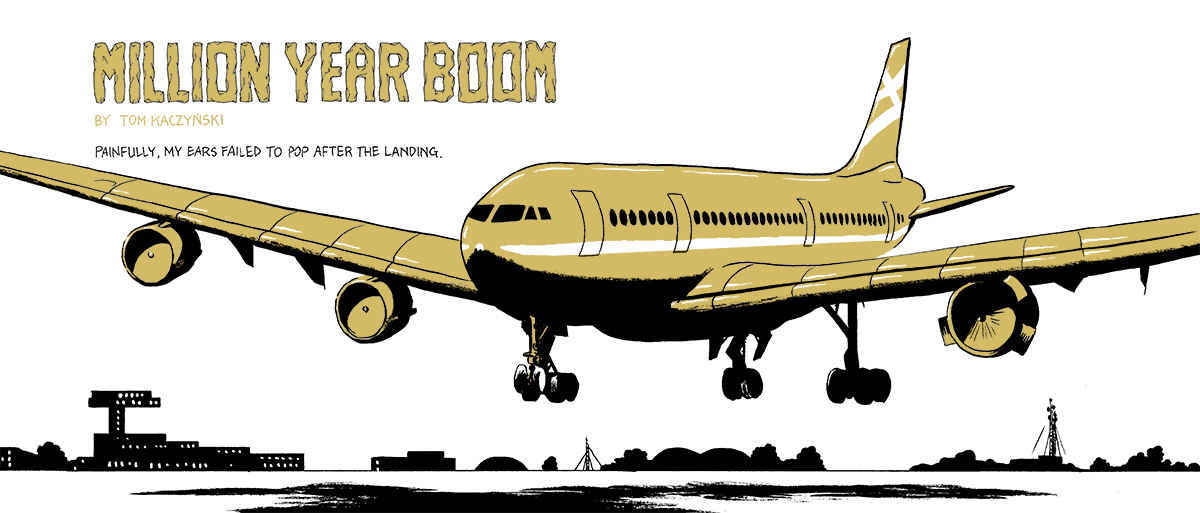
Million Year Boom, the best-known story by the author, found its way into the celebrated Best Nonrequired Reading anthology. It’s another Ballard-influenced story that excavates the primitive drives concealed within us under a thin veneer of civilization.
Green Boom
We demand a greener future. Global warming is irrevocably changing the planet. Humanity has become a geological agent, like asteroids, tectonic
shifts, or bat guano. Our civilization will leave a mark on geological strata. “This is the Anthropocene! We are the gods of destruction. We must do something!” At least, that’s what we like to tell ourselves.
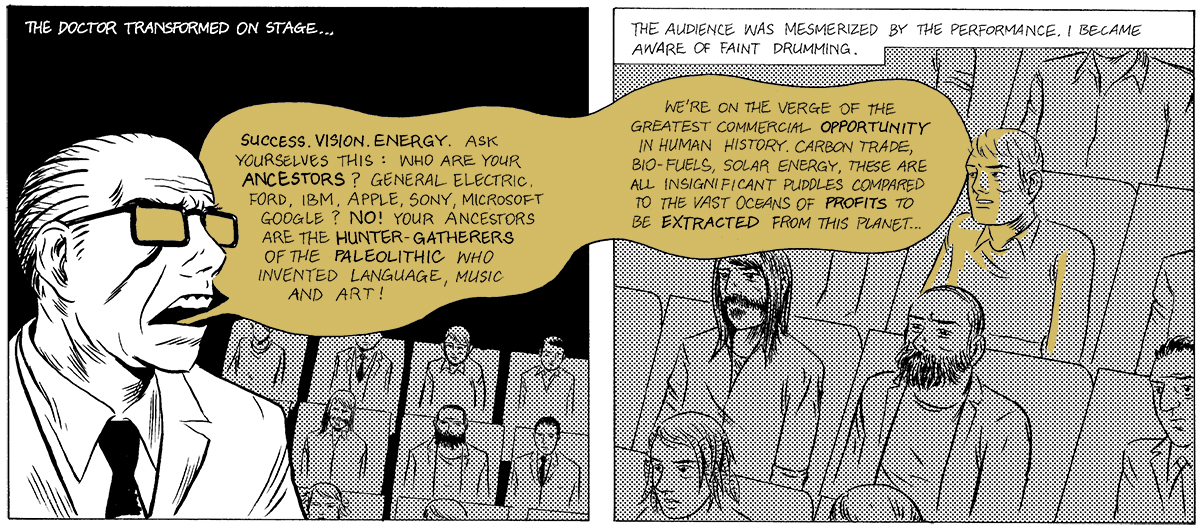
Techno Primitive
Our late-capitalist societies (late for what?) should account for all undervalued externalities (think greenhouse emissions, exporting waste, etc.) in our biosphere. Imagine this scenario pushed to the absolute limit. Under this new regime, the entire biomass of the planet would have to be counted, weighed, measured, understood, and monetized. This kind of hyper-rationalization of all matter and biomass on the earth will result in a new scientific techno-animism.
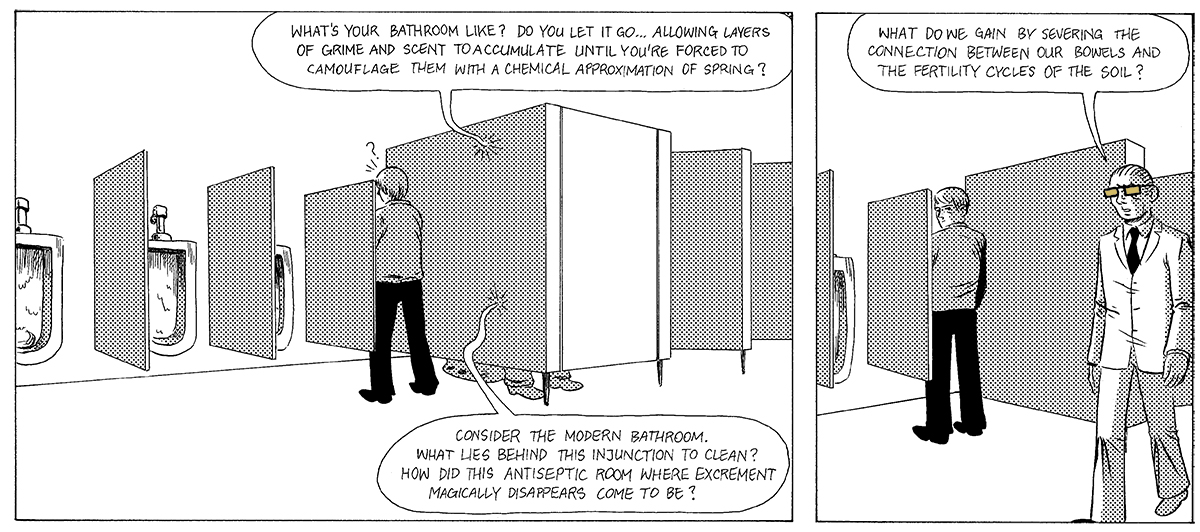
Science and big tech do not create knowledge but clouds of data. We see science and data as a solution, but we should view them as another kind of pollution, a destabilizing process that deterritorializes societies. The most advanced science and technology are rapidly retribalizing and re-primitivizing societies. It is a paradox that most scientists and intellectuals do not want to confront.
Unrepeat
Cyclical theories of development grasp this intuitively. When there’s enough moisture in the atmosphere, the wet season arrives. When water falls to the ground, things grow. This repeats every year. The cycle can break, of course, but it eventually restabilizes into a new cyclical process. What kind of weather do clouds of data bring?
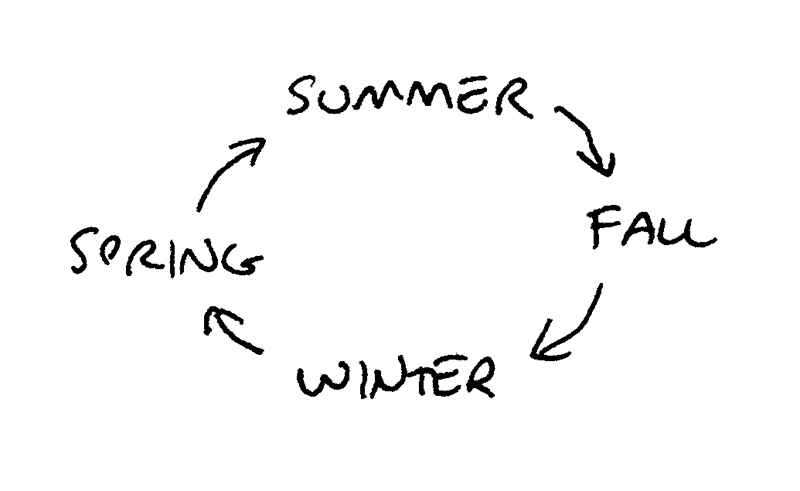
Agrarian societies think in terms of growing cycles:
• spring > summer > fall > winter > spring …
Cosmopolitan societies (Greece, Rome, Medieval Europe, etc. [ 1 ]) think in terms of great ages:
• golden age > bronze age > decadent age > the fall > golden age …
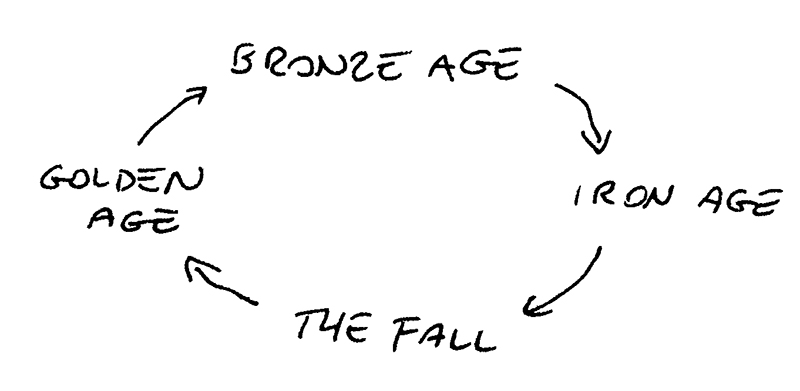
These above modes are analogous.
Broken Wheel
Modern society, on the other hand, thinks in terms of binary eschatological teleology (BET):
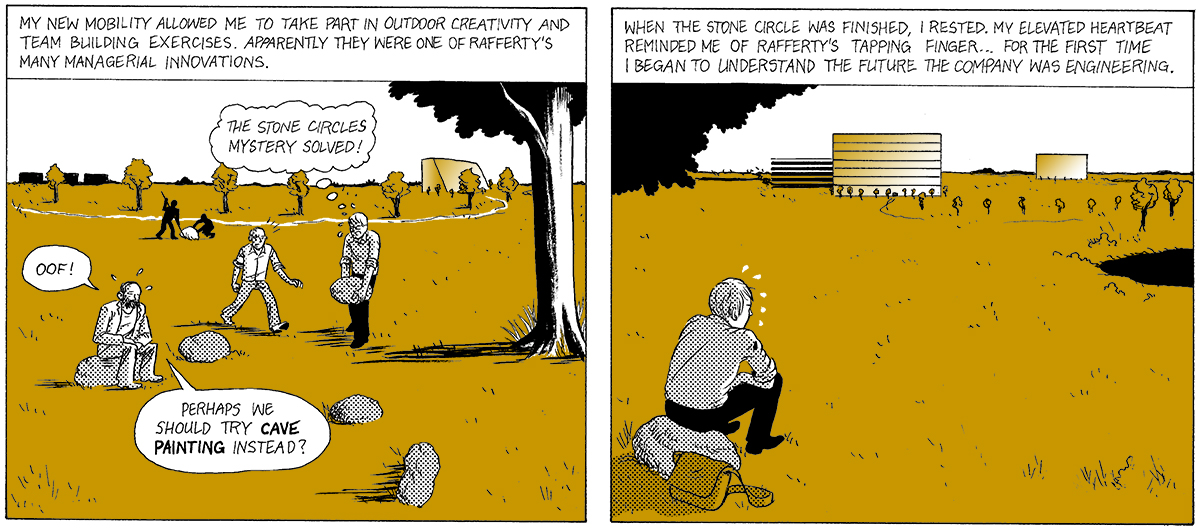
• present > g a p o f t i m e > utopia or dystopia.

In other words, the future is binary (good/bad) and exists at an unknown distance from us. The critical difference is that we no longer view ourselves as human animals. Since we broke the cycle, we now see ourselves as beyond nature.
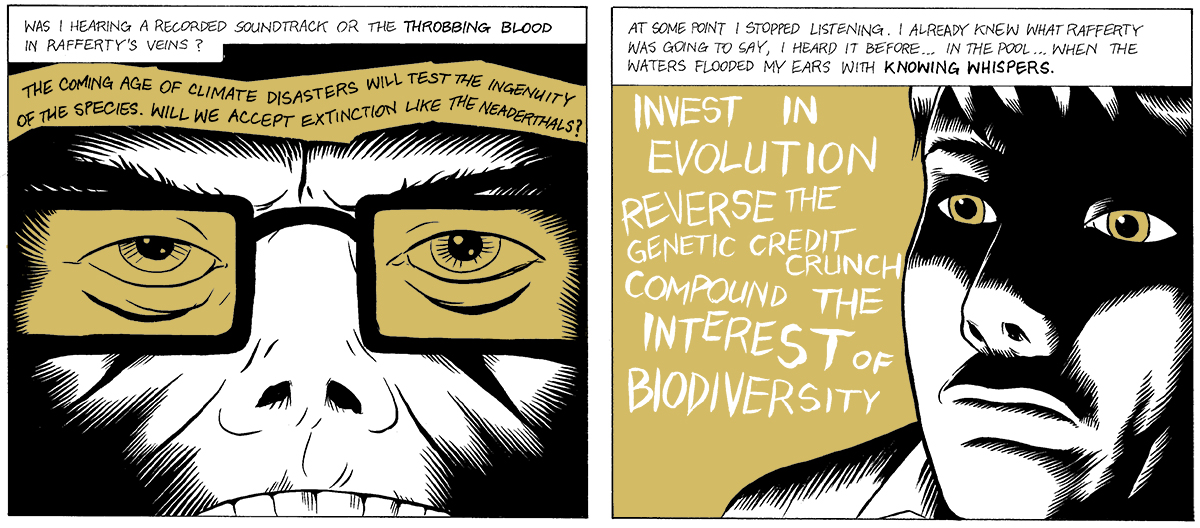
Even green activists who want to protect the planet imply we are more significant than nature. Or when they insist that we must de-industrialize (i.e., devolve) — the implication is that our current stage of evolution is already beyond nature. There is no understanding of the forces that we unleashed in this paradigm. [ 2 ]
RE-Cycle
To continue as a species, we need to understand two things: the cycles of a planetary society and who we are. There is no one cycle, but there are two that matter above all:
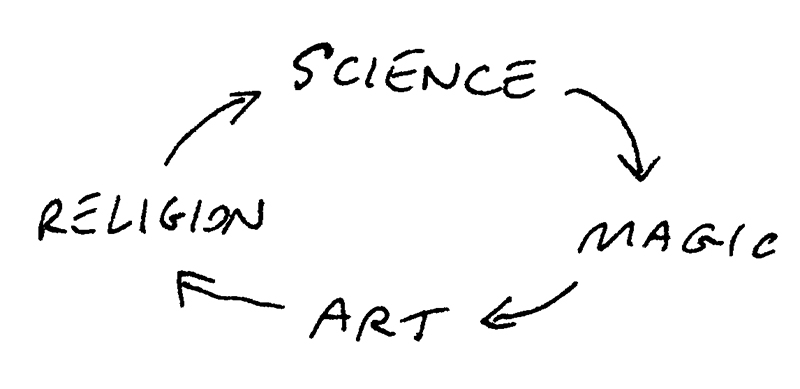
• Art > Religion > Science > Magic > Art …
• Conquest > Consolidation > Conquest …
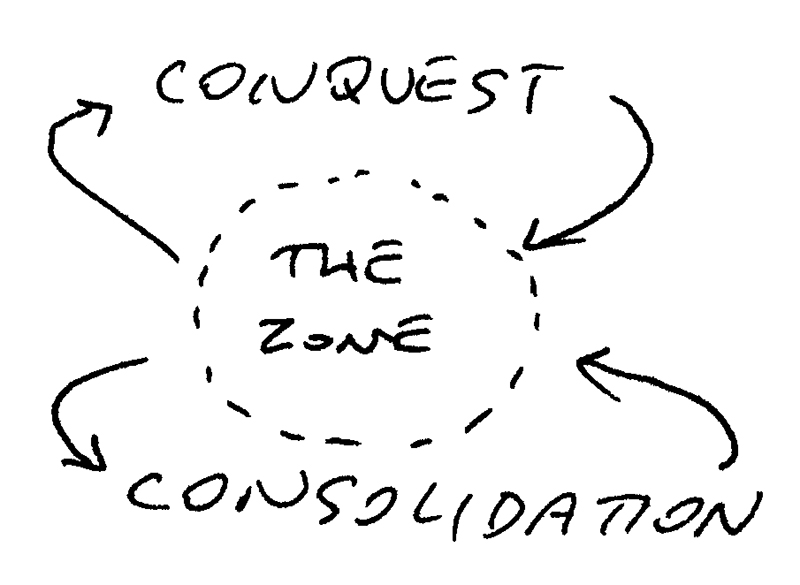
We are animals who master territory. Mastering is conquest/consolidation. The Conquest / Consolidation cycle will be dealt with in a future post. [ 3 ]
RE-Value
The valuation of all capitalist externalities is analogous to the valuation of attention (screen time, participation, engagement, and other such metrics). However, we must supplement this process of material valuation with a spiritual (mental, ethereal) valuation. Nietzsche tried to convey this with his “reevaluation of all values” notion in Genealogy of Morality. Marx’s theory of value makes similar claims. [ 4 ] These reevaluations will happen whether we like them or not, so we must do so in a controlled fashion.
Two-Pronged Fork
The future is a choice between two options. [ 5 ] Option one: global society will destabilize and (d)evolve into techno-cyber-animist magic niche-cults competing for scarce planetary resources. We remain an Earth-bound civilization. This is the end of history, the apocalypse, the final revelation of the BET mentality.
The other option is harnessing off-planet resources. In other words, to continue our unstable but productive expansionary economics, we must expand our energy inputs using extra-planetary resources (see Utopia Dividend). This option extends our understanding of ecology beyond the planetary biosphere and creates a new cycle.
Re-Demonetize Everything
If every blade of grass has monetary value, how is that different from the animistic kami of Shinto religions? Already we can see the sprouting of this ideology in the green movements. The recent rumored correspondence between Greta Thunberg and infamous eco-terrorist Ted Kaczynski (no relation to the author as far as we can ascertain) is one of the many signs.
Remonetize money
Why does everything necessary to life become expensive? Because inflationary money is worthless. In economics, money seeks stability. Since inflationary currency constantly leaks value, it must colonize all things that stay valuable. If money were stable (deflationary), all other goods would become less expensive [ 6 ]. In mythical terms, inflationary currency, Midas-like, turns everything into gold; it destroys everything. Deflationary currency, on the other hand, is Alladin’s lamp, powerful but limited by the user’s wisdom.
Economics and religious sentiments must not mix. The economic sphere must remain autonomous and independent. We must take steps to forcefully bracket economic activity from intersecting with spiritual matters. The mixing eventually results in for-profit religions, magic, and art. The blending is exciting but counter-productive. Material valuation of immaterial spheres is a recipe for disaster. These spheres should remain independent. “Render to Caesar the things that are Caesar’s, and to God the things that are God’s.” [ 7 ]
Algorithmic Marxism
Though we would be loath to admit it, Marx attempted a Nietzschean revaluation of capitalist values into communist or socialist ones. Unfortunately, his critique smuggled religious, psychological, and magical values into economics. His famous formulation: “All that is solid melts into the air,” is the equivalent of “let there be light” or god’s breath that animated dead clay. If Marx flipped Hegel right side up, then we must do the same with Marx.
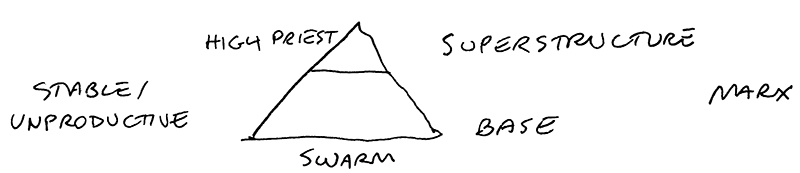
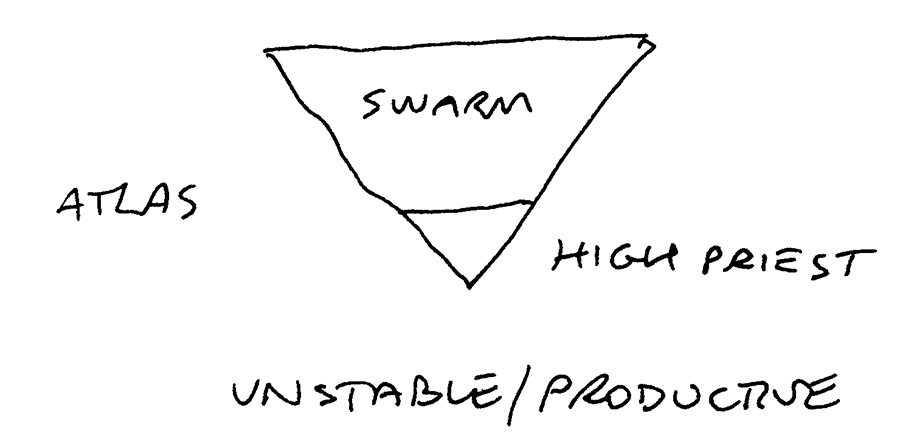
The Base > Superstructure formulation is another pyramid scheme. These formulations clarify in the same way that a pyramid explains the power relations embedded in society. By naming the devil (Capital), Marx gave it power unimagined before. The subsequent invention of Marxist analysis and critical theory by the Soviet states and the Frankfurt School is almost algorithmic:
• Input: a critique of the power of Capital
• Output: Capital increases its power
Critique: A Summoning
Critique constantly invents new ways for Capital to win; it is an incantation and invocation [ 8 ]. Words are the key to postmodern critique; it relies almost entirely on verbal games. These are forms of magic. The theorists are under the impression that they are banishing the entities they describe. Instead, they give them more power by concretizing, naming, and materializing them out of a previously fluid notion [ 9 ]. Many demons are born in theory courses.
Equal Opportunity Sacrifice
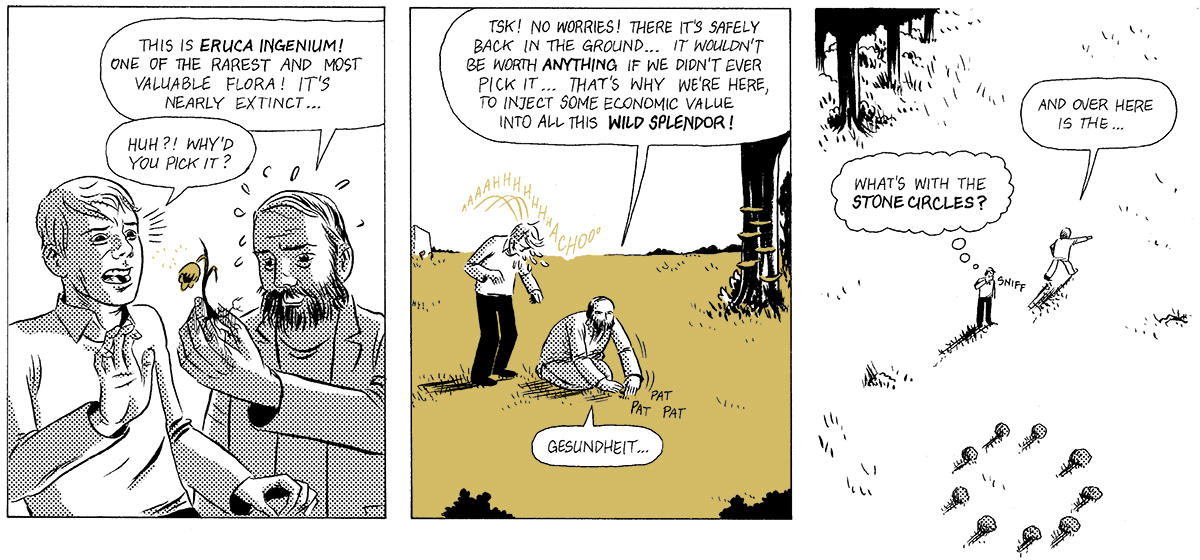
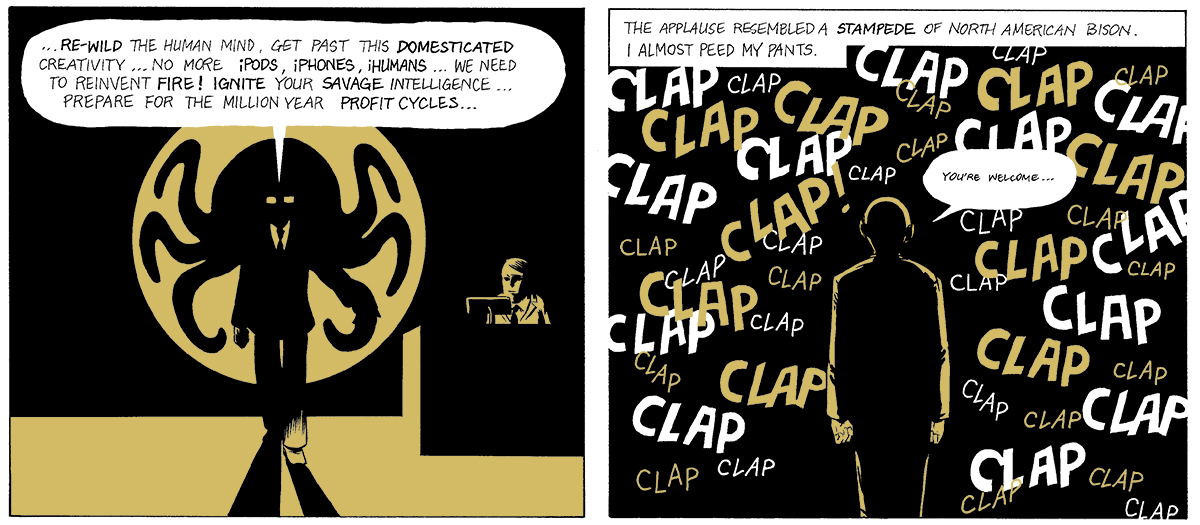
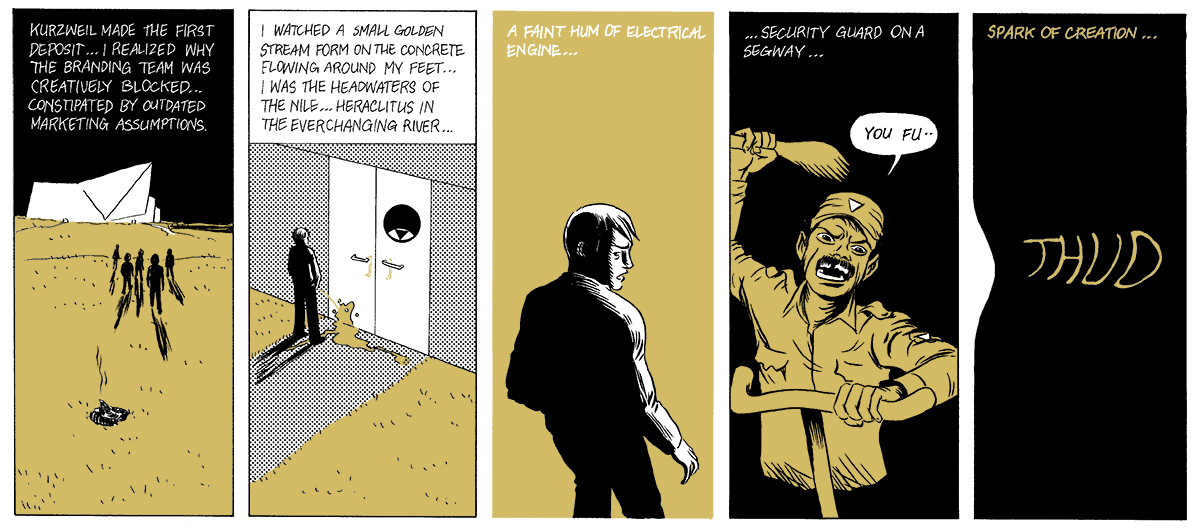
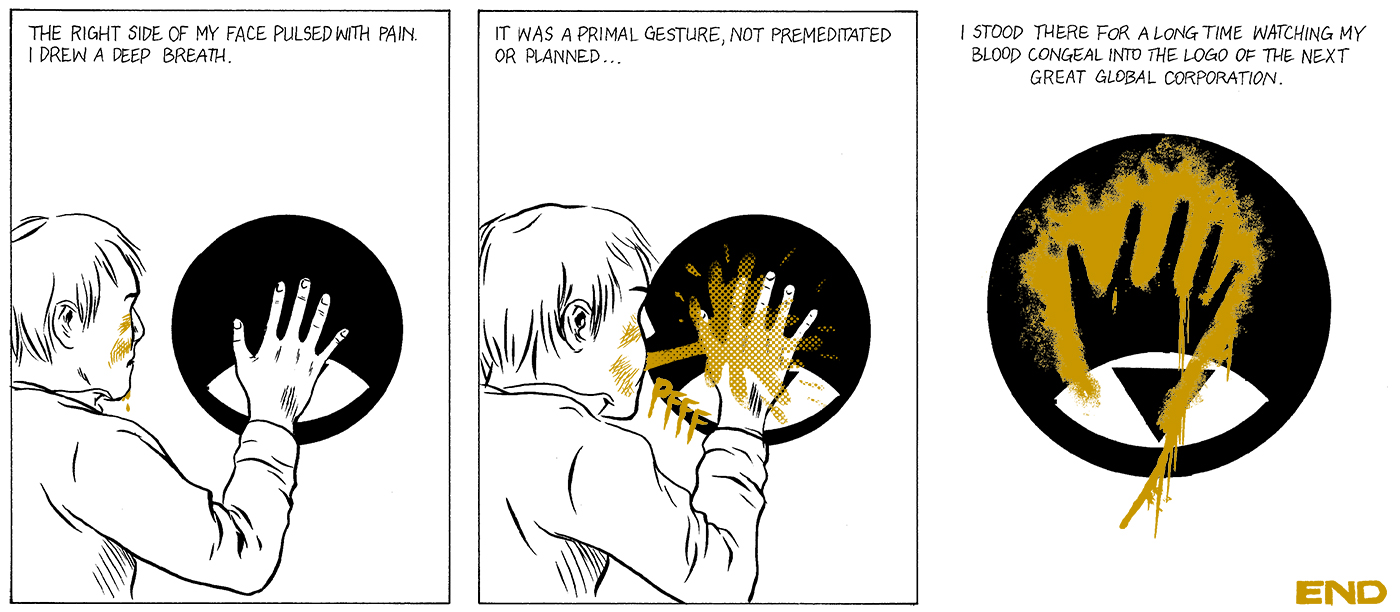
The dénouement of the story (p. 69-70), the awkward conflagration between Segway-riding (remember the Segway?) security guards and amped-up business execs, and the resulting bloody sigil — a blood offering and a sacrificial act — are a prophetic sign of things to come.
The valuation of all matter is flat metaphysics (flat ontology), where all objects (biotic, abiotic, or virtual) exist at a single value status. These flat (read, democratic) systems often carry primitive valuations akin to ritual sacrifices. For example, a society can achieve balance only by sacrificing entities (humans, animals, etc.). The value of each entity is equivalent in some way to the perceived value lost or gained. Power diffuses and becomes difficult to ascertain. Eye for an eye. Everyone is a potential rival. Justice can only be immanent mob justice.
Hi-Arch
Hierarchical modern and proto-modern societies paradoxically lack these mechanisms. They do value some entities over others. But, the value of entities at the top emerges from the collective value of entities below. In other words, value flows up (in contrast to trickle-down economics—another name for socialism) and aggregates.
These systems are unstable but very productive. Generating higher hierarchical levels (CEOs, Popes, politicians) can only be accomplished by raising the aggregate entities below. The higher-level entities act as anointed ‘sacrifice kings,’ ready to receive collective punishment through revolution or social scorn. It crystalizes and directs power. Justice is transcendent: law.
The hierarchical system can only improve through increased instability; this is Capitalism’s danger and paradox. Only a continuously increasing (extra-planetary) energy input can temporarily stabilize it until the next growth crisis/cycle. All stable systems (ecological, social, seasons, etc.) are only durable for a limited time. (see Utopia Dividend, 36th Chamber of Commerce).
NOTES:
[ 1 ] Please note that I am primarily concerned with western cyclical notions. The work (Beta Testing the Ongoing Apocalypse) is a commentary on the decline of the west.
[ 2 ] Bizarre inconsistencies arise from these lines of thinking. On the one hand, we must protect nature from humans, but on the other, we must devolve our civilization to be ‘natural.’ If all energy must be sourced from natural biomass again, we will consume all biomass. By re-naturalizing, we will destroy nature like the locust. Paradoxically, “unnatural” energy sources (like nuclear) allow us to leave biomass alone.
[ 3 ] This is expressed as territorialization/deterritorialization in Deleuze, Solve/Coagula in Alchemy, etc.
[ 4 ] How To Philosophize with a Hammer And Sickle by Jonas Čeika. Repeater Books (November 9, 2021).
[ 5 ] I know I am being very binary-eschatologically-teleological.
[ 6 ] This is a gross simplification, of course. Price fluctuation would continue depending on supply and demand. But, holding money would be analogous to how ‘investment’ works today. But, the ‘investor’ would only need to hold money instead of figuring out how to game the inflationary system by manipulating the ‘portfolio’ by following financial bubbles (property, commodity, crypto, etc.).
[ 7 ] Mark 12 : 17, The Bible, King James Version.
[8] For example, see Foucault’s work on the discursive construction of sexuality in the 19th century.
[9] This is how demonic summoning works.
-
Jim Starlin’s Dreadstar 9-10 (1982)
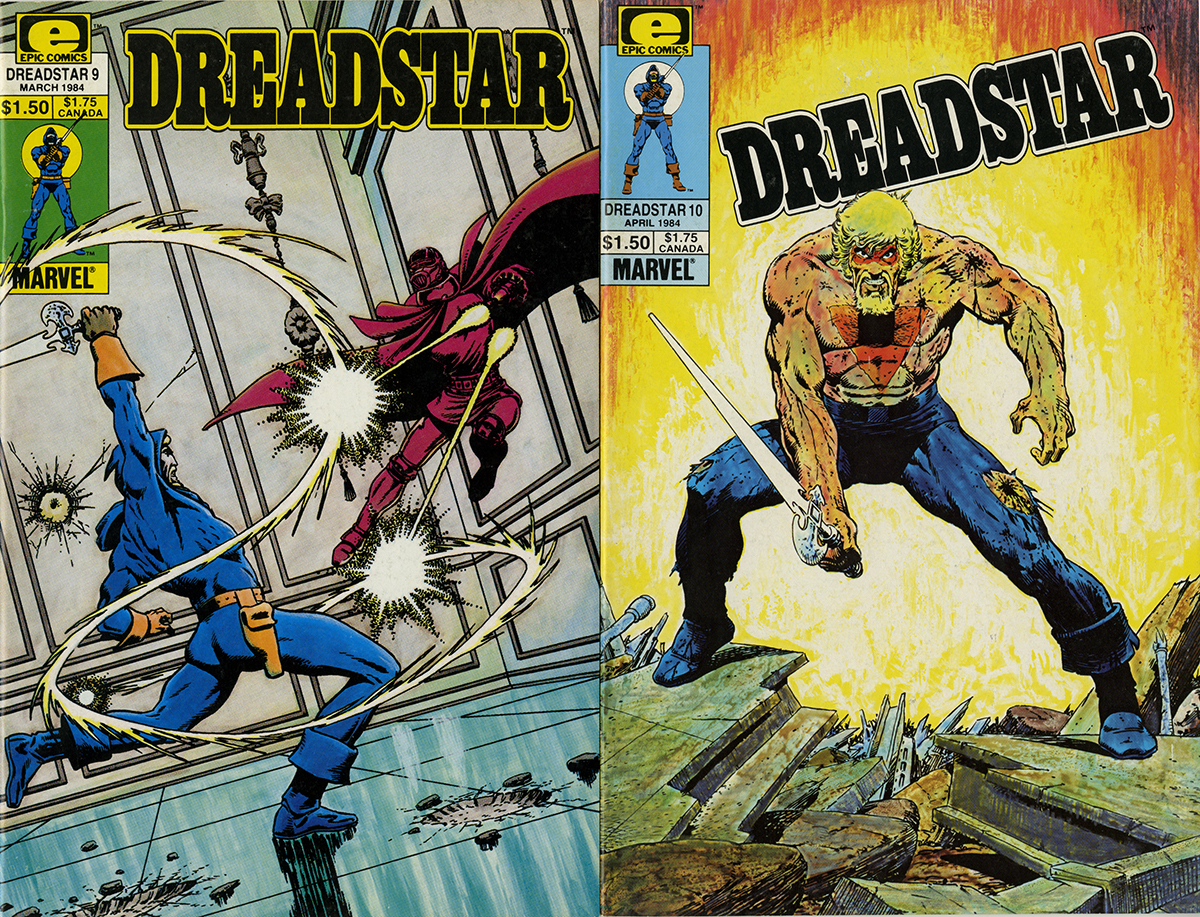
Note: This post continues an ongoing series on Jim Starlin’s Dreadstar, an underrated creator-owned comic from the early 1980s. You can start by reading the post linked below or click here to see other posts in the series.
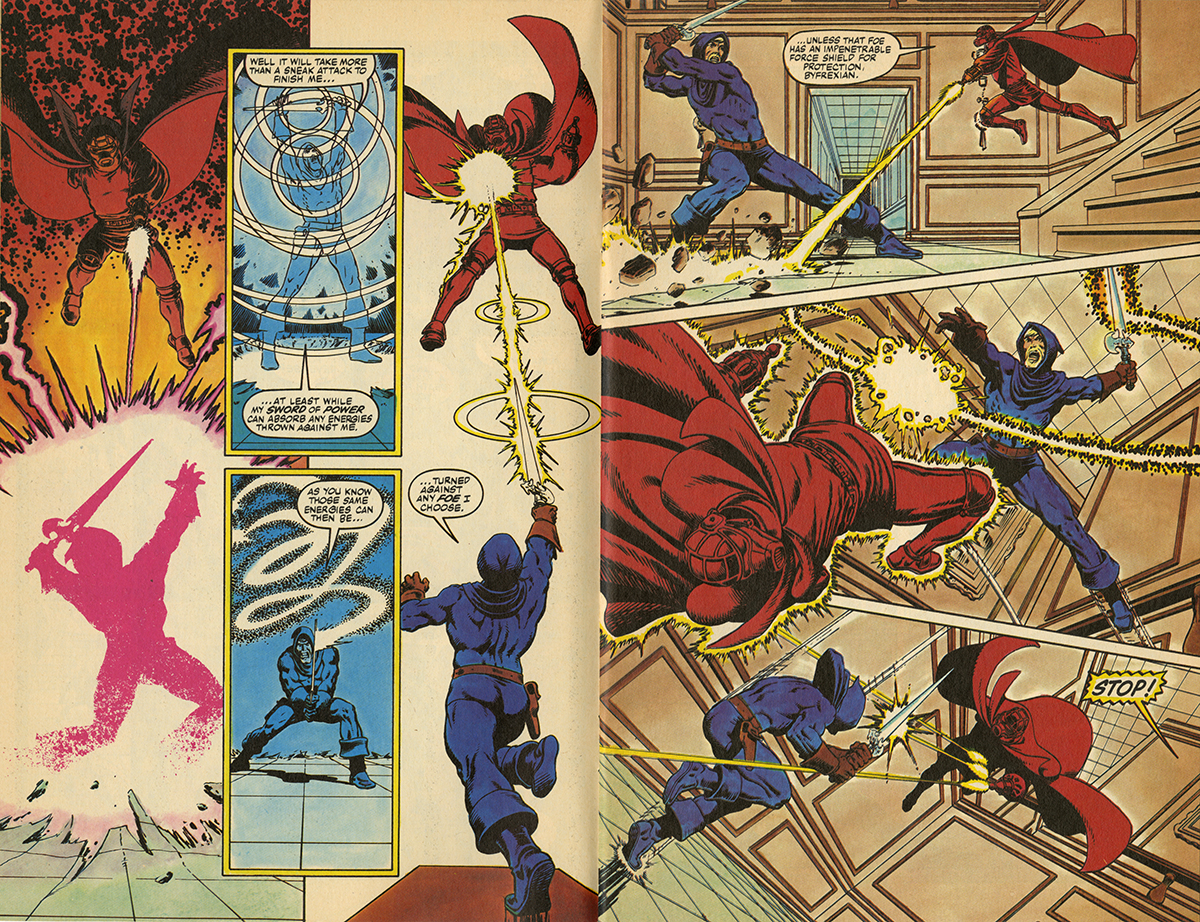
Dreadstar #9 Color
Issues 9 & 10 contain the much anticipated final confrontation between Dreadstar and Z. Still, the first thing to notice is the color. Starlin & Epic used the “blue-line” painted method in these two issues. Richmond Lewis (colorist of Batman: Year One, The Shadow (1987, #1-6), and others ) has an excellent and precise description of the process:
“In the “blue-line” process, the black-and-white inkline drawing (by Mignola and Russell) was reproduced on a sheet of clear acetate; the same drawing was also reproduced in light blue ink on a sheet of drawing paper. The colorist, using the printed blue lines as a guide, was free to color the drawing using any media (transparent or opaque) because the clear acetate could be dropped over the color in order to see what the final printed version would look like. (In the printing process, the color art was photographed for the color printing plates, while the inkline art was photographed separately for the black printing plate only, which kept the black line crisp).”
http://www.theartistschoice.com/rlewis.html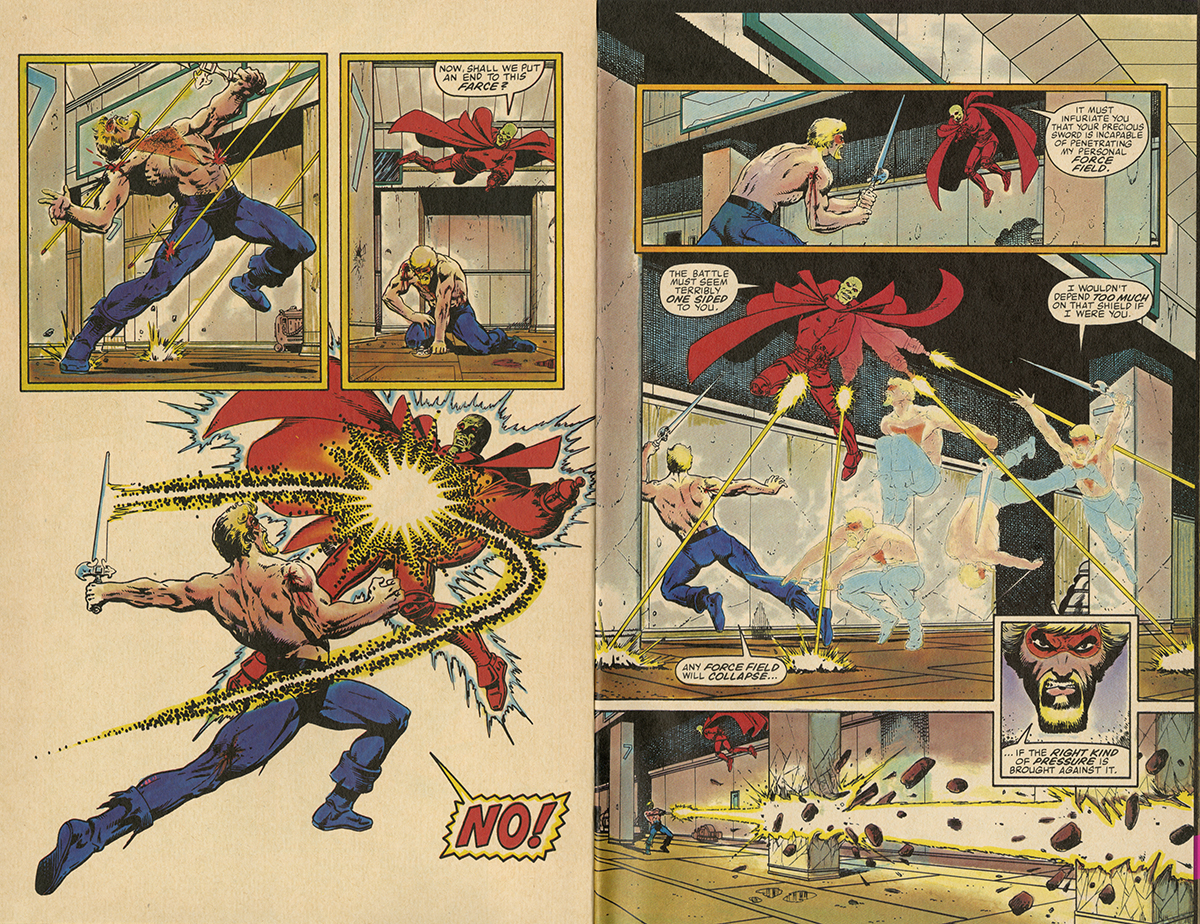
Dreadstar #10 The blue line technique results in much more color depth and variation than the typical flat color using most comics. It essentially allows the colorist to use whatever tools they want: markers, watercolors, gouache, etc. With the advent of digital color and scanning, this method is not used anymore. But the technique of layering black ink lines over a color layer lives on. It is still used today. Applications like Photoshop use the ‘layer’ as a primary interface metaphor. The artist can separate art and design elements into distinct transparent layers.
Paper
The blue line process was possible only because, from its inception, Dreadstar was printed on premium paper (called Baxter). At the time (the early 80s), most comics were still published on various grades of cheap newsprint. Newsprint is a very soft and absorbent paper. Ink ‘sinks’ into it and softens lines and colors. This results in most old comics’ classic soft ‘comic bookish’ color look. The premium paper used in Dreadstar is much less absorbent, allowing ink to ‘sit’ on top, resulting in sharper details and subtle, vibrant colors. Scroll down to the end for some additional resources on comics color process.
Final Destination
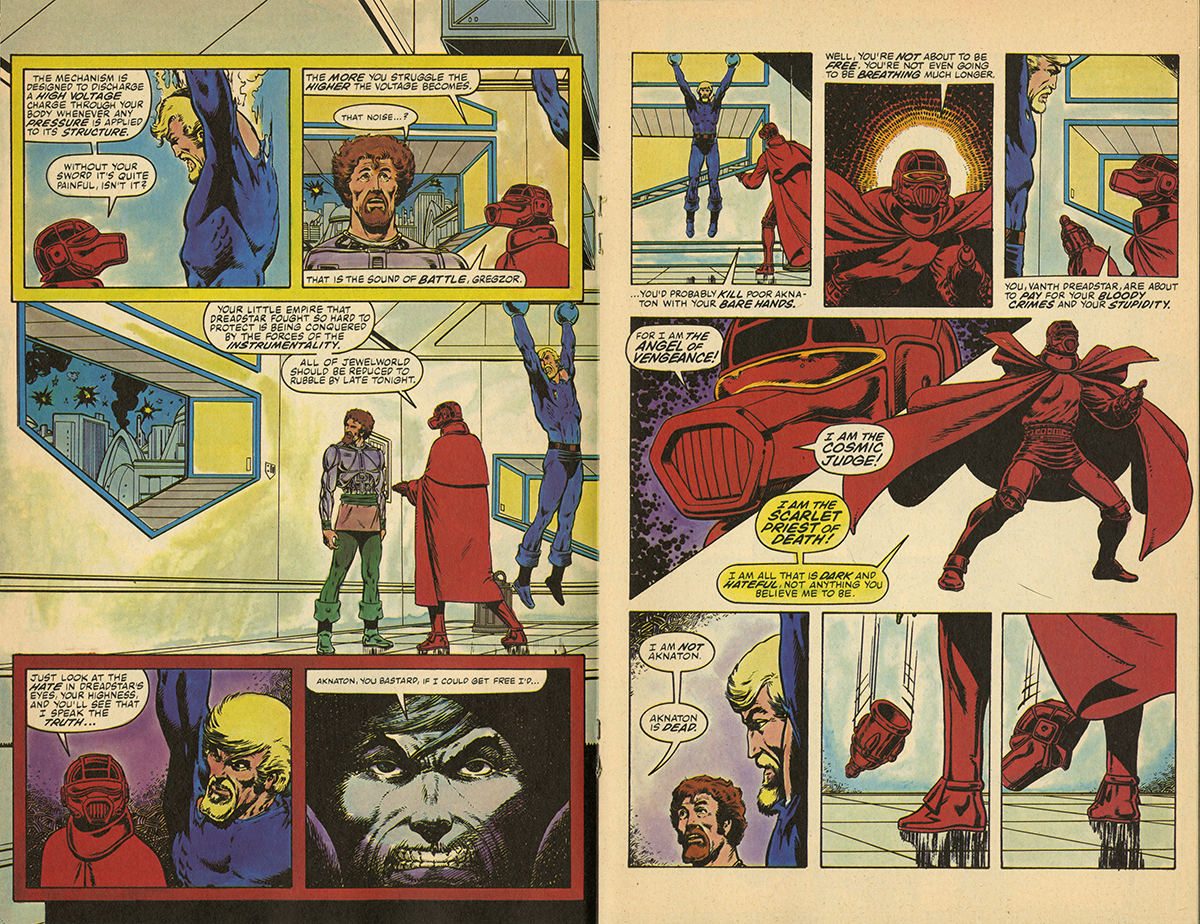
But enough about the process. Let’s get back to the story. Vanth is convinced Z is Aknaton. King Gregzor (who appeared killed by Z in issue 7) proves to be Z’s ace in the hole. Gregzor becomes transformed into a cyborg, and at a critical moment, the king—controlled by Z—unwillingly turns against Vanth. After a brief battle, Z subdues Vanth. Z reveals that he’s… not Aknaton!
Spoiler Alert!
This is the culmination of a 10-issue story arc. Don’t go any further if you’re planning on reading the series.
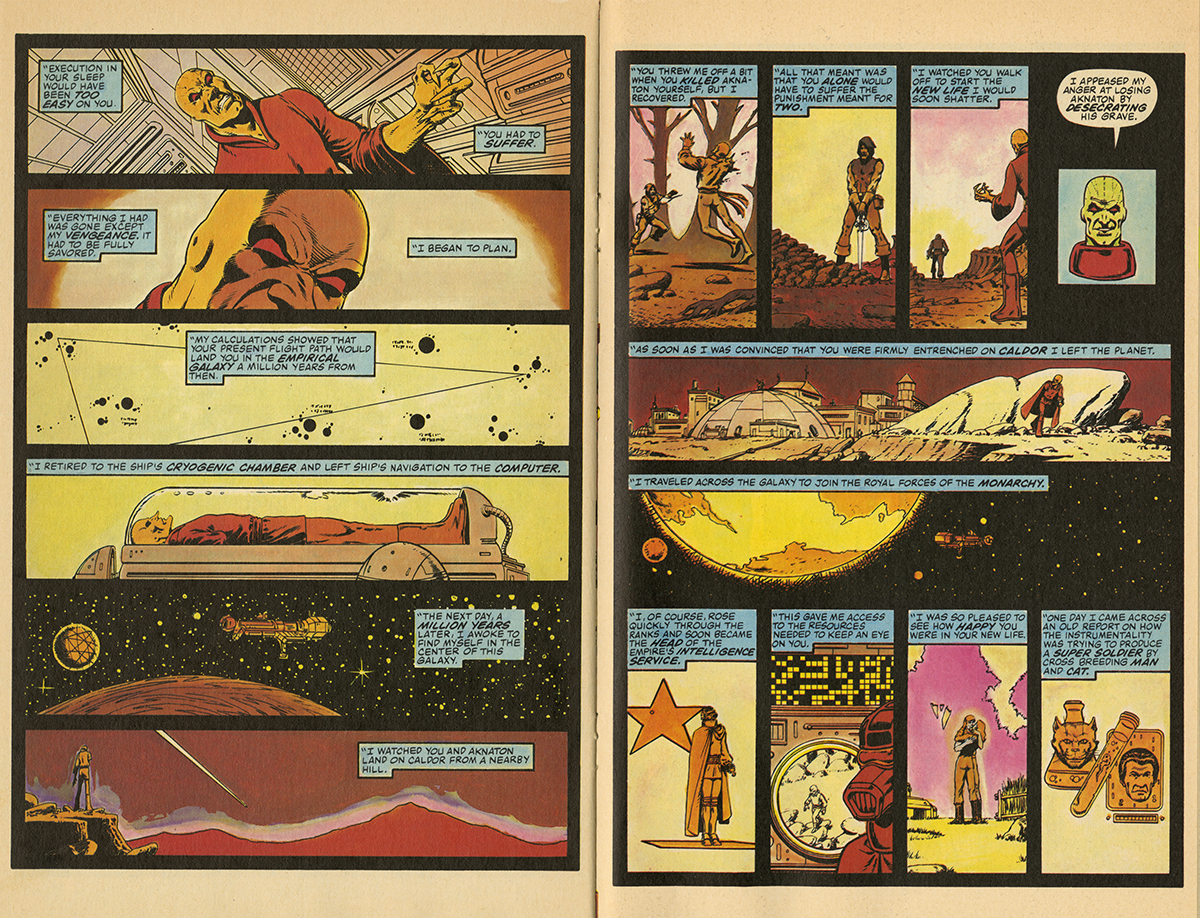
The Coldest Revenge
He’s Z-7458! Wait, what!? Who!? He’s a Zygotean, the last of his kind, and the only other survivor from the Milky Way! He was on a deep space science vessel exploring the galaxy’s edges. At the same time, the Orsirisian / Zygotean war reached its crescendo. He followed events of the war via military ether transmissions. He learned of Aknaton, his plans, and Vanth and the Infinity Horn. He turned his vessel away from the Milky Way to flee the coming galactic holocaust. Someone had to continue the Zygotean dynasty. After the Milky Way’ ceased to be,’ he detects the mystical sphere containing Aknaton & Vanth. Instead of destroying them then and there, he decides that this is too easy. He begins to plot revenge, figures out where the sphere would land, sets a course to follow it, and enters suspended animation for a million years!
Z waits for Vanth to establish a new life in the new galaxy and then proceeds to destroy it. Z manipulated Vanth the entire time! He engineered the Monarchy assault on Caldor to ruin his new life. And he desecrated the grave of Aknaton, making Vanth believe in Aknaton’s resurrection. Now the two lock into the final confrontation. The old cliche says, “revenge is a dish best served cold.” This revenge is a million years old and has a temperature of absolute zero!
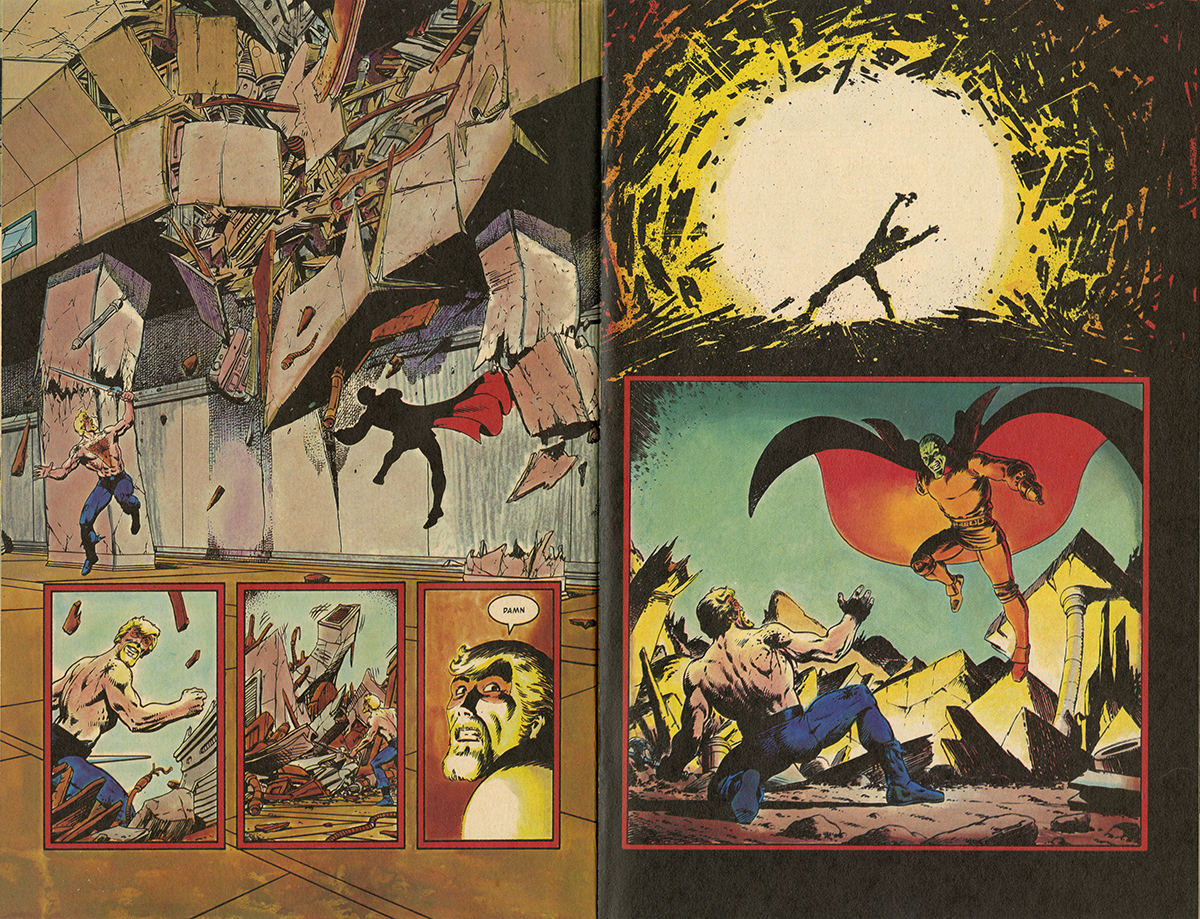
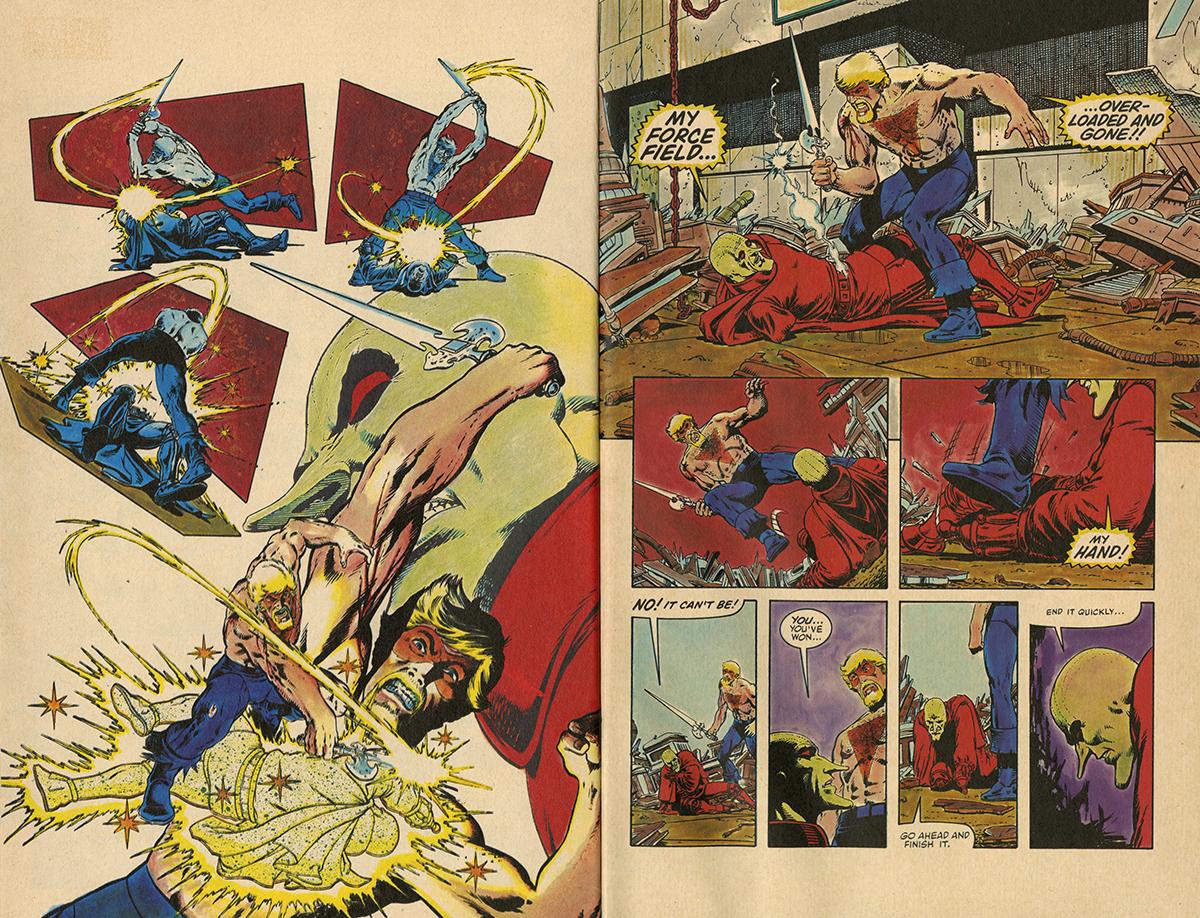
What follows is a massive battle between the characters. This time Vanth plays dirty, setting a trap for Z. Starlin gets to show off his considerable action choreography chops.
Sharp Dilemma
In the end, Vanth brutally kills Z with an iron chain. The mystical sword is too clean a death! I wonder why Starlin opts not to use the blade at this crucial moment? The fashion for sword & sorcery was waning in comics. In opting for the chain, Starlin was signaling that something different would be happening with Dreadstar in the future. Indeed, in later issues, Starlin dispensed with the blade altogether.
Additional Comics Color Resources:
Check out Frank Santoro’s color riffs for those interested in learning more about old-school color techniques.
Kevin Nowlan talks color w/ Frank Santoro.
-
The Cozy Apocalypse; Adalbert Arcane’s Notes and Theories to Beta Testing the Ongoing Apocalypse
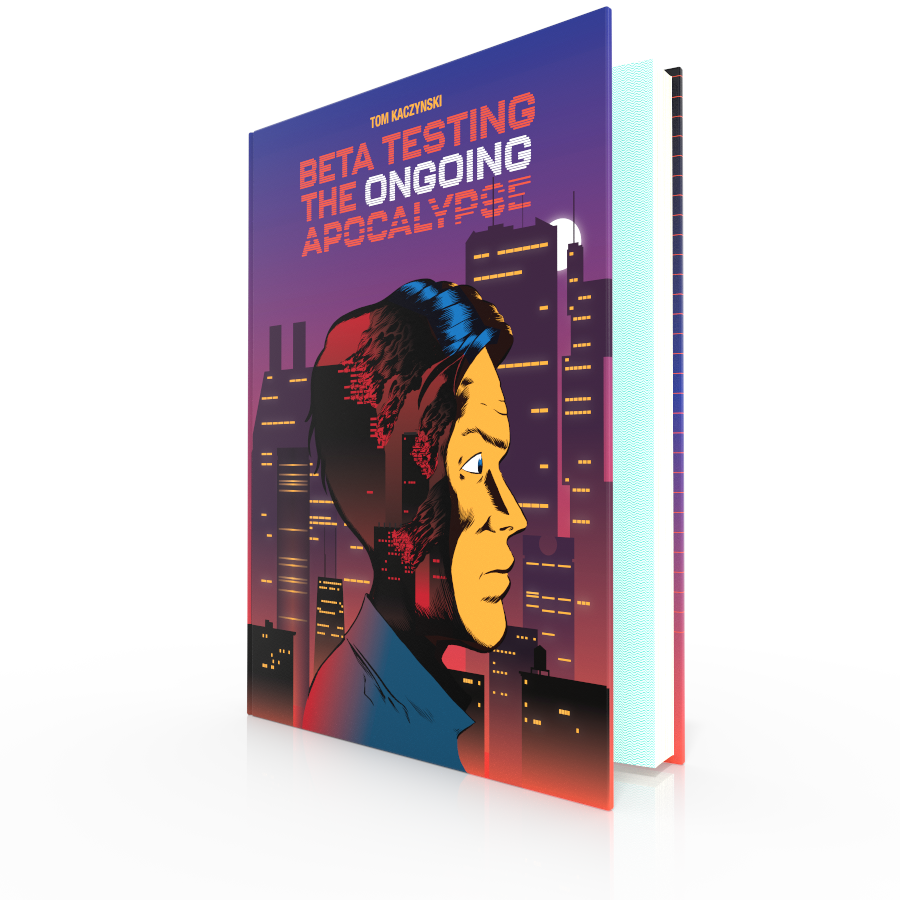
This post is part of a series: Adalbert Arcane’s expanded Notes & Theories to Beta Testing the Ongoing Apocalypse by Tom Kaczynski (Fantagraphics, 2022). This time we have Adalbert’s notes on two short “cozy catastrophe” [ 1 ] comics: Phase Transition and Cozy Apocalypse. All posts in this series can be accessed here.
The two stories form a diptych. The Cozy Apocalypse functions as a spiritual apotheosis to Phase Transition. The intense, primal wish to cleanse the world with a torrential flood ends in frantic splashing in a shallow muddy puddle; a welcome respite from the daily grind; a cozy catastrophe.
PHASE TRANSITION
“Walter Gropius published photographs of Buffalo’s grain elevators in the Jahrbuch des Deutschen Werkbundes (Yearbook of the German Association of Craftsmen) in 1913 (the same year Marcel Duchamp made the first of his many Bicycle Wheels).” Ten years later, in Vers Une Architecture, Le Corbusier called grain silos “the first fruits of the New Age.” [2] Almost 100 years after the inauguration of modernist architecture, we live in the civilizational equivalent of an orchard strewn with rotting fruit.
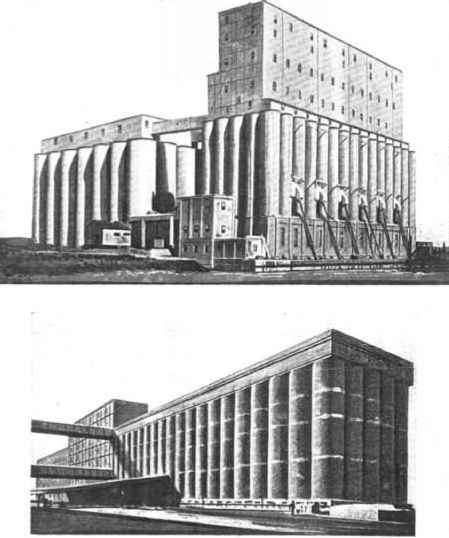
Silos from Vers Une Architecture When one first encounters a silo, there’s a feeling of uncanny familiarity. The structure’s shape and presence are like experiencing a primal form, a template [3+4] for the world we encounter today; a beautiful, functional form but hollow, drained of its original functionalist context.
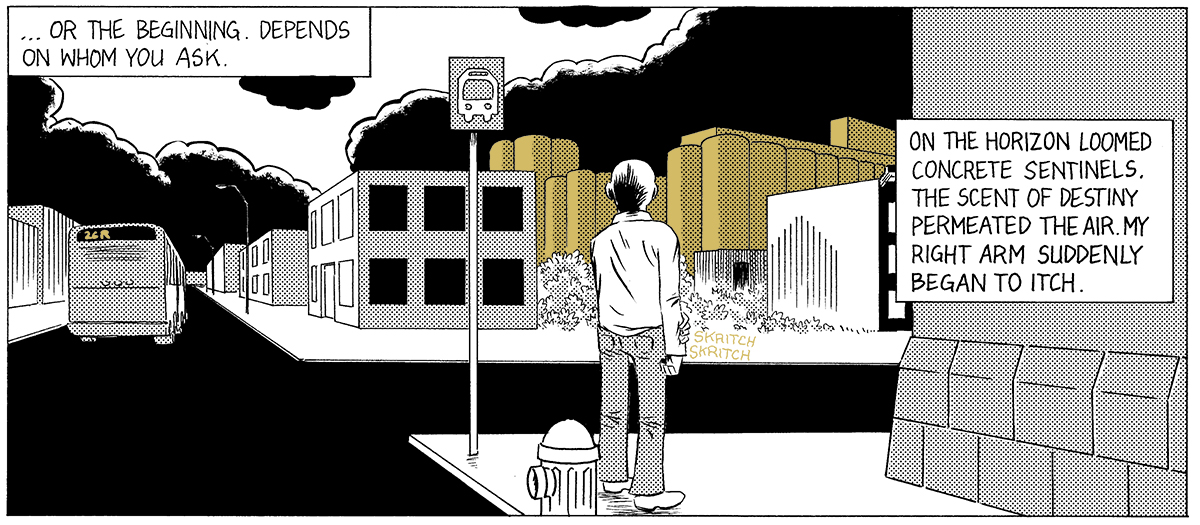
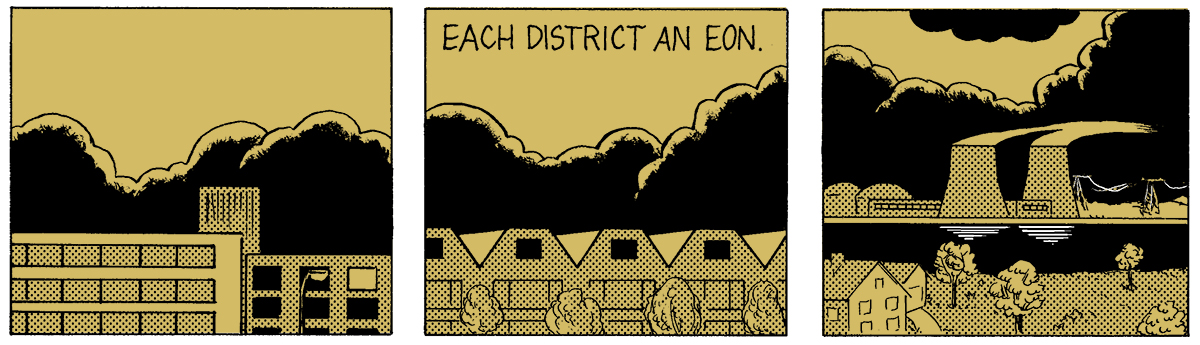
Our present experience is akin to the cave dwellers of the past. The world was built by someone else. We dwell inside the crumbling infrastructure like Cro-magnon inside caves. Outside our limited horizons, we stumble on unusual structures ripped from times past. Their presence, crumbling and puzzling, is an avatar of a past golden age.
COZY APOCALYPSE
This is the state of the world. We indulge in apocalyptic scenarios like candy. We see the movies, read the books, and watch the news. “The apocalypse is around the corner! How awful! Why won’t somebody do something!? Wouldn’t our lives be more exciting if it really happened?”
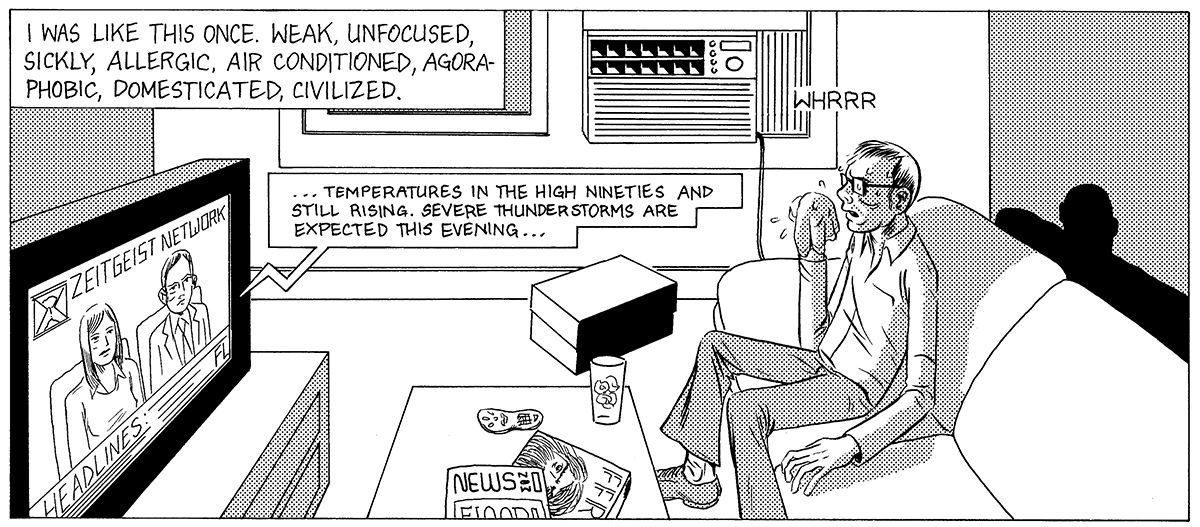
We wonder performatively on social media from our cozy couches.
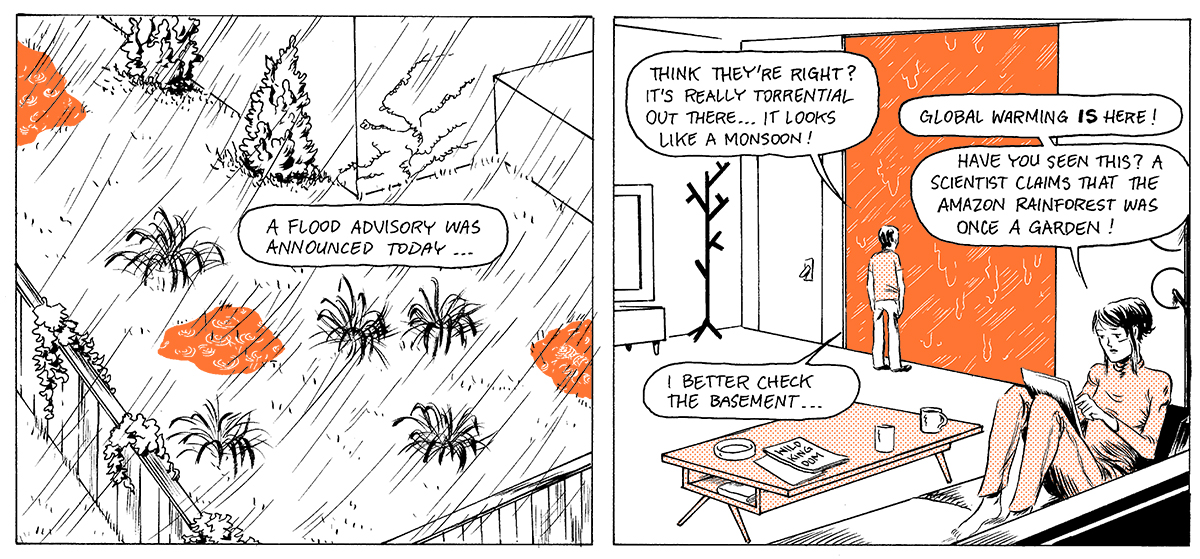
The personal is political. We have become accustomed to reading everything through a hyper-paranoid-critical lens. Signs of the apocalypse are everywhere. All events contain threads that connect them to something big and monstrous. We see local temperature fluctuations and immediately connect them to a global climate phenomenon. All phenomena resolve into apocalyptic hyperobjects.
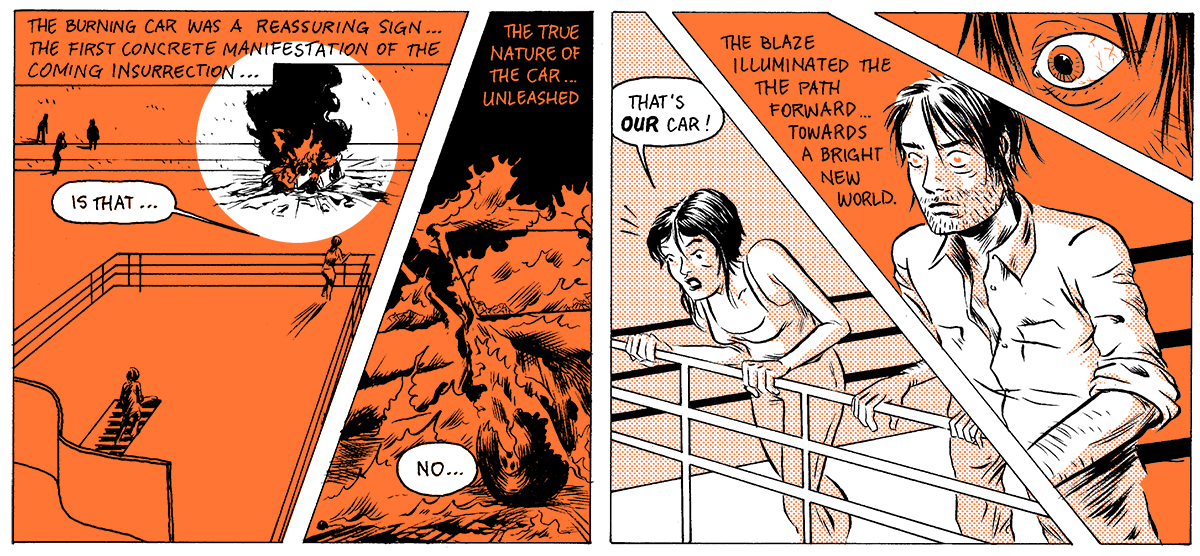
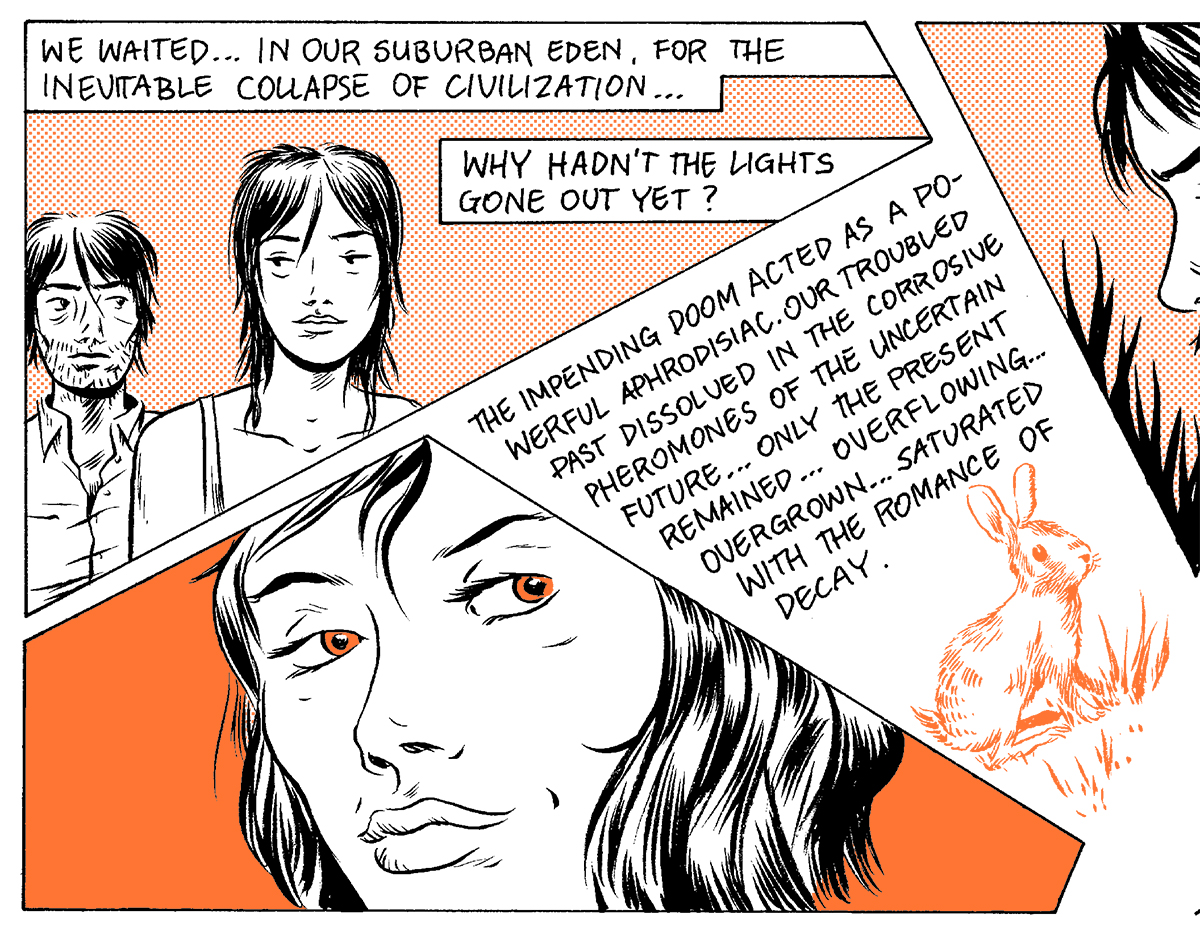
The death of God left a void. Old rituals and myths that shaped the world around us have been displaced by the meaningless churn of particles, processes, and invisible forces. A new magical poetic has risen to fill the void: the butterfly effect. Does the flap of a butterfly’s wings in Brazil set off a tornado in Texas? [ 5 ]
We have become the butterflies, ritualistically flapping our wings, separating recycling, donating to causes, changing our social avatars, hoping not to trigger a tornado in Texas. Maybe if we flap a little less vigorously, preferably while comfortably watching the grim news, the tornado will not come? We monitor its progress on a billion screens, [6] unconsciously willing the worst-case scenarios into existence. “See, I told you it would happen! Global warming! ‘Nuff said!” We connect the dots on our cozy couches.
NOTES:
[ 1 ] In the 1970s, science-fiction writer Brian Aldiss coined the term “cozy catastrophe” to describe a fictional plot in which a bourgeois protagonist finds pleasure while the world goes to shit. “The essence of cozy catastrophe is that the hero should have a pretty good time (a girl, free suites at the Savoy, automobiles for the taking) while everyone else is dying off,” Aldiss wrote. Quote from wired.com.
[ 2 ] “What Modernism Learned from the World’s First Grain Elevator” By Jennifer Kabat (https://www.frieze.com/article/what-modernism-learned-worlds-first-grain-elevator)
[ 3 ] The temple was the original template. The hidden source of Plato’s eternal forms, which he glimpsed during his initiation into the Eleusis Mysteries (“blessed sight and vision” witnessed in a “state of perfection” 3).
[ 4 ] Murarescu, Brian, The Immortality Key, p. 24
[ 5 ] According to Edward Norton Lorenz, an earlier formulation used a seagull instead of a butterfly: “One meteorologist remarked that if the theory were correct, one flap of a sea gull’s wings would be enough to alter the course of the weather forever. The controversy has not yet been settled, but the most recent evidence seems to favor the sea gulls.” We could go back as far back as Fichte to find similar ideas: “you could not remove a single grain of sand from its place without thereby… changing something throughout all parts of the immeasurable whole.” Quote from scientificamerican.com
[ 6 ] What is the cost of all this real-time monitoring? According to Heisenberg, one implication of quantum physics is that the act of measurement always disturbs the object measured. “The physical reason behind this uncertainty is that measurement, by its very nature, requires using some sort of energy–for example, shining a light on the object to be measured. Light consists of discrete units, or quanta, of energy known as photons. Shining a light on an electron means bombarding it with photons, each of which has a big effect on the electron.” How does the Heisenberg principle square with Lorenz’s Butterfly? Is there a macro-version of the Heisenberg principle? How do you accurately measure planetary-scale climate phenomena without first creating planetary-scale measuring devices? And, simultaneously, do you not fundamentally alter the planet? The modern environmental movement, born on the first Earth Day (Apr. 22, 1970), was explicitly influenced by the images of Earth broadcast from the moon by Frank Borman, Jim Lovell, and William Anders (Christmas Eve; Dec. 24, 1968). Quote from bbc.com
-
Tintin in Arturo Pérez-Reverte’s The Nautical Chart
This one is just fun. The Nautical Chart by Arturo Pérez-Reverte is a love letter to adventure novels, well, adventure novels of the sea to be specific. In fact, The Nautical Chart could be read as an imaginative riff on a single Tintin panel. Instead of a review, I offer this extended quote that features one of the greatest comics adventurers, Tintin.
“At that, clutching the two books to her chest, she began to laugh. She seemed like a different woman, laughing openly, happily, and then she said, “Thundering typhoons!” She deepened her voice and spoke like a one-eyed, peg-leg, pirate with a parrot on his shoulder. Then, as the sun turned the asymmetrical tips of her hair even brighter gold, she sat down next to Coy and again opened the brightly colored books and began to turn the pages. “The sea is here too,” she said. “Look. And adventure is still possible. You can get drunk with Captain Haddock—Loch Lomond whiskey, in case you didn’t know, holds no secrets for me. I also parachuted over a mysterious island with the green flag of the EFSR in my arms, crossed the borders between Syldavia and Borduria more times than you can count, swore by the mustache of Kurvi Tasch, sailed on the Karaboudjan, the Ramona, the Speedol Star, the Aurora and the Sirius—more ships than you, I’m sure. I searched for Red Rackham’s treasure, westward, farther westward, and walked the moon while Thompson and Thompson, with their green hair, performed as clowns in the Hiparco Circus. And when I’m lonely, Coy, when I’m very, very, very lonely, than I light on of your friend Hero’s cigarettes, make love with Sam Spade, and dream of Maltese Falcons while through the smoke I summon my old friends Abdullah, Alácazar, Joylon Wagg, Chester, Zorrino, Skut Oliveira de Figueira, and listen to the CD of the jewel song from Faust on an old Bianca Castafiore recording.
As she spoke she set the two books on the table, They were old editions, one with blue binding and the other green. The frontispiece of the first showed Tintin, Snowy, and Captain Haddock in a plumed hat, and a galleon under full sail. In the second, Tintin and snowy were skimming along the bottom of the sea in a submarine shaped like a shark.
“That’s Professor Calculus’s submarine,” said Tánger. “When I was a girl, I saved my money from birthdays, saint’s days, and Christmas gifts to buy these books, pinching pennies as hard as Scrooge himself.”
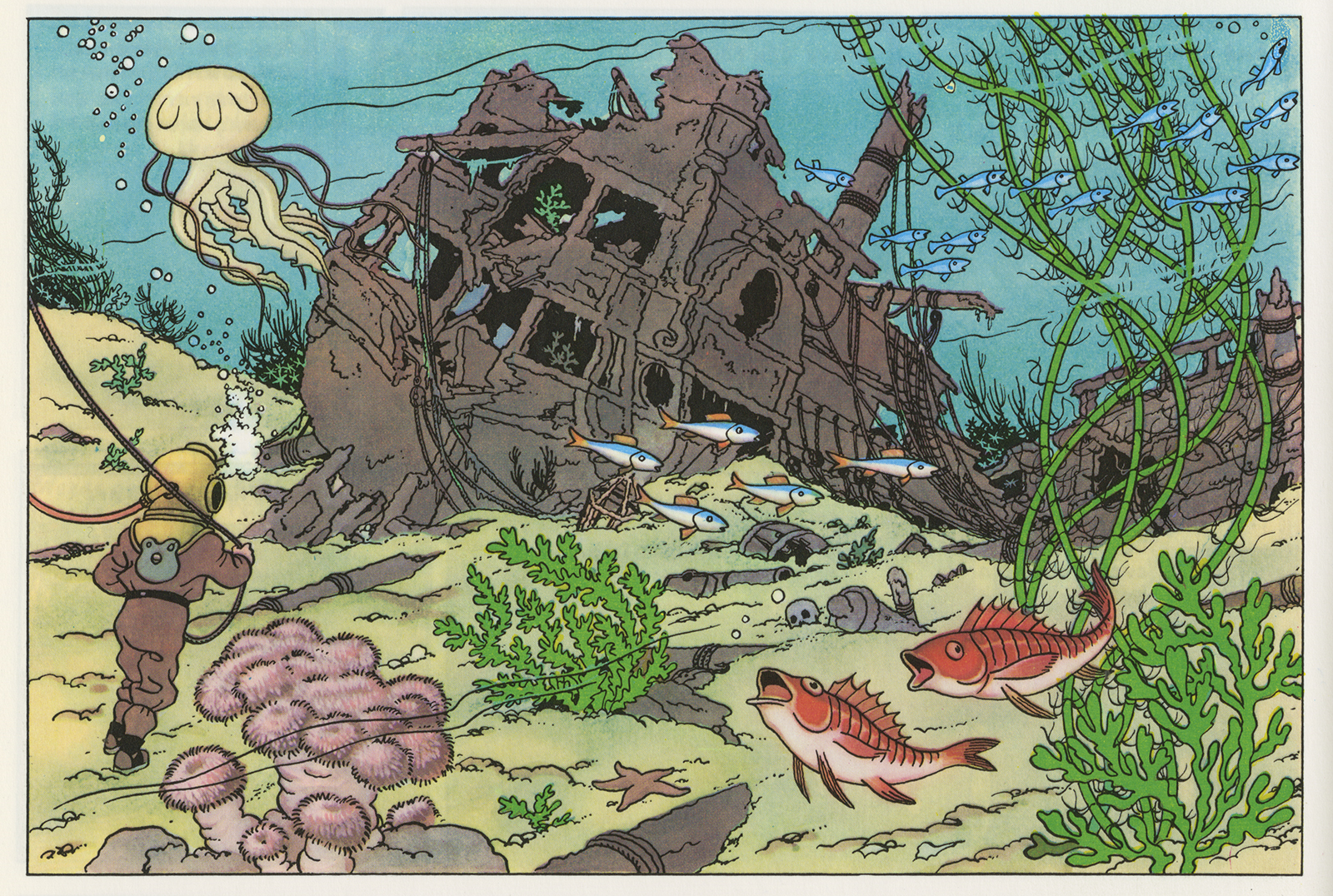
Red Rackham’s Treasure, page 40 “She opened Red Rackham’s Treasure to page 40. In a large illustration in the middle of the page, Tintin, dressed in a diving suit, was walking along the bottom of the sea toward the impressive wreck of the sunken Unicorn.”
“Look carefully,” she said in a solemn voice. “That one picture marked my life.”
The Nautical Chart by Arturo Pérez-Reverte, p.96-97BK Munn has a long-running blog showing books when they appear in various comics. Maybe I should start a series on comics that appear in books?
-
Beta Testing the Ongoing Apocalypse: Adalbert Arcane’s Notes and Theories to the Sound Strips
This post is part of a series: Adalbert Arcane’s expanded Notes & Theories to Beta Testing the Ongoing Apocalypse (by Tom Kaczynski, Fantagraphics, 2022). This time we have Adalbert’s notes to three short sound-themed strips: White Noise, Noise, A History, Hotel Silencio. All posts in this series can be accessed here.
“The eternal silence of infinite spaces frightens me.”
PascalWHITE NOISE
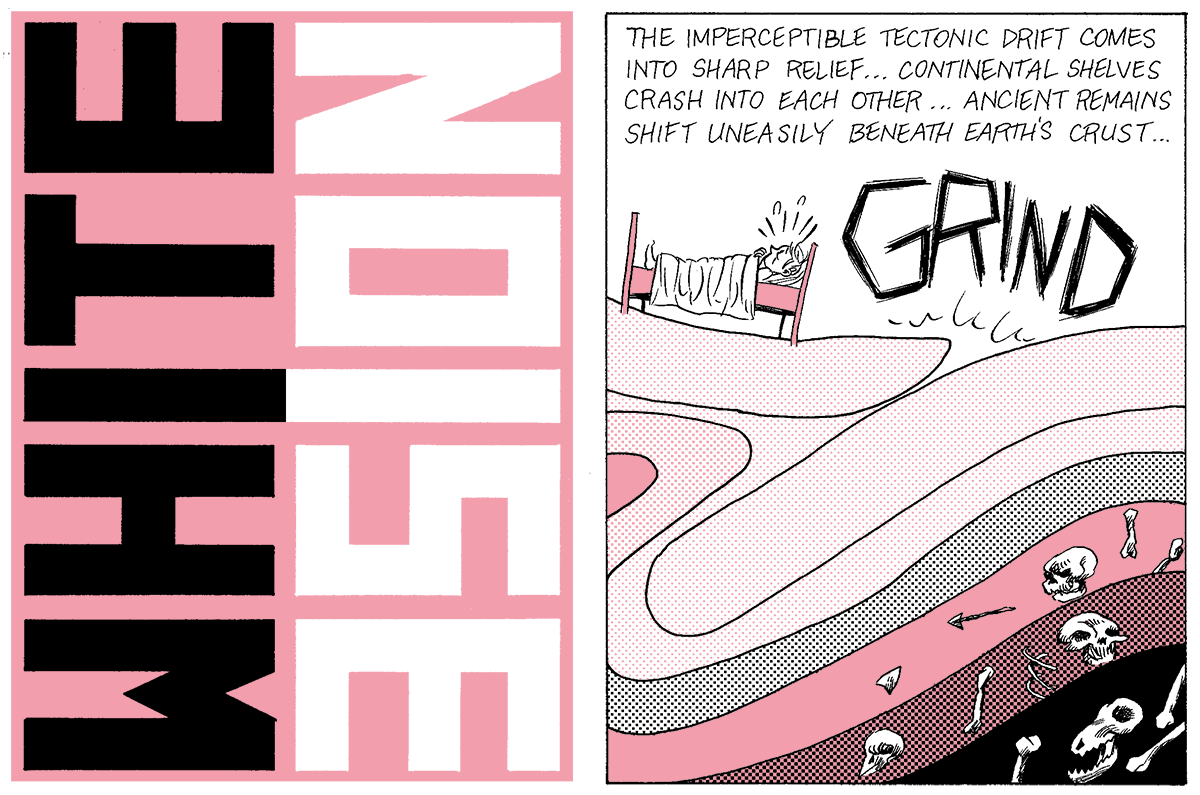
When creating this story, the author claims he was unaware of Don DeLillo’s novel with the same title (see Hotel Silencio and Noise, a History).
NOISE, A HISTORY
Noise, a History was written and drawn before Music for Neanderthals. This one page distills the author’s interest in the development of sound, noise, and other auditory phenomena. One can imagine the Big Bang, the silent explosion of our universe into being, as containing all the sounds of the universe. Think of white light comprising all the visible and invisible spectrum colors. Noise, A History, functions as a signal detector filter that isolates specific notes and harmonies from the noise of the Big Bang.
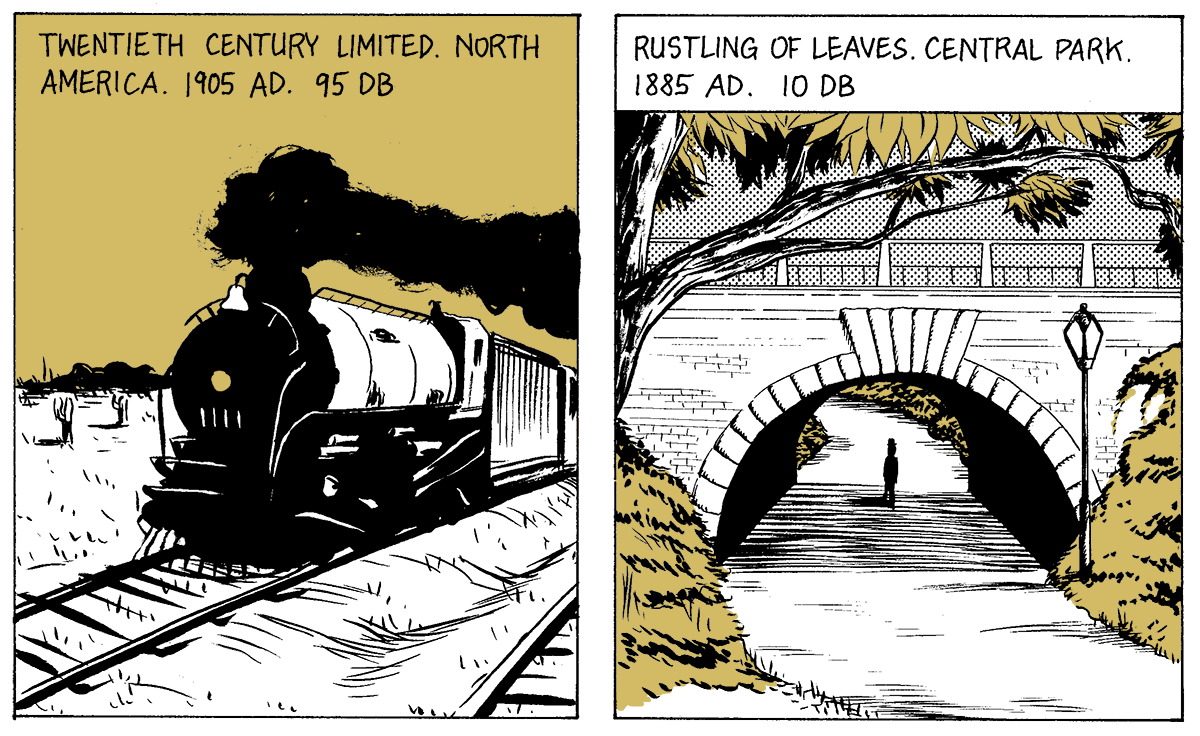
When you add all the sounds together, do you get silence? Or a massive cacophony? We are constantly detecting new sounds produced by that ur-explosion. The history of civilization is discovering and manufacturing new auditory phenomena and the privatization of sound.
HOTEL SILENCIO
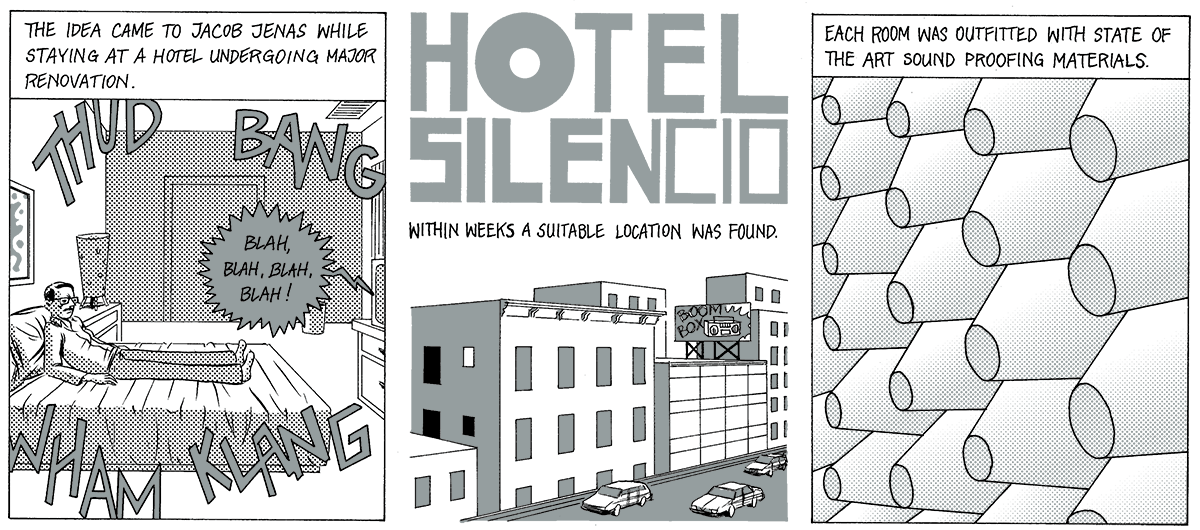
“In the absence of sound, you become the sound.”
https://www.atlasobscura.com/places/orfield-labs-quietchamberThe quietest room in the world is in Minnesota, approximately five minutes from where the author currently lives. The story was written before the author moved into the area. It is unknown if he moved to be closer to the anechoic chamber. The experience inside the room is described as maddening.
It is surprising how much humans rely on principles of echolocation for their stability and their relationship to the world. It has recently been discovered [ 1 ] that memories are spatial. Our selves are built from accrued layers of spatially tagged memories—we are a memory palace. We exist in a personal echo chamber that constantly depends on outside sound to orient itself on the principle of echolocation.
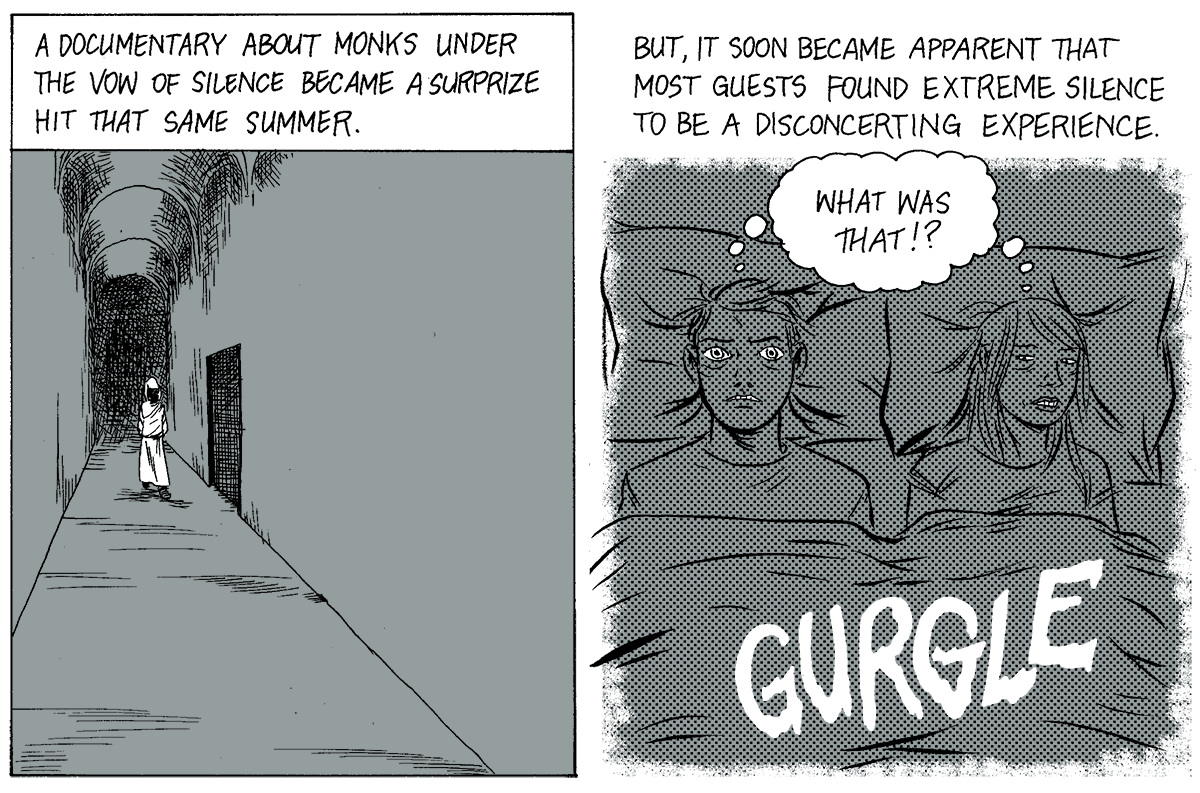
The ambient sound of the world (see White Noise) acts as an aetheric substance that allows us to move through the world by orienting via sound and vision. It allows us to be outward-oriented, following the sounds and sights of the world or the desiring machine. This is also known as a ‘body without organs’ in Deleuzian terms.
That relationship is fundamentally broken when you ‘become the sound’ inside the anechoic chamber. The sound of your internal organs reminds you that there’s no there, there. There’s nothing to anchor you to the outside. The phone call (of your consciousness) is coming from inside the house! The desiring machine breaks down. You become ‘organ without body’… analogous to a schizophrenic steaming mass of microbial life arranged in shapes and patterns; a chattering miasmic fluid; a viscous semi-liquid bag of mostly water with skin stretched tight like a drum. Who is playing the drum?
NOTES:
[ 1 ] “Your Mind is a Vast Landscape” by Adalbert Arcane in Cartoon Dialectics #2, Uncivilized Books, 2020
-
Jim Starlin’s Dreadstar 7-8 (1982)
This post is a continuation of an ongoing series on Jim Starlin’s Dreadstar, an underrated creator-owned comic from the early 1980s. You can start by reading the post linked below or click here to see other posts in the series.
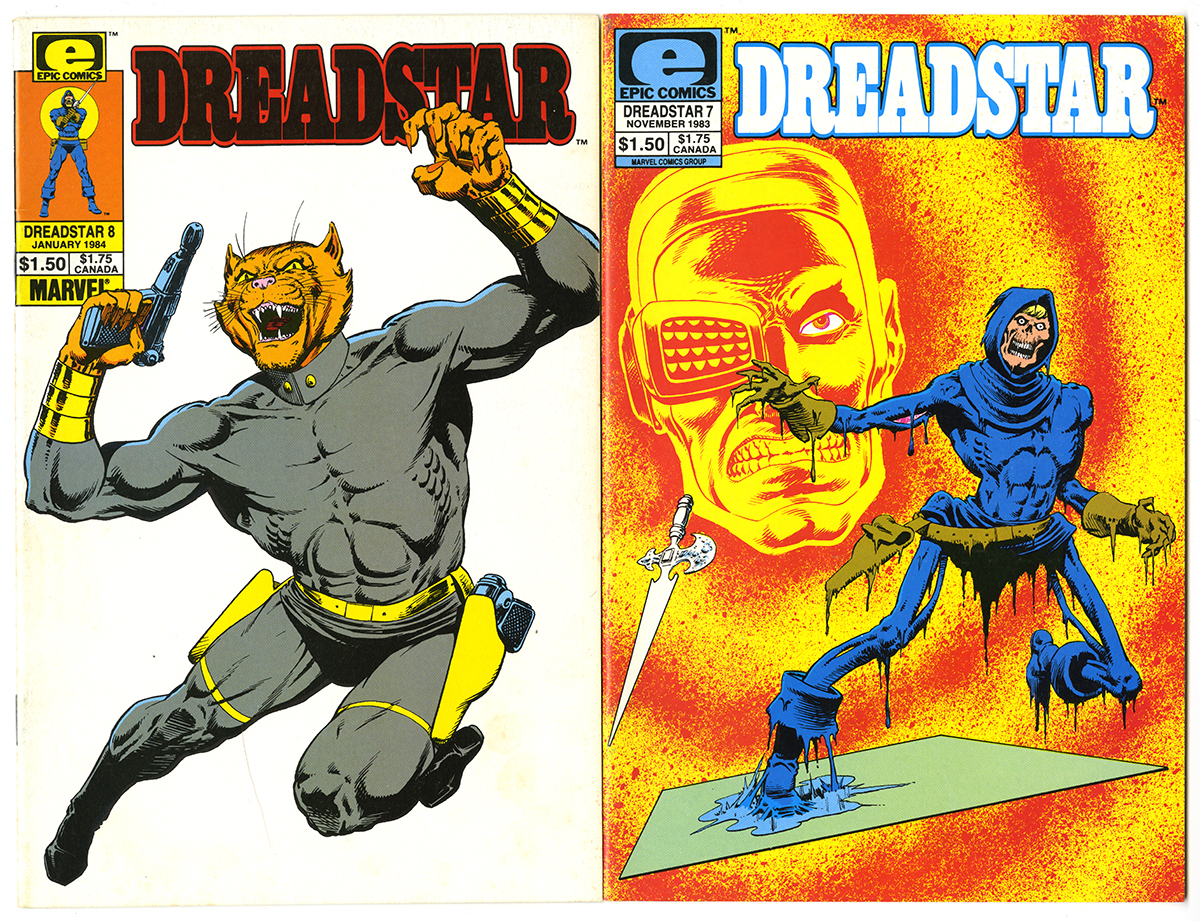
Covers to Dreadstar 7 & 8 Dreadstar 7
Vanth goes to Caldor to access a “minimally defended small traffic monitoring station.” He’s after some secret data about catorlite, a mysterious substance valuable to the Instrumentality Church. He easily overpowers the guards and jacks—Neuromancer-like—into a telepathic computer network. It gets a bit cyberpunk over the following few pages as Vanth surfs the net searching for the info. Then, he gets attacked—telepathically from across the universe—by Dr. Anton A. Lanstrom Mezlo (what a name!), who ambushes him while Vanth scours the net for information.
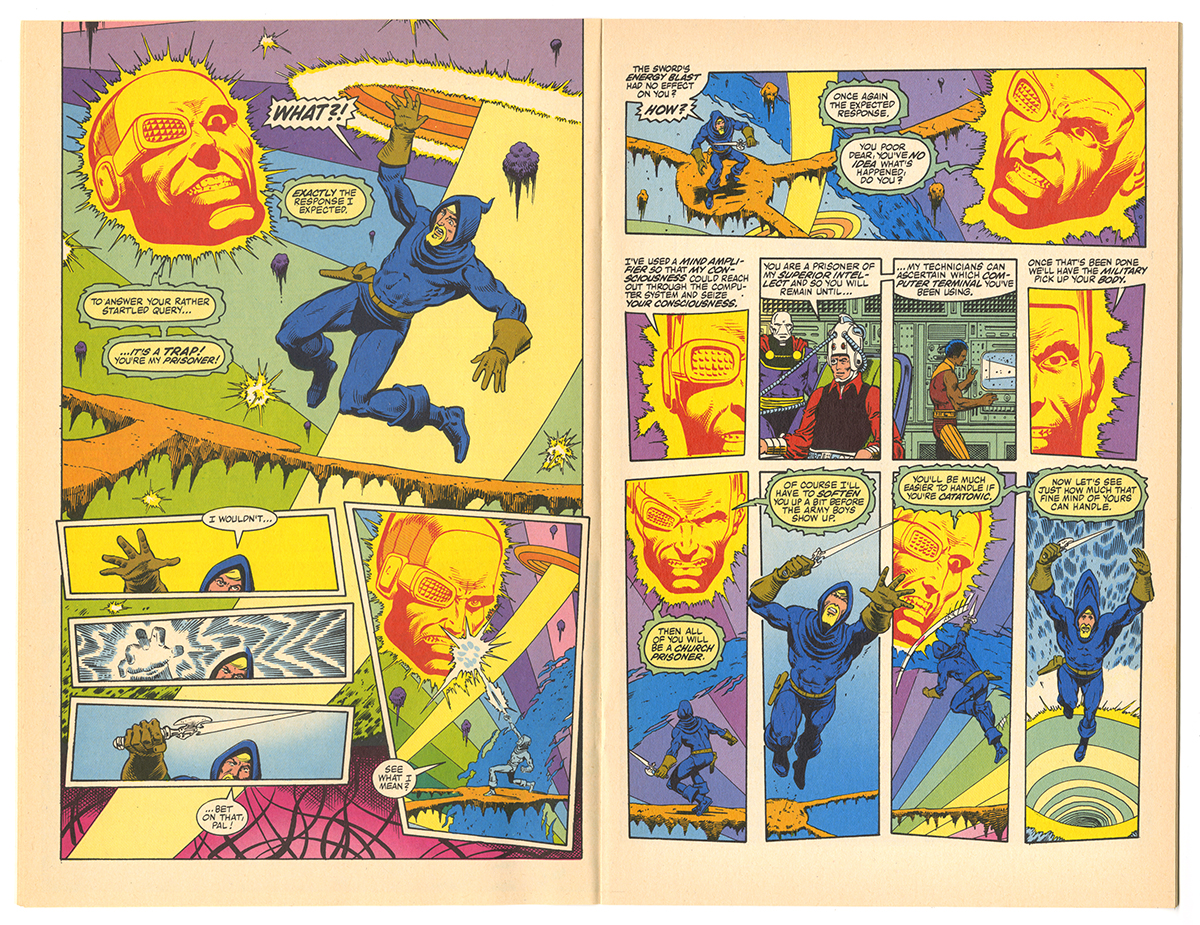
Ditkoesque sequence Psychic Ditko
While the start of the info-retrieval sequence visually owes something to cyberpunk, Mezlo’s psychic attack shifts into Ditkoesque mystical/psychic realms, complete with portals, suspended pathways, Ditko-tendril (a Ditko analog to Kirby dots?), and psychedelic colors. Starlin has long internalized Ditko’s visual conventions as the proper way to depict magical realms and psychic combat.
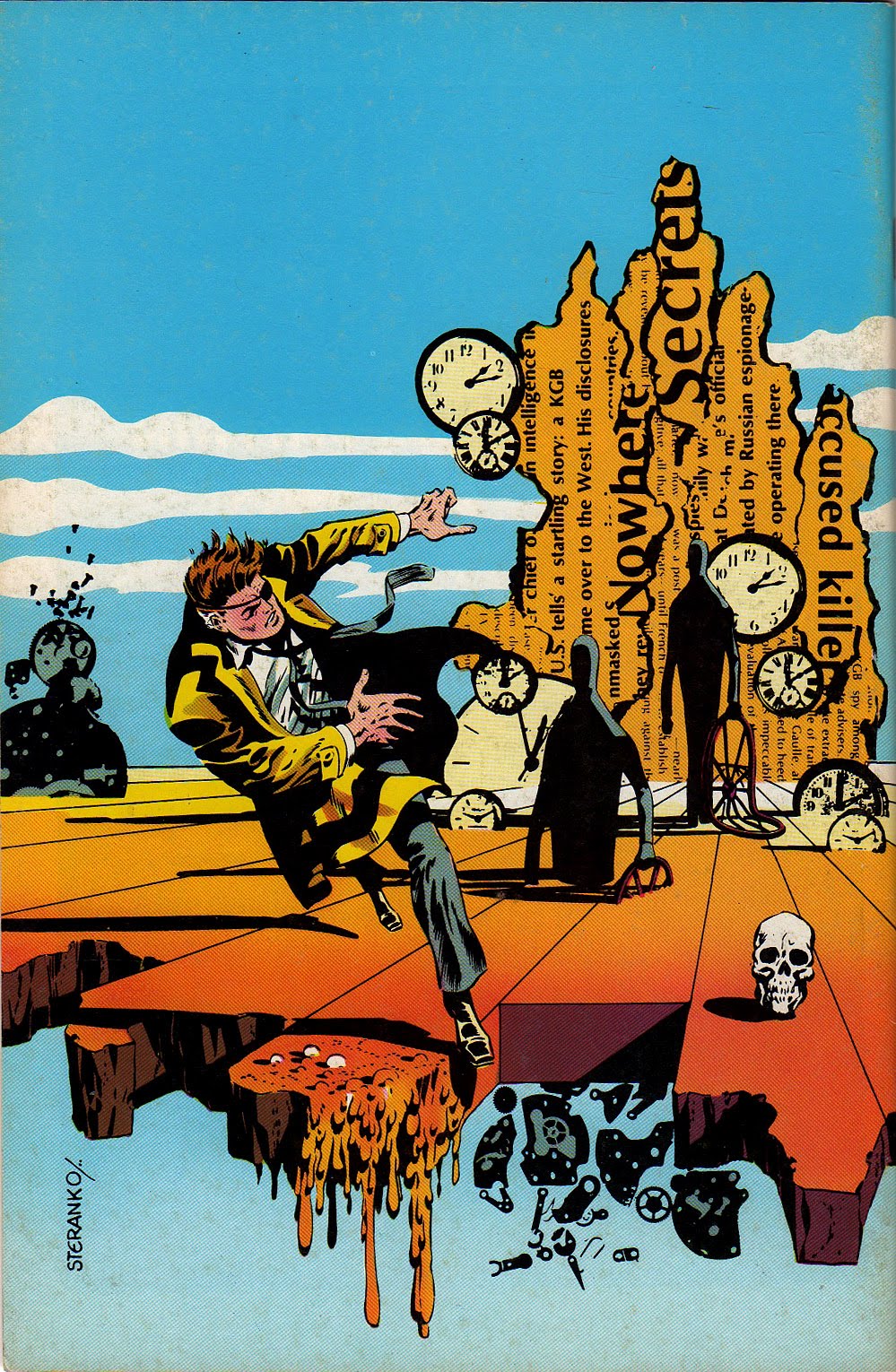
Steranko collage Cyberpunk Aesthetics
But it is, the cyberpunk-flavored telepathic computer interface is the most exciting innovation here. Over several panels, Vanth is suspended in cyberspace, which is depicted as printed out dense lines of programming code. It’s a rare instance of collage in comics. Kirby and Steranko innovated the collage technique in comics by creating surreal cosmic modernist images out of magazine clippings. Starlin’s cyber-collage has a different flavor. I don’t know for sure, but it appears to be xeroxes of printed (on a dot-matrix-printer?) computer code collaged with original art. If anything, this speaks to the increasing availability of printers and copy machines in the early 80s. This technology will be used increasingly in comics in the coming years.
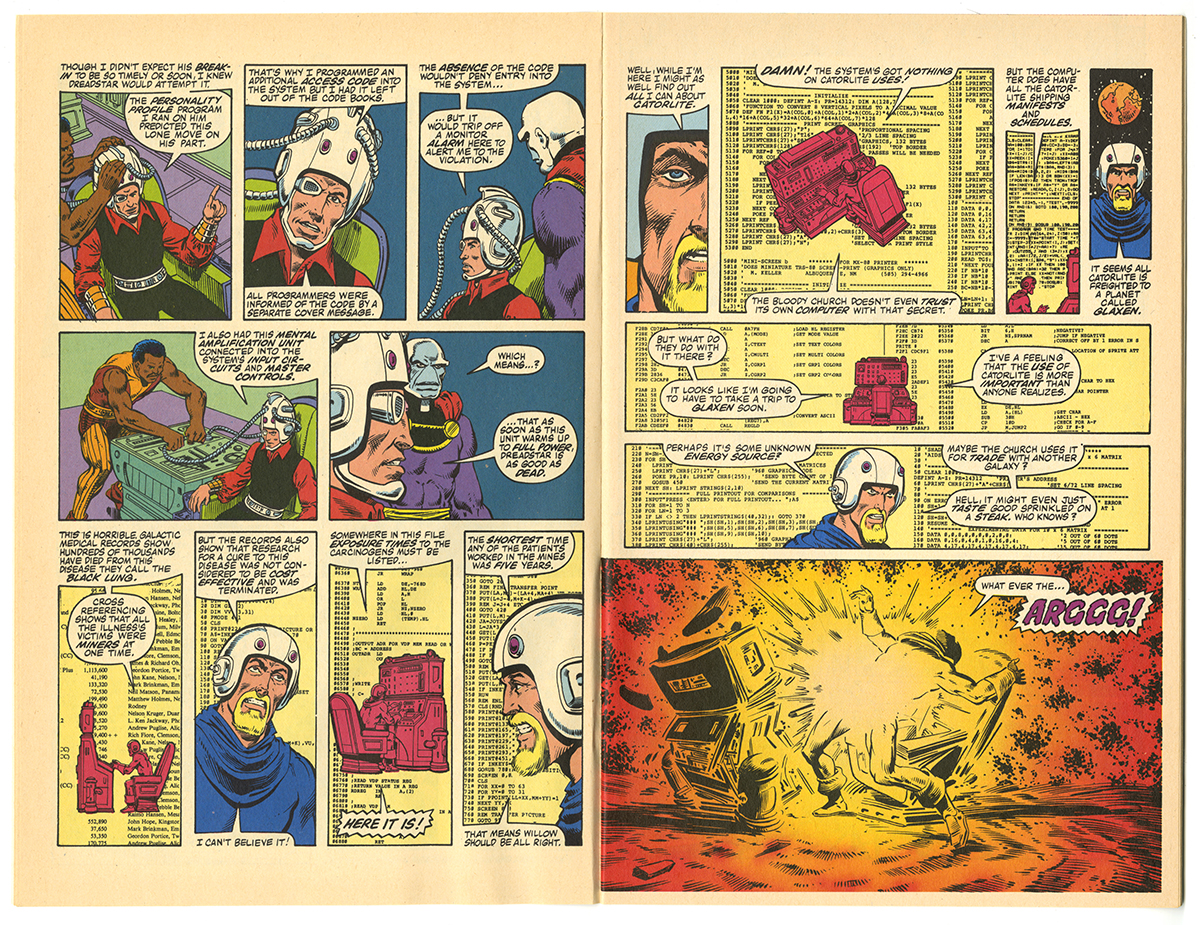
Cyberpunk sequence Cyber Typography
It is also an early foreshadowing of cyberpunk visual typographical chaos. Think of the animated strings of code present in the opening titles of Ghost in the Shell or the Matrix films. This issue (Nov 1983) predates even the publication of William Gibson’s Neuromancer (July 1984, though some of his short stories have already appeared). I can’t think of an earlier version of Starlin’s cyber-typographic innovation. The only parallel that comes to mind is Ken Bruzenak’s fully-integrated typography in Howard Chaykin’s American Flagg! Though Chaykin’s comics have a very different and unique design. Please comment below if you can think of other similar instances.
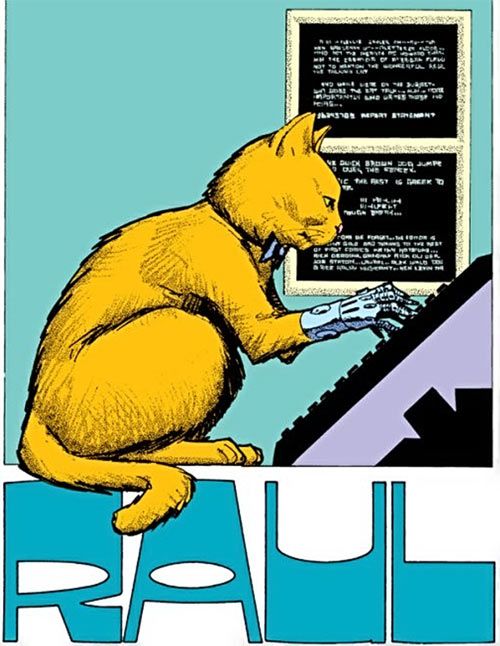
From Howard Chaykin’s American Flagg! #5 A psychic battle ensues, and as Vanth appears to have lost, he is saved last minute by Willow, who cuts the connection, rendering Mezlo unresponsive, “completely catatonic.” They didn’t get the information they wanted, but now they know where to go next: planet Glaxen. Vanth wanted to check on something else on Calador, a grave… and the grave turns out to be empty. An ominous sign.
Meanwhile, the Monarch’s Vizir Z, last seen in #4, shows up at the end to cause some chaos. The fully armored and masked mysterious figure is always a good bet to be hiding some kind of revelation, usually related to the history of one of the characters.
Dreadstar 8
Vanth Dreadstar tells his crew who he is: a million-year-old being from another galaxy—one of only two survivors of the complete annihilation of the Milky Way. We get the whole story: Milky Way was dominated by two alien civilizations at war. The first, the Orsirosians, were great scientists and magicians who built their civilization on truth and fairness. The other society, the Zygoteans, were just as skilled in magic and science, but they went wrong somehow and found meaning only in warfare and conflict.
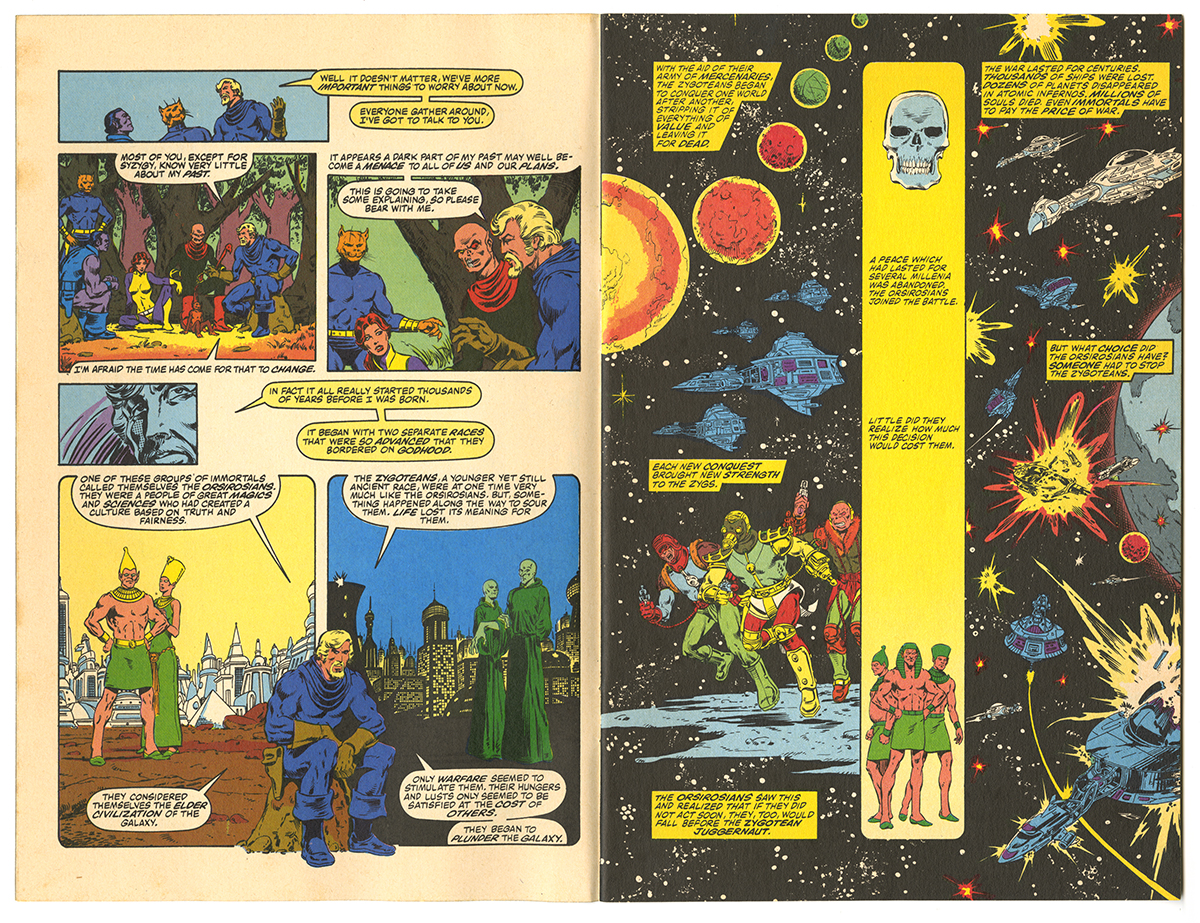
Deep Time montage Infinite War
As the Zogoteans wreaked havoc on the Milky Way, the Orsirsians had no choice but to enter the conflict. The war in the Empirical galaxy lasted 200 years, but the war in the Milky Way lasted for hundreds of thousands of years. The Orsirisans, led by Lord Aknaton, began work on a doomsday device, the Infinity Horn (a precursor of Starlin’s Infinity Gauntlet?). Death was preferable to Zygotean conquest. As the war continued, Aknaton looked for the correct beings to activate the Infinity Horn. He planted seeds on many planets to find the right individuals. Vanth Dreadstar was one of these individuals.
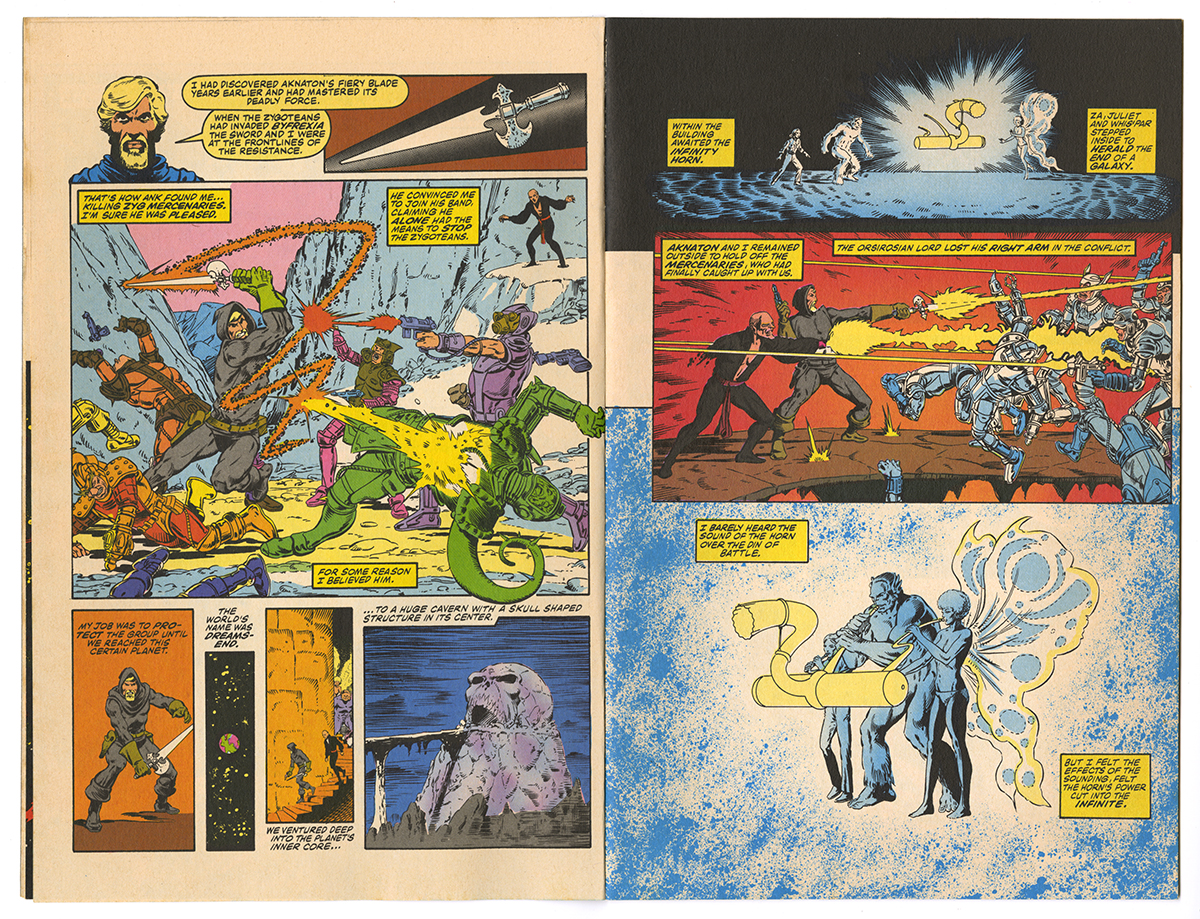
The Infinity Horn activates The mystical sword eventually wielded by Vanth was planted on his planet by Aknaton years before Vanth was even born. Vanth’s finding and mastering the powers of the blade primed him to join Aknaton’s crusade. As the Zygoteans final assault on the Orsirisians approached, Aknaton and Dreadstar held them off as long as possible before activating the Infinity Horn. They succeeded, and annihilated the Milky Way. Only Aknaton and Vanth survive in a mystical bubble.
Million Year Memories
They entered suspended animation, and the bubble traveled the spaceways for a million years until it crashed-landed on planet Caldor in the Empirical galaxy. Vanth, crazed from grief and insane from survivor guilt, kills Aknaton and becomes the sole survivor of the Milky Way.
BUT, Aknatons’s grave is empty! Vanth suspects that he’s Monarchy’s Vizir Z. Aknaton had lost his arm in the last phase of the Milky Way conflict, and Z is also missing one. Z is also powerful, able to mystically shield himself from Willow’s powerful telepathy. Vanth, Skeevo, and Oedi travel to Jewel World, the capital of the Monarchy, to see if they can find any more information on Z to confirm Vanth’s suspicions. And they are RIGHT! In the process, Oedi gets almost killed, and they find out that Z has betrayed the Monarchy and opened the door to an Instrumentality invasion of Jewel World. Vanth sends his friends away and stays on Jewel to confront Z.
Deep Time / Flat History
The Dreadstar mythology is absolutely bonkers. A million years separate the destruction of the Milky Way and current events in the comic. Add another several hundred thousand years for the galaxy-wide war, and time stretches immeasurably. This is deep time, cosmically deep! Characters like Vanth and Aknaton have lived for incredible amounts of time. All of our current human civilization would fit into only a tiny sliver of that history. Our very species is younger than the wars Dreadstar describes.
At the same time, there’s a weird flattening of time. Events from millions of years ago are present with us in glorious detail. The memories of these characters don’t seem to degrade. Their motivations and loyalties stay locked in. Revenge can build over a million years and be as fresh as at the conception. This is the logic of the comic book series or TV series. Each new episode “resets” the timeline. Even as events and history accrue, the characters remain essentially the same. Many of the comics of the 70s and 80s still had this ahistorical characteristic.
A new sensibility was creeping into comics around this time—a more novelistic quality, where meaningful events and a real sense of history emerge. To give Starlin a bit of credit, Dreadstar does a bit of both. He attempts to provide weight to the stories, but he’s confined by the demands of an ongoing series, where change, almost by definition, must be minimal.
